Opinion - (2025) Volume 11, Issue 4
Received: 01-Aug-2025, Manuscript No. jpnp-25-175506;
Editor assigned: 04-Aug-2025, Pre QC No. P-175506;
Reviewed: 18-Aug-2025, QC No. Q-175506;
Revised: 22-Aug-2025, Manuscript No. R-175506;
Published:
29-Aug-2025
, DOI: 10.37421/2472-0992.2025.11.37
Citation: Schneider, Miriam ”Biotechnology Fuels Faster Agricultural Genetic Progress.” J Pharmacogn Nat Prod 11 (2025):376.
Copyright: © 2025 improvement g. This is an open-access article distributed under the terms of the Creative Commons Attribution License, which permits unrestricted use, distribution and reproduction in any medium, provided the original author and source are credited.
Genomic selection has become a game-changer in dairy cattle breeding. Essentially, it allows breeders to predict an animal's genetic merit using DNA markers, rather than waiting for progeny performance. This significantly speeds up the breeding process, helping us improve traits like milk yield and disease resistance much faster, ultimately leading to more productive and healthier herds[1].
CRISPR-Cas9 genome editing offers powerful tools for improving crops. This technology allows precise modifications to plant DNA, enabling scientists to introduce desirable traits like enhanced disease resistance, better nutritional value, and increased yield. Itâ??s opening doors to developing resilient and high-performing crops to meet global food demands[2].
Applying genomic prediction in aquaculture is truly transformative. By using genetic markers, breeders can more accurately select fish with superior traits, like faster growth rates or increased disease resistance, at an earlier stage. This accelerates breeding cycles and boosts productivity in farmed fish populations, which is vital for sustainable seafood production[3].
Gene editing technologies are proving invaluable for enhancing disease resistance in livestock and poultry. By making precise genetic alterations, we can develop animals that are inherently more resilient to common diseases. This reduces the need for antibiotics, improves animal welfare, and makes livestock production more efficient and sustainable[4].
Omics technologies, like genomics, transcriptomics, and proteomics, are fundamentally changing crop improvement. They give us a detailed view of plant biology, helping us identify genes and pathways linked to desirable traits. This allows breeders to make more informed decisions, accelerating the development of crops with better yield, quality, and stress tolerance[5].
Genomic selection is now being effectively applied to forest trees. By analyzing genetic markers, we can predict traits like growth rate, wood quality, and disease resistance in young trees. This significantly shortens the breeding cycle compared to traditional methods, enabling faster development of superior tree varieties for sustainable forestry and biomass production[6].
Gene editing holds immense promise for improving production traits and animal welfare in livestock. We're talking about precisely modifying genes to enhance traits like meat quality, milk composition, or feed efficiency, and also to bolster natural disease resistance. This technology offers a pathway to more efficient and ethically sound animal agriculture[7].
Integrated multi-omics approaches are becoming crucial for crop improvement. By combining data from genomics, transcriptomics, proteomics, and metabolomics, researchers get a holistic view of plant biology. This comprehensive understanding helps pinpoint complex genetic interactions for traits like stress tolerance and nutrient use efficiency, speeding up the breeding of superior crop varieties[8].
Genetic engineering offers advanced strategies to significantly improve plant disease resistance. Through targeted modifications, scientists can equip crops with stronger defenses against pathogens, reducing yield losses and the need for chemical treatments. This contributes to more resilient agricultural systems and sustainable food production globally[9].
Accelerating genetic gain in crop breeding is absolutely critical for addressing climate change. By employing modern breeding techniques like genomic selection and gene editing, we can develop crops that adapt faster to changing environmental conditions, resist new pests, and maintain high yields under stress. This ensures food security in a rapidly changing world[10].
Modern breeding practices are undergoing a significant revolution, driven by advanced genetic technologies that promise enhanced productivity, improved welfare, and increased sustainability across diverse agricultural sectors. These innovations are critical for meeting global food demands and adapting to environmental challenges. The integration of genomics, gene editing, and various omics approaches allows for unprecedented precision and speed in developing superior traits in crops, livestock, and even forest trees, ushering in a new era of biological engineering for global benefit.
Genomic selection represents a powerful paradigm shift, particularly in animal breeding, fundamentally changing how genetic improvements are achieved. For instance, in dairy cattle, this technique allows breeders to accurately predict an animal's genetic merit using DNA markers early in life, bypassing the lengthy process of waiting for progeny performance. This significantly accelerates improvements in crucial traits like milk yield, feed efficiency, and disease resistance, fostering healthier and more productive herds that are better suited for modern farming systems [1]. Similarly, in the aquaculture industry, genomic prediction transforms the selection process, enabling earlier identification of fish with superior growth rates or enhanced disease resistance. This not only boosts productivity in farmed fish populations but also underpins more sustainable seafood production practices [3]. The benefits extend impressively to forestry, where genomic selection is effectively applied to predict traits such as rapid growth rate, superior wood quality, and robust disease resistance in young trees. This dramatically shortens breeding cycles compared to traditional methods, facilitating the faster development of superior tree varieties essential for sustainable forestry and efficient biomass production [6].
Gene editing technologies, notably the versatile CRISPR-Cas9 system, provide precise tools for modifying DNA, opening new avenues for both crop and livestock improvement with unparalleled accuracy. In the realm of crops, this technology allows for targeted genetic changes to introduce highly desirable traits like enhanced disease resistance against various pathogens, better nutritional value for consumers, and increased yield per harvest, ultimately leading to the development of more resilient and high-performing crop varieties [2]. For livestock and poultry, gene editing proves invaluable in bolstering intrinsic disease resistance, creating animals inherently more resilient to common diseases. This innovation significantly reduces the need for antibiotics, thereby improving animal welfare and making livestock production more efficient and sustainable in the long run [4]. Beyond merely resisting diseases, gene editing in livestock holds immense promise for enhancing specific production traits such as meat quality, milk composition, or feed efficiency, contributing directly to more efficient and ethically sound animal agriculture practices [7].
Beyond individual gene manipulation, integrated omics technologiesâ??including genomics, transcriptomics, proteomics, and metabolomicsâ??are revolutionizing crop improvement by offering a holistic and detailed view of complex plant biology. These comprehensive insights help researchers identify complex genetic interactions and crucial biochemical pathways linked to highly desirable traits like enhanced stress tolerance, improved nutrient use efficiency, and overall resilience, thereby speeding up the development of superior crop varieties that can thrive in challenging environments [5, 8]. Furthermore, broader genetic engineering strategies provide advanced methods to significantly improve plant disease resistance. By precisely equipping crops with stronger intrinsic defenses against pathogens through targeted modifications, these approaches effectively reduce yield losses and diminish the need for chemical treatments, supporting more resilient agricultural systems and sustainable food production globally [9].
The collective and strategic application of these modern breeding techniques, encompassing genomic selection, advanced gene editing, and sophisticated multi-omics approaches, is absolutely critical for accelerating genetic gain, especially in the face of ongoing global climate change. These powerful technologies enable the rapid development of crops that can adapt faster to dramatically changing environmental conditions, resist the emergence of new pests and diseases, and steadfastly maintain high yields even under increasing environmental stress [10]. Ultimately, these profound biotechnological advancements are pivotal in ensuring global food security, fostering sustainable agricultural practices, and enhancing the overall resilience of our intricate food systems in a rapidly evolving and unpredictable world.
Modern biotechnologies are fundamentally transforming agriculture, aquaculture, and forestry. Genomic selection has emerged as a game-changer, allowing breeders to predict an animal's genetic merit using DNA markers, which significantly speeds up breeding processes in dairy cattle, aquaculture, and forest trees. This leads to faster improvements in critical traits such as milk yield, growth rates, wood quality, and disease resistance, ultimately fostering more productive and healthier populations. Parallel to this, gene editing technologies, particularly CRISPR-Cas9, offer powerful tools for precise modifications to plant and animal DNA. This enables scientists to introduce desirable traits like enhanced disease resistance, better nutritional value, increased yield in crops, and improved resilience to diseases, production traits, and welfare in livestock. Furthermore, integrated omics technologiesâ??genomics, transcriptomics, proteomics, and metabolomicsâ??provide a holistic view of plant biology. These comprehensive insights help identify genes and pathways linked to desirable traits, accelerating the development of crops with superior yield, quality, and stress tolerance. Genetic engineering also offers advanced strategies to significantly improve plant disease resistance, reducing reliance on chemical treatments. Collectively, these biotechnological advancements are crucial for accelerating genetic gain in breeding, enabling faster adaptation to climate change, enhancing global food security, and promoting more efficient and sustainable agricultural systems.
None
None
Xi L, Yu Z, Yong H. "Genomic selection and its applications in dairy cattle breeding".J Dairy Sci 106 (2023):831-840.
Indexed at, Google Scholar, Crossref
Kui C, Yaping W, Rui Z. "CRISPR/Cas9-mediated genome editing for crop improvement: current progress and future challenges".Plant Biotechnol J 20 (2022):851-863.
Indexed at, Google Scholar, Crossref
José MY, Juan PL, Ricardo B. "Genomic prediction for genetic improvement in aquaculture: a review".Anim Genet 52 (2021):3-16.
Indexed at, Google Scholar, Crossref
Kai L, Yongqiang Z, Yang L. "Application of gene editing technology in improving disease resistance in livestock and poultry".Anim Dis 3 (2023):30.
Indexed at, Google Scholar, Crossref
Sumaira S, Sajida R, Sobia T. "Omics technologies for crop improvement: current status and future prospects".J Plant Pathol 104 (2022):397-409.
Indexed at, Google Scholar, Crossref
Bao T, Jianhua W, Tian W. "Genomic selection in forest trees: progress and future prospects".Tree Genet Genomes 19 (2023):16.
Indexed at, Google Scholar, Crossref
Dennis O, MarÃa LA, Randall SP. "Gene editing in livestock to improve production traits and welfare".Anim Front 11 (2021):11-17.
Indexed at, Google Scholar, Crossref
Hansa M, Anil K, Mahendra KM. "Integrated Multi-Omics for Crop Improvement: Challenges and Opportunities".Front Plant Sci 14 (2023):1286940.
Indexed at, Google Scholar, Crossref
Mengli W, Hong P, Zhenwei Z. "Advances in genetic engineering strategies for improving plant disease resistance".Crit Rev Biotechnol 42 (2022):165-182.
Indexed at, Google Scholar, Crossref
Mark T, Peter L, Dominique F. "Accelerating genetic gain in crop breeding for climate change".Curr Opin Plant Biol 72 (2023):102344.
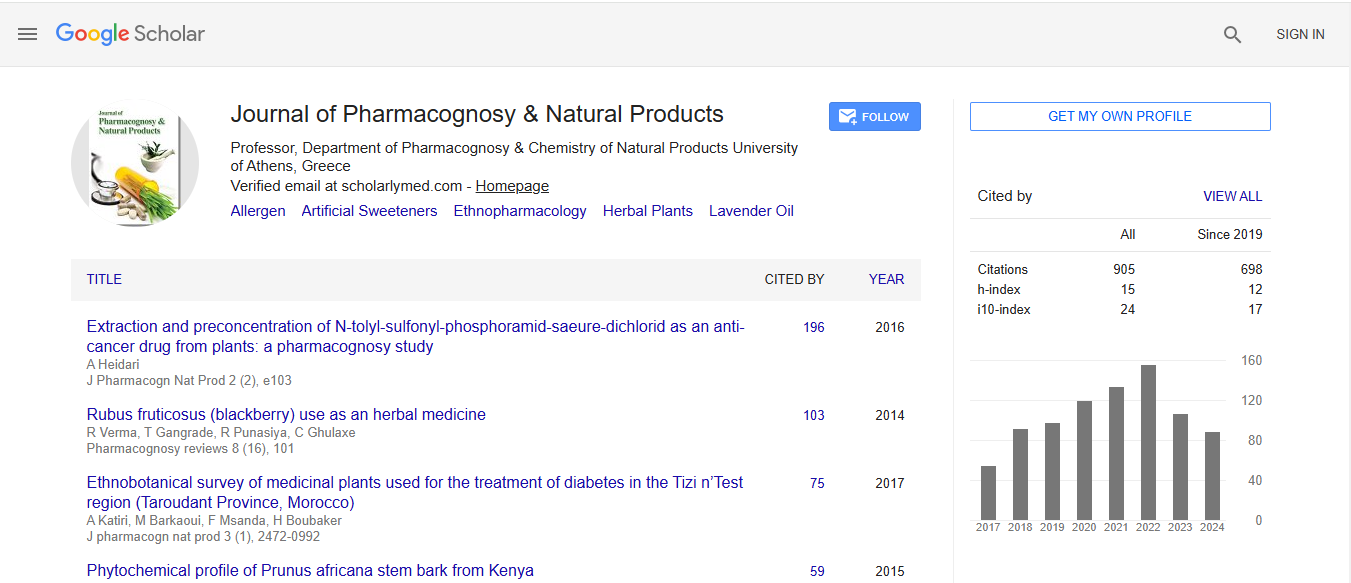
Journal of Pharmacognosy & Natural Products received 606 citations as per Google Scholar report