Brief Report - (2025) Volume 14, Issue 6
Received: 31-Oct-2025, Manuscript No. jio-26-184835;
Editor assigned: 03-Nov-2025, Pre QC No. P-184835;
Reviewed: 17-Nov-2025, QC No. Q-184835;
Revised: 21-Nov-2025, Manuscript No. R-184835;
Published:
28-Nov-2025
, DOI: 10.37421/2329-6771.2025.14.584
Citation: Nguyen, Linh. ”Biomarkers Predict Integrative Oncology Treatment Response.” J Integr Onco 14 (2025):584.
Copyright: © 2025 Nguyen L. This is an open-access article distributed under the terms of the Creative Commons Attribution License, which permits unrestricted use, distribution and reproduction in any medium, provided the original author and source are credited.
The precise identification of reliable biomarkers is paramount for predicting patient responses to integrative oncology interventions, a critical step towards achieving personalized cancer care. This field of research is dedicated to refining therapeutic strategies by thoroughly understanding the inherent variability in individual patient responses when subjected to a combination of conventional treatments and complementary approaches. The primary focus of these investigations is to explore a diverse array of molecular, immunological, and physiological markers that possess the potential to predict treatment efficacy and anticipate any potential adverse side effects, thereby optimizing overall patient outcomes and significantly enhancing their quality of life [1].
A significant area of exploration within integrative oncology involves the investigation of circulating tumor DNA (ctDNA) as a biomarker for the meticulous monitoring of patient responses to comprehensive multimodal integrative oncology strategies, particularly in individuals diagnosed with advanced non-small cell lung cancer. Preliminary findings from these studies compellingly suggest that observable alterations in ctDNA levels can provide an exceptionally early and non-invasive indicator of treatment effectiveness, thus offering invaluable guidance for real-time therapeutic adjustments [2].
The intricate immune microenvironment within the tumor has been recognized for its substantial influence on the overall treatment response. Emerging research endeavors are actively exploring specific immune cell profiles and fluctuating cytokine levels as potential biomarkers for forecasting patient outcomes among those receiving integrative oncology care for breast cancer. The outcomes of these studies have underscored the identification of distinct immune signatures that are strongly associated with positive treatment responses, thereby paving the way for more precise immunotherapy stratification within diverse integrative settings [3].
Furthermore, the patient's nutritional status and their unique metabolic profiles are increasingly being acknowledged for their profound role as modulators of cancer treatment response. This particular area of research is dedicated to examining specific biomarkers that are intrinsically linked to metabolism and the levels of essential micronutrients, which may hold the key to predicting how patients will respond to various integrative oncology interventions, with a particular emphasis on gastrointestinal cancers. A central theme is the critical importance of establishing a personalized nutritional strategy that is directly informed by these identified biomarkers [4].
Telomere length and the activity of the enzyme telomerase are intrinsically associated with the fundamental processes of cellular aging and the complex mechanisms of cancer progression. Current research is actively investigating their potential utility as biomarkers for predicting patient responses to integrative cancer therapies, with a specific focus on elderly patient populations. Early findings suggest a discernible link between dynamic changes in telomere length and the overall efficacy of complementary therapeutic approaches in effectively managing cancer and its associated treatment-related side effects [5].
The profound influence of the gut microbiome on both the development of cancer and the body's response to treatment is a rapidly expanding and dynamic field of scientific inquiry. This current review aims to synthesize the most up-to-date knowledge regarding gut microbial signatures, positioning them as valuable biomarkers for predicting patient outcomes within the context of integrative oncology. A key highlight is the potential for specific microbial compositions to predict responses to a wide range of integrative modalities, including carefully designed dietary interventions and the use of probiotics [6].
Epigenetic modifications, encompassing crucial processes such as DNA methylation and histone modifications, play a fundamentally important role in regulating gene expression and are deeply implicated in the development and progression of cancer. This specific line of research is focused on identifying particular epigenetic markers that have the capability to predict patient response to integrative oncology interventions, with a concentrated effort on patients diagnosed with hematological malignancies. The study strongly suggests that detailed epigenetic profiling can significantly aid in the tailored application of complementary therapies to meet the unique needs of individual patients [7].
Psychological well-being and stress-related biomarkers are increasingly recognized as integral components of comprehensive cancer care. This particular study is dedicated to exploring the utility of specific biomarkers, including cortisol levels, heart rate variability, and various psychological distress scores, as potential predictors of response to mind-body interventions when integrated within an integrative oncology framework. The obtained results indicate that these specific markers can effectively help in identifying those patients who are most likely to derive substantial benefits from stress-reduction techniques [8].
Genetic polymorphisms, particularly those influencing drug metabolism and detoxification pathways, are being investigated for their role as pharmacogenomic biomarkers in predicting patient responses to adjuvant integrative therapies, especially among cancer survivors. This research emphasizes how inherent genetic variations can significantly impact both the efficacy and the overall tolerability of certain complementary agents, thereby facilitating the development of highly personalized treatment plans [9].
Vascular endothelial growth factor (VEGF) and the intricate signaling pathways associated with it are fundamentally critical in the processes of angiogenesis and tumor progression. This detailed investigation specifically explores VEGF levels, alongside other related angiogenic factors, as potential biomarkers for predicting patient response to various integrative oncology treatments. A particular focus is placed on understanding the impact of integrated dietary interventions and structured exercise programs. The findings collectively suggest that the strategic modulation of these specific pathways can lead to a notable enhancement in overall treatment efficacy [10].
The identification of reliable biomarkers is crucial for tailoring integrative oncology interventions to individual patients. This research area focuses on understanding patient variability in response to combined conventional therapies and complementary approaches. Key efforts involve exploring molecular, immunological, and physiological markers to predict efficacy and side effects, ultimately optimizing outcomes and quality of life [1].
Circulating tumor DNA (ctDNA) is being investigated as a biomarker for monitoring response to integrative oncology in advanced non-small cell lung cancer. Changes in ctDNA levels may offer an early, non-invasive indication of treatment effectiveness, guiding real-time therapeutic adjustments [2].
The immune microenvironment significantly influences treatment response. Research is exploring immune cell profiles and cytokine levels as predictive biomarkers for integrative oncology in breast cancer. Specific immune signatures are linked to positive responses, aiding in immunotherapy stratification within integrative settings [3].
Nutritional status and metabolic profiles are recognized as modulators of cancer treatment response. This research examines biomarkers related to metabolism and micronutrients to predict response to integrative oncology, especially in gastrointestinal cancer. Personalized nutritional strategies informed by these biomarkers are emphasized [4].
Telomere length and telomerase activity, associated with cellular aging and cancer, are being studied as biomarkers for integrative cancer therapies, particularly in older adults. Findings suggest a link between telomere dynamics and the efficacy of complementary approaches in managing cancer and its side effects [5].
The gut microbiome's impact on cancer development and treatment response is a growing area. This review synthesizes knowledge on gut microbial signatures as biomarkers for integrative oncology, highlighting how specific compositions may predict response to modalities like dietary interventions and probiotics [6].
Epigenetic modifications, including DNA methylation and histone modifications, are key to gene regulation and cancer. Research is identifying epigenetic markers to predict response to integrative oncology in hematological malignancies, suggesting epigenetic profiling can tailor complementary therapies [7].
Psychological and stress-related biomarkers are important in cancer care. This study evaluates cortisol levels, heart rate variability, and psychological distress scores as predictors of response to mind-body interventions in integrative oncology, indicating their utility in identifying patients likely to benefit from stress-reduction techniques [8].
Genetic polymorphisms in drug metabolism and detoxification pathways are being explored as pharmacogenomic biomarkers for predicting response to adjuvant integrative therapies in cancer survivors. These variations can influence the efficacy and tolerability of complementary agents, aiding personalized treatment planning [9].
Vascular endothelial growth factor (VEGF) and its signaling pathways are critical in angiogenesis and tumor progression. This study investigates VEGF levels and angiogenic factors as biomarkers for predicting response to integrative oncology, considering the impact of dietary interventions and exercise. Modulating these pathways may enhance treatment efficacy [10].
This collection of research highlights the critical role of biomarkers in predicting patient responses to integrative oncology interventions. Studies explore a wide range of potential markers, including circulating tumor DNA (ctDNA) for early treatment response monitoring in lung cancer, immune cell profiles and cytokine levels for breast cancer, and metabolic and nutritional markers for gastrointestinal cancers. The influence of the gut microbiome, epigenetic modifications, telomere length, and psychological factors like stress are also investigated as predictive indicators. Furthermore, pharmacogenomic markers related to genetic polymorphisms and angiogenic factors like VEGF are examined for their utility in personalizing treatment strategies. The overarching goal is to refine therapeutic approaches, optimize patient outcomes, and improve the quality of life through a deeper understanding of individual variability in response to combined conventional and complementary cancer therapies.
None
None
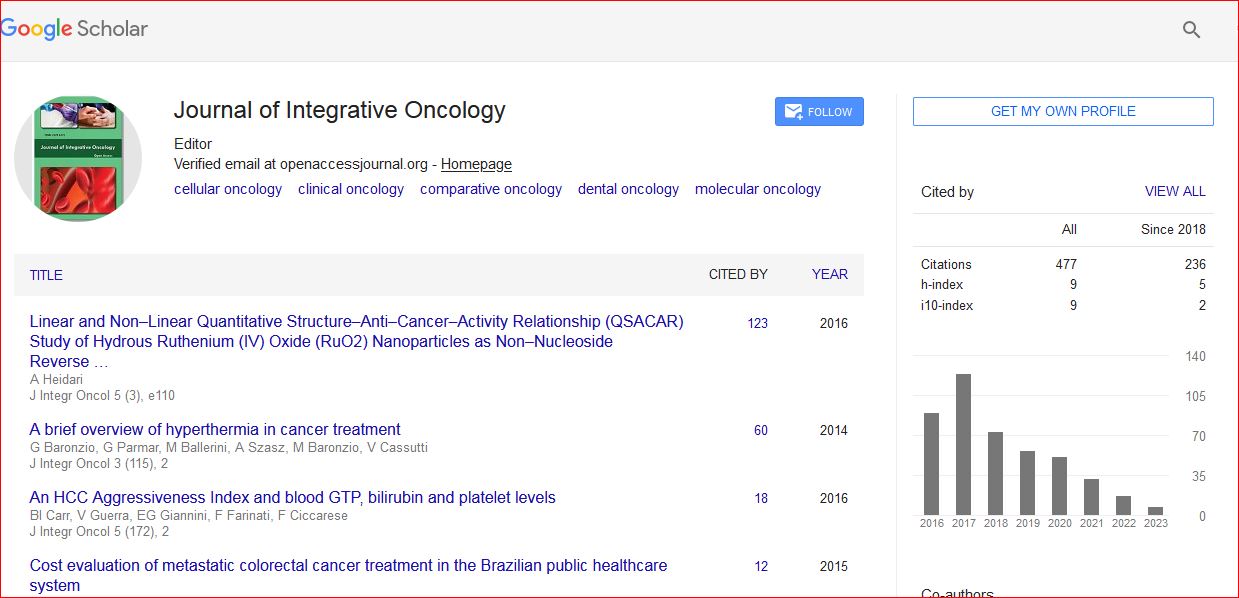
Journal of Integrative Oncology received 495 citations as per Google Scholar report