Opinion - (2025) Volume 11, Issue 3
Received: 01-Aug-2025, Manuscript No. jotr-25-175600;
Editor assigned: 04-Aug-2025, Pre QC No. P-175600;
Reviewed: 18-Aug-2025, QC No. Q-175600;
Revised: 22-Aug-2025, Manuscript No. R-175600;
Published:
29-Aug-2025
, DOI: 10.37421/2476-2261. 2025.11.319
Citation: El-Haddad, Fatima. ”Biomarkers: Essential for Precision Medicine and AI.” J Oncol Transl Res 11 (2025):319.
Copyright: © 2025 El-Haddad F. This is an open-access article distributed under the terms of the Creative Commons Attribution License, which permits unrestricted use, distribution and reproduction in any medium, provided the original author and source are credited.
This article provides an important update on the state of biomarkers in neurodegenerative diseases, highlighting their critical role in early diagnosis, disease progression monitoring, and assessing treatment efficacy. It emphasizes the ongoing advancements in identifying robust biomarkers, particularly in conditions like Alzheimer's and Parkinson's, which are key to developing effective interventions and improving patient outcomes[1].
This piece delves into the transformative potential of liquid biopsy in colorectal cancer, explaining how it enables precision medicine by providing non-invasive insights into tumor genetics and treatment response. What this really means is better patient stratification and real-time monitoring, moving us towards more personalized and effective therapeutic strategies[2].
The article discusses the crucial role of predictive biomarkers in guiding immunotherapy decisions for solid tumors. Understanding these biomarkers is essential because they help identify which patients are most likely to respond to immune checkpoint inhibitors, thus reducing unnecessary treatments and improving clinical outcomes. It's about getting the right treatment to the right patient[3].
This paper explores how Artificial Intelligence (AI) and machine learning are revolutionizing biomarker discovery and development. It highlights the power of these computational tools to analyze complex biological datasets, accelerating the identification of novel predictive biomarkers that would be challenging to find through traditional methods. Essentially, Artificial Intelligence (AI) is making biomarker research faster and more effective[4].
Here's a comprehensive review of emerging predictive biomarkers for gastric cancer, offering insights into new avenues for diagnosis, prognosis, and treatment stratification. It underscores the unmet need for reliable markers in gastric cancer, detailing promising candidates that could someday improve patient management and help doctors make more informed decisions[5].
This article focuses on the prognostic and predictive biomarkers relevant to metastatic uveal melanoma, a rare but aggressive cancer. It provides a detailed overview of markers that help predict disease progression and response to systemic therapies, offering hope for improved risk stratification and personalized treatment approaches for patients facing this challenging diagnosis[6].
The paper goes 'Beyond PD-L1' to explore novel biomarkers for predicting response to immune checkpoint inhibitors, which is really significant because PD-L1 isn't always sufficient. It covers a range of emerging markers, from tumor mutational burden to gut microbiome composition, offering a broader perspective on how we might better select patients for these life-saving immunotherapies[7].
This work identifies predictive biomarkers for the early detection and progression of Alzheimer's disease, which is incredibly important for intervention. By pinpointing these markers, we can potentially diagnose the disease much earlier and track its advancement, paving the way for timely treatments and better disease management before significant cognitive decline sets in[8].
This article explores circulating tumor Deoxyribonucleic Acid (ctDNA) as a predictive biomarker in non-small cell lung cancer, emphasizing its potential for non-invasive monitoring. What this means for patients is that ctDNA can help assess treatment response, detect minimal residual disease, and predict recurrence, making it a powerful tool for personalized cancer care and dynamic treatment adjustments[9].
The article reviews predictive biomarkers for therapy response in rheumatoid arthritis, which is crucial for optimizing patient treatment. It highlights the variability in patient responses to different therapies and the need for markers that can guide treatment selection, aiming to improve patient outcomes by ensuring they receive the most effective intervention from the start[10].
The field of biomarkers is experiencing significant advancements, with these critical tools playing an increasingly vital role in medical diagnostics and personalized treatment. We are seeing breakthroughs in their application for early diagnosis, effectively monitoring disease progression, and accurately assessing treatment efficacy across various conditions. Notably, in neurodegenerative diseases such as Alzheimer's and Parkinson's, identifying robust biomarkers is paramount. These markers are key to developing effective interventions and ultimately improving patient outcomes. What this really means is that by pinpointing predictive biomarkers for the early detection and progression of Alzheimer's disease, we can potentially diagnose the condition much earlier. This enables us to track its advancement, paving the way for timely treatments and better disease management before significant cognitive decline sets in[1][8].
In the realm of oncology, liquid biopsy represents a transformative approach for precision medicine, particularly in colorectal cancer. It offers non-invasive insights into tumor genetics and crucial information about treatment response. The practical implication is enhanced patient stratification and real-time monitoring of disease, moving us closer to truly personalized and effective therapeutic strategies. Here's the thing, circulating tumor Deoxyribonucleic Acid (ctDNA) is emerging as a powerful predictive biomarker in non-small cell lung cancer. Its potential for non-invasive monitoring is immense; ctDNA can help clinicians assess treatment response, detect minimal residual disease, and predict recurrence, making it an invaluable tool for personalized cancer care and dynamic treatment adjustments based on real-time data[2][9].
Understanding predictive biomarkers is absolutely essential for guiding immunotherapy decisions, especially for solid tumors. These markers are critical because they help identify which patients are most likely to respond to immune checkpoint inhibitors. By using these insights, doctors can reduce unnecessary treatments and significantly improve clinical outcomes, getting the right treatment to the right patient. Moreover, research is moving 'Beyond programmed death-ligand 1 (PD-L1)' to explore novel biomarkers for predicting response to immune checkpoint inhibitors. This is really significant because PD-L1 alone isn't always sufficient. A range of emerging markers are now being considered, from tumor mutational burden to the composition of the gut microbiome, offering a broader perspective on how we might better select patients for these potentially life-saving immunotherapies and optimize their therapeutic benefit[3][7].
A comprehensive review of emerging predictive biomarkers for gastric cancer offers new avenues for diagnosis, prognosis, and treatment stratification. It underscores a pressing unmet need for reliable markers in this challenging cancer type, detailing promising candidates that could revolutionize patient management and lead to more informed medical decisions. Similarly, for metastatic uveal melanoma, a rare but aggressive cancer, specific prognostic and predictive biomarkers provide a detailed overview. These markers help predict disease progression and response to systemic therapies, offering hope for improved risk stratification and personalized treatment approaches for patients. Furthermore, beyond cancer, predictive biomarkers are proving invaluable for optimizing patient treatment in conditions like rheumatoid arthritis. They address the variability in patient responses to different therapies by guiding treatment selection, aiming to improve patient outcomes by ensuring they receive the most effective intervention from the very beginning[5][6][10].
Artificial Intelligence (AI) and machine learning are fundamentally transforming the landscape of biomarker discovery and development. These powerful computational tools can analyze incredibly complex biological datasets with unprecedented efficiency. This capability accelerates the identification of novel predictive biomarkers that would otherwise be exceedingly challenging to uncover through traditional research methods. The bottom line is, Artificial Intelligence (AI) is making biomarker research significantly faster, more precise, and ultimately more effective, pushing the boundaries of what's possible in medical research and personalized medicine[4].
The provided data underscores the profound and rapidly evolving significance of biomarkers in modern medicine, illustrating their crucial applications from early disease diagnosis to personalized treatment strategies. These molecular indicators are vital for understanding and managing neurodegenerative conditions, notably Alzheimer's and Parkinson's, where they facilitate early detection, track disease progression, and assess the effectiveness of therapeutic interventions. In oncology, liquid biopsy, particularly through circulating tumor Deoxyribonucleic Acid (ctDNA), is transforming precision medicine for various cancers, including colorectal and non-small cell lung cancer. This non-invasive method offers invaluable real-time insights into tumor genetics and treatment response, paving the way for more tailored patient care. Beyond this, predictive biomarkers are indispensable for optimizing immunotherapy in solid tumors, helping clinicians select patients who will benefit most from immune checkpoint inhibitors and explore novel markers beyond traditional ones like programmed death-ligand 1 (PD-L1). The data also details the development of specific biomarkers for challenging cancers such as gastric cancer and metastatic uveal melanoma, enhancing prognosis and guiding treatment stratification. Artificial Intelligence (AI) and machine learning are significantly accelerating biomarker discovery by enabling the analysis of complex biological datasets, making research faster and more effective. Furthermore, predictive biomarkers are proving critical in autoimmune diseases like rheumatoid arthritis, guiding treatment selection to ensure optimal patient responses and outcomes. Collectively, these advancements highlight a shift towards more precise, efficient, and patient-centric healthcare.
None
None
Henrik Z, Kaj B, Charlotte ET. "Biomarkers in Neurodegenerative Diseases: An Update".Curr Opin Neurol 34 (2021):219-228.
Indexed at, Google Scholar, Crossref
Jun G, Liang Q, Hongming W. "Liquid Biopsy for Precision Medicine in Colorectal Cancer: Current Landscape and Future Perspectives".Cancers 14 (2022):3416.
Indexed at, Google Scholar, Crossref
Xin W, Junwei L, Zhiyong L. "Predictive Biomarkers for Response to Immunotherapy in Solid Tumors".J Clin Oncol 38 (2020):1675-1685.
Indexed at, Google Scholar, Crossref
Bin C, Jun W, Yang Y. "Artificial Intelligence and Machine Learning in Biomarker Discovery and Development".Mol Cancer 22 (2023):45.
Indexed at, Google Scholar, Crossref
Wei Z, Qi Z, Jian-Guo G. "Emerging Predictive Biomarkers in Gastric Cancer: A Comprehensive Review".Front Oncol 11 (2021):732486.
Indexed at, Google Scholar, Crossref
Sara LO, Sophie XS, Alexander NS. "Prognostic and Predictive Biomarkers in Metastatic Uveal Melanoma".Curr Opin Ophthalmol 33 (2022):212-219.
Indexed at, Google Scholar, Crossref
Ling L, Jie L, Hua W. "Beyond PD-L1: Novel Biomarkers for Predicting Response to Immune Checkpoint Inhibitors".J Hematol Oncol 16 (2023):77.
Indexed at, Google Scholar, Crossref
Andrea LE, Laura EG, Kristine Y. "Predictive Biomarkers for Early Detection and Progression of Alzheimer's Disease".JAMA Netw Open 4 (2021):e2124508.
Indexed at, Google Scholar, Crossref
Se-Hoon L, Woong-Yang P, Yongjoo K. "Circulating Tumor DNA as a Predictive Biomarker in Non-Small Cell Lung Cancer".Ann Oncol 31 (2020):1320-1332.
Indexed at, Google Scholar, Crossref
Ronald FvV, Rene EMT, Peter CT. "Predictive Biomarkers for Therapy Response in Rheumatoid Arthritis: A Review".Nat Rev Rheumatol 18 (2022):99-112.
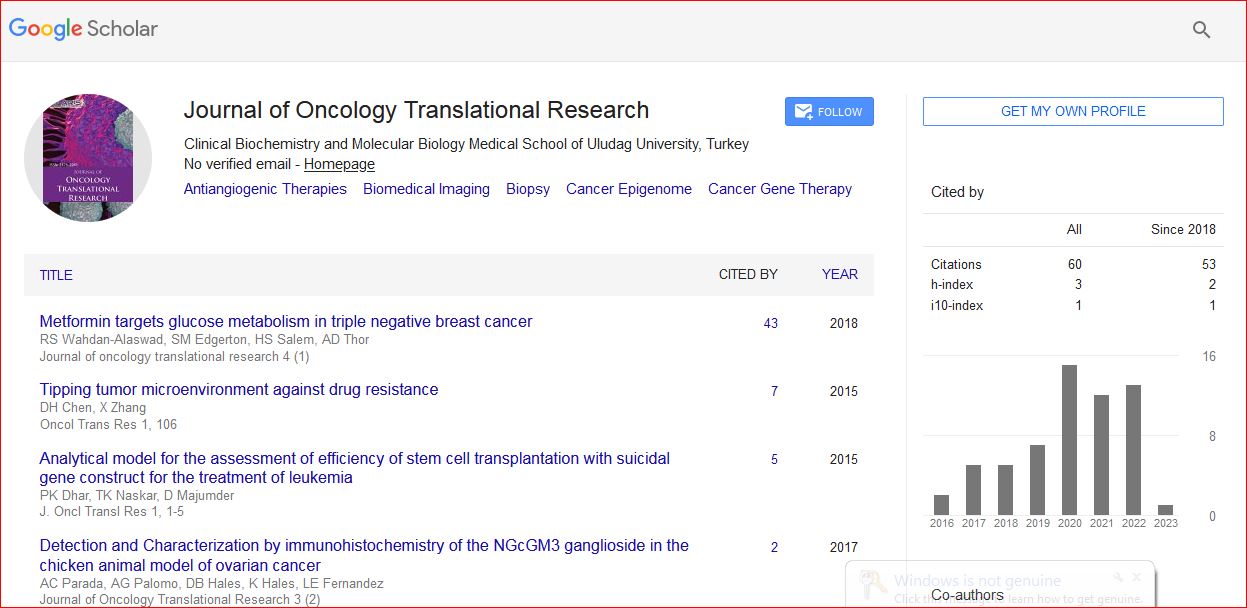
Journal of Oncology Translational Research received 93 citations as per Google Scholar report