Commentary - (2025) Volume 16, Issue 5
Received: 01-Oct-2025, Manuscript No. jmbd-26-179573;
Editor assigned: 03-Oct-2025, Pre QC No. P-179573;
Reviewed: 15-Oct-2025, QC No. Q-179573;
Revised: 23-Oct-2025, Manuscript No. R-179573;
Published:
30-Oct-2025
, DOI: 10.37421/2155-9929.2025.16.722
Citation: Mendoza, Carlos. ”Biomarker-Guided Diagnosis: Revolutionizing Precision Medicine.” J Mol Biomark Diagn 16 (2025):722.
Copyright: © 2025 Mendoza C. This is an open-access article distributed under the terms of the Creative Commons Attribution License, which permits unrestricted use,
distribution and reproduction in any medium, provided the original author and source are credited.
Biomarker-guided diagnosis signifies a pivotal advancement in healthcare, ushering in an era of precision medicine where treatments are tailored to individual molecular profiles. This approach leverages detailed molecular insights to refine medical interventions, moving beyond generalized strategies to highly individualized ones. The ultimate goal is to enhance diagnostic accuracy, predict disease progression more reliably, and guide the selection of therapies, thereby improving patient outcomes by minimizing adverse effects and maximizing therapeutic efficacy. One compelling illustration of this paradigm is the application of circulating tumor DNA (ctDNA) in oncology. Analyzing ctDNA enables early cancer detection, monitors treatment response, and identifies resistance mechanisms through non-invasive means. This dynamic molecular information is crucial for personalized cancer care, allowing for timely adjustments to treatment strategies as the disease evolves. In the realm of infectious diseases, proteomic and transcriptomic biomarkers are revolutionizing diagnostic capabilities. The identification of specific pathogen-derived proteins or host response signatures facilitates rapid and accurate identification of causative agents, even in complex clinical scenarios. This molecular precision is instrumental in selecting appropriate antimicrobial therapies and combating the growing threat of antimicrobial resistance. The diagnostic utility of microRNAs (miRNAs) in neurological disorders represents another rapidly expanding frontier. These small non-coding RNAs can function as sensitive and specific biomarkers for neurodegenerative conditions such as Alzheimer's and Parkinson's diseases. Their detectability in biofluids offers a less invasive pathway for early diagnosis and disease progression monitoring, paving the way for timely interventions. Genomic and epigenomic profiling form the bedrock of biomarker-guided diagnosis for hereditary diseases. The identification of germline mutations or epigenetic alterations provides essential information for risk assessment, diagnosis, and the personalized management of genetic disorders. This deep molecular understanding empowers proactive healthcare strategies and facilitates informed genetic counseling. The development of liquid biopsies, which analyze biomarkers present in bodily fluids like blood, urine, or saliva, is a cornerstone of contemporary biomarker-guided diagnosis. These non-invasive techniques offer a powerful means for disease detection, monitoring, and characterization across a wide spectrum of medical fields, significantly enhancing the patient experience and improving access to advanced diagnostic tools. Pharmacogenomics, a critical component of biomarker-guided precision healthcare, harnesses genetic information to anticipate an individual's response to various drugs. By pinpointing genetic variants that influence drug metabolism or efficacy, clinicians can prescribe medications that are both most effective and safest, thereby reducing the incidence of adverse drug reactions and optimizing treatment outcomes. Single-cell analysis technologies are instrumental in advancing biomarker discovery and enhancing diagnostic precision. By examining individual cells, researchers can identify rare cell populations, delineate heterogeneous disease states, and detect subtle molecular changes that might be obscured in bulk analyses. This granular approach is essential for comprehending complex diseases and developing highly targeted therapies. The integration of artificial intelligence (AI) and machine learning (ML) is profoundly transforming biomarker-guided diagnosis. AI/ML algorithms possess the capability to analyze extensive datasets encompassing both molecular and clinical information, thereby identifying novel biomarkers, predicting disease risk, and stratifying patients for optimal treatment pathways. This computational prowess accelerates the translation of molecular discoveries into practical clinical applications. Despite these advancements, significant challenges persist in biomarker-guided diagnosis, including the standardization of assays, the rigorous validation of biomarkers, and ensuring equitable access to sophisticated molecular testing. Addressing these critical hurdles is paramount to fully realizing the potential of precision healthcare and translating these molecular insights into widespread clinical benefits for all patients.
Biomarker-guided diagnosis represents a substantial evolution in healthcare, steering towards precision medicine by employing molecular insights to customize medical interventions. This methodology aims to elevate diagnostic accuracy, predict disease trajectories more effectively, and inform therapeutic selections, ultimately leading to improved patient outcomes through highly individualized strategies that minimize side effects and maximize treatment benefits. In the field of oncology, the analysis of circulating tumor DNA (ctDNA) serves as a prime example of biomarker-guided diagnosis. The examination of ctDNA facilitates early cancer detection, monitors the effectiveness of treatments, and non-invasively identifies mechanisms of drug resistance. This real-time molecular data is vital for implementing personalized cancer care, enabling dynamic adjustments to treatment regimens as dictated by the evolving disease state. Within infectious diseases, the application of proteomic and transcriptomic biomarkers is revolutionizing diagnostic processes. The ability to identify specific proteins from pathogens or host response patterns allows for the rapid and accurate detection of causative agents, even in intricate clinical settings. Such molecular precision supports the selection of appropriate antimicrobial treatments and aids in the fight against rising antimicrobial resistance. The diagnostic potential of microRNAs (miRNAs) in neurological disorders is a rapidly growing area of research. These small, non-coding RNA molecules can act as sensitive and specific indicators for conditions like Alzheimer's and Parkinson's diseases. Detecting miRNAs in bodily fluids offers a less invasive method for early diagnosis and tracking disease progression, facilitating prompt therapeutic interventions. Genomic and epigenomic profiling are fundamental to diagnosing hereditary diseases through biomarkers. Identifying germline mutations or epigenetic alterations provides crucial information for assessing risk, confirming diagnoses, and managing genetic disorders with personalized approaches. This molecular comprehension empowers proactive health management and informs genetic counseling. Liquid biopsies, which involve the analysis of biomarkers found in body fluids such as blood, urine, or saliva, are a key element of modern biomarker-guided diagnostics. These non-invasive techniques offer a powerful means of detecting, monitoring, and characterizing diseases across various medical disciplines, significantly enhancing patient comfort and accessibility to advanced diagnostic methods. Pharmacogenomics, an integral part of biomarker-guided precision healthcare, utilizes an individual's genetic makeup to predict their response to medications. By identifying genetic variations that influence how drugs are metabolized or whether they are effective, clinicians can prescribe the most suitable and safe drugs, thereby reducing adverse reactions and optimizing treatment results. Single-cell analysis technologies are playing an increasingly important role in the discovery of biomarkers and the refinement of diagnostic accuracy. By scrutinizing individual cells, researchers can detect rare cell populations, understand disease heterogeneity, and identify subtle molecular changes that might be overlooked in analyses of larger cell groups. This detailed approach is essential for understanding complex diseases and developing targeted treatments. The incorporation of artificial intelligence (AI) and machine learning (ML) is dramatically reshaping biomarker-guided diagnosis. AI/ML algorithms are capable of processing massive volumes of molecular and clinical data to uncover new biomarkers, predict disease risks, and categorize patients for the most effective treatments. This computational capability accelerates the transition of molecular findings into practical clinical use. Key challenges in biomarker-guided diagnosis include the need for standardized testing methods, comprehensive validation of identified biomarkers, and ensuring equitable access to advanced molecular diagnostic technologies. Addressing these obstacles is crucial for fully realizing the promise of precision healthcare and translating molecular discoveries into tangible clinical benefits for all patient populations.
Biomarker-guided diagnosis is revolutionizing healthcare by enabling precision medicine through molecular insights. This approach enhances diagnostic accuracy, predicts disease progression, and guides personalized therapeutic selection, leading to improved patient outcomes. Examples include the use of circulating tumor DNA in oncology for early detection and monitoring, omics-based diagnostics for infectious diseases, microRNAs for neurological disorders, and genomic/epigenomic profiling for hereditary conditions. Liquid biopsies offer non-invasive detection, while pharmacogenomics tailors drug prescriptions based on genetic profiles. Single-cell analysis provides granular disease insights, and AI/ML accelerates biomarker discovery. Key challenges involve standardization, validation, and equitable access to these advanced diagnostics.
None
None
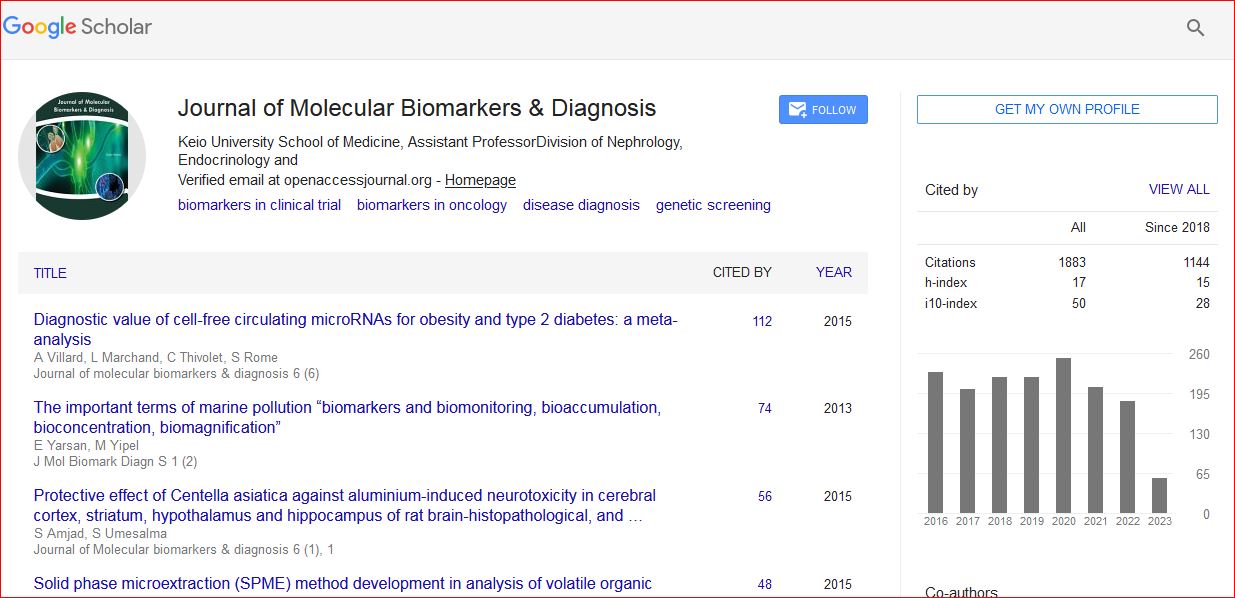
Journal of Molecular Biomarkers & Diagnosis received 2054 citations as per Google Scholar report