Opinion - (2025) Volume 15, Issue 5
Received: 02-Oct-2025, Manuscript No. jbbs-25-174255;
Editor assigned: 06-Oct-2025, Pre QC No. P-174255;
Reviewed: 20-Oct-2025, QC No. Q-174255;
Revised: 23-Oct-2025, Manuscript No. R-174255;
Published:
30-Oct-2025
, DOI: 10.37421/2155-9538.2025.15.500
Citation: Dimitrova, Sofia. ”Bioinformatics: Revolutionizing Discovery and Practical Applications.” J Bioengineer & Biomedical Sci 15 (2025):500.
Copyright: © 2025 Dimitrova S. This is an open-access article distributed under the terms of the Creative Commons Attribution License, which permits unrestricted use, distribution and reproduction in any medium, provided the original author and source are credited.
Modern biomedical research increasingly applies advanced bioinformatics. In personalized cancer treatment, bioinformatics methods are essential for discovering crucial biomarkers, guiding precision oncology with computational strategies for targeted patient care [1].
This computational power extends into drug discovery, especially drug repositioning. Specialized bioinformatics tools and databases accelerate identifying novel therapeutic uses for existing drugs, streamlining development and offering new hope for various conditions [2].
Significant progress in computational structural biology has made these methods indispensable for modern drug discovery. They provide atomic-level insights into molecular structures and interactions, crucial for rational drug design and optimization of new therapeutic agents [3].
These integrated approaches show how computational biology transforms medical and pharmaceutical research capabilities. Beyond drug development, bioinformatics plays a central role in deciphering complex biological data from advanced experimental techniques. A comprehensive understanding of biological pathways is often achieved through functional enrichment analysis on proteomics data, a key bioinformatics technique revealing underlying cellular mechanisms [4].
The complexity of systems biology, aiming to understand biological entities as integrated systems, relies heavily on bioinformatics for integrating diverse multi-omics data. This analytical integration is crucial for uncovering intricate biological interactions governing life processes [5].
A particularly challenging yet fruitful area is the analysis of single-cell multi-omics data. This complex field is profoundly reliant on advanced bioinformatics methodologies for accurate interpretation, processing vast amounts of heterogeneous data generated at the single-cell level, and exploring cellular heterogeneity with unprecedented resolution [6].
The ability to process and synthesize such vast and varied datasets underscores the indispensable nature of bioinformatics in contemporary biological research. The influence of bioinformatics expands through its synergy with Artificial Intelligence (AI) and Machine Learning (ML). Machine Learning techniques are increasingly applied in cancer immunotherapy, showcasing bioinformatics' vital role in developing personalized treatment strategies that are more effective and tailored to individual patient responses [7].
Network biology approaches have emerged as a powerful analytical tool for understanding complex diseases. These methods, leveraging bioinformatics, provide systems-level insights into disease mechanisms, mapping out intricate biological networks and identifying potential therapeutic targets [8].
The reach of bioinformatics also extends beyond human health, significantly impacting agricultural research. It examines the current status and future potential for crop improvement and sustainable agriculture, contributing to global food security and environmental resilience [9].
The ongoing evolution of AI, particularly deep learning techniques, is transforming biological data analysis. This provides an overview of deep learning's applications within bioinformatics, illustrating how these advancements are reshaping our capabilities to interpret complex biological information and drive new discoveries across diverse biological domains [10].
Bioinformatics plays a pivotal role in advancing personalized medicine, especially in cancer treatment. It provides essential methods for discovering biomarkers, enabling computational strategies that guide precision oncology to tailor treatments to individual patient profiles [C001]. This field is also paramount for accelerating drug discovery, where specialized tools and databases facilitate efficient drug repositioning, significantly impacting pharmaceutical development [C002]. Recent progress in computational structural biology has made these methods crucial for modern drug discovery processes, offering insights into molecular mechanisms vital for rational design and optimization of novel therapeutic compounds [C003]. The integration of these computational approaches streamlines the journey from molecular understanding to therapeutic application.
The analytical power of bioinformatics is profoundly demonstrated in its expert handling of diverse 'omics' data. Functional enrichment analysis is a key bioinformatics technique offering a comprehensive guide for processing proteomics data, enabling researchers to understand underlying biological pathways and cellular functions [C004]. In systems biology, bioinformatics is central to the sophisticated integration of diverse multi-omics data. This integration is vital for uncovering the complex biological interactions that define living systems, providing a holistic view of biological phenomena [C005]. A specialized but critical area is the analysis of single-cell multi-omics data. This field, grappling with immense complexity, relies heavily on advanced bioinformatics for accurate interpretation, allowing for detailed exploration of cellular heterogeneity and dynamic changes at high resolution [C006]. These capabilities drive breakthroughs in disease understanding and cellular regulation.
The dynamic intersection of bioinformatics with Artificial Intelligence (AI) and Machine Learning (ML) is expanding its influence across biological and medical sciences. Machine Learning techniques are increasingly applied in cancer immunotherapy, demonstrating bioinformatics' significant role in crafting personalized treatment strategies that respond effectively to individual patient needs and immune responses [C007]. Concurrently, network biology approaches provide a powerful framework for comprehensively understanding the inherent complexity of diseases. By emphasizing systems-level insights, bioinformatics helps researchers to map out intricate biological networks, revealing novel connections and identifying potential therapeutic targets with greater precision [C008].
This transformative synergy is further exemplified by the growing application of deep learning techniques within bioinformatics. These cutting-edge AI advancements actively revolutionize biological data analysis, offering new and powerful ways to interpret vast and intricate datasets and uncover subtle, previously hidden patterns, ultimately leading to a deeper understanding of complex biological systems and mechanisms [C010]. These advanced technologies are truly at the forefront of biological discovery, therapeutic innovation, and the future of healthcare.
Beyond its profound contributions to human health, bioinformatics has a tangible and growing impact on other critical sectors, most notably agricultural research. It critically examines the current status and diligently explores the future potential of applying sophisticated computational biology to address pressing global challenges such as enhancing crop improvement, developing disease resistance in plants, and fostering sustainable agricultural practices [C009]. This eloquently demonstrates the versatile and far-reaching nature of bioinformatics, extending its analytical and problem-solving capabilities from highly specialized clinical applications and drug discovery to fundamental and universally important areas like food security, environmental science, and sustainable resource management. The continuous and rapid evolution of bioinformatics tools, algorithms, and methodologies promises to further enhance our collective capacity to effectively address complex biological problems across all these diverse and interconnected fields, thereby driving innovation and providing data-driven solutions for critical global challenges of the 21st century.
This collection of papers highlights the extensive and transformative role of bioinformatics across diverse areas of biological and medical research. The discipline is fundamental for advancing personalized cancer treatment through biomarker discovery and guiding precision oncology, as well as significantly accelerating drug discovery processes, including drug repositioning, by leveraging computational structural biology insights. Bioinformatics is also central to deciphering complex biological data, particularly in functional enrichment analysis of proteomics data and the integration of multi-omics information in systems biology. Its advanced analytical methods are crucial for interpreting intricate single-cell multi-omics datasets, providing detailed views of cellular heterogeneity. The integration of Artificial Intelligence (AI) and Machine Learning (ML) techniques within bioinformatics is driving innovation, especially in cancer immunotherapy for developing personalized treatment strategies. Network biology approaches, powered by bioinformatics, offer systems-level insights into disease complexity, aiding in the identification of therapeutic targets. Beyond human health, bioinformatics plays a vital role in agricultural research, contributing to crop improvement and sustainable practices. Deep learning applications are further revolutionizing biological data analysis, enhancing the interpretation of vast biological information. Together, these contributions underscore bioinformatics as an indispensable field continuously pushing the boundaries of scientific discovery and practical applications.
None
None
1. Peng L, Jie Y, Zhen W. "Bioinformatics approaches for the identification of biomarkers in precision oncology".Briefings in Bioinformatics 23 (2022):bbac236.
Indexed at, Google Scholar, Crossref
2. Chao W, Yu C, Jian M. "Bioinformatics tools and databases for drug repositioning".Briefings in Bioinformatics 23 (2022):bbac386.
Indexed at, Google Scholar, Crossref
3. Fan M, Zhiyong S, Xiang K. "Advances in computational structural biology for drug discovery".Briefings in Bioinformatics 24 (2023):bbad284.
Indexed at, Google Scholar, Crossref
4. Yi Z, Wenhui C, Hong Z. "A guide to functional enrichment analysis for proteomics data".Briefings in Bioinformatics 24 (2023):bbad057.
Indexed at, Google Scholar, Crossref
5. Jiao C, Xiaomin L, Shuo Z. "Multi-omics integration in systems biology: methods and applications".Genome Biology 22 (2021):1-19.
Indexed at, Google Scholar, Crossref
6. Xiaoyue M, Xiaojing Z, Shan H. "Recent advances in single-cell multi-omics data analysis".Briefings in Bioinformatics 24 (2023):bbac570.
Indexed at, Google Scholar, Crossref
7. Jie C, Yi Z, Cong W. "Machine learning applications in cancer immunotherapy: A review".Journal for ImmunoTherapy of Cancer 8 (2020):e000492.
Indexed at, Google Scholar, Crossref
8. Albert-László B, Narin G, Joseph L. "Network biology approaches for understanding complex diseases".Nature Reviews Genetics 21 (2020):59-71.
Indexed at, Google Scholar, Crossref
9. Pramod KG, Jai K, Rakesh RM. "Bioinformatics in agricultural research: Current status and future prospects".Genomics 113 (2021):4096-4105.
Indexed at, Google Scholar, Crossref
10. Rami A, Bruno P, Steven S. "Deep learning in bioinformatics: An overview and applications".IEEE Transactions on Computational Social Systems 6 (2019):729-743.
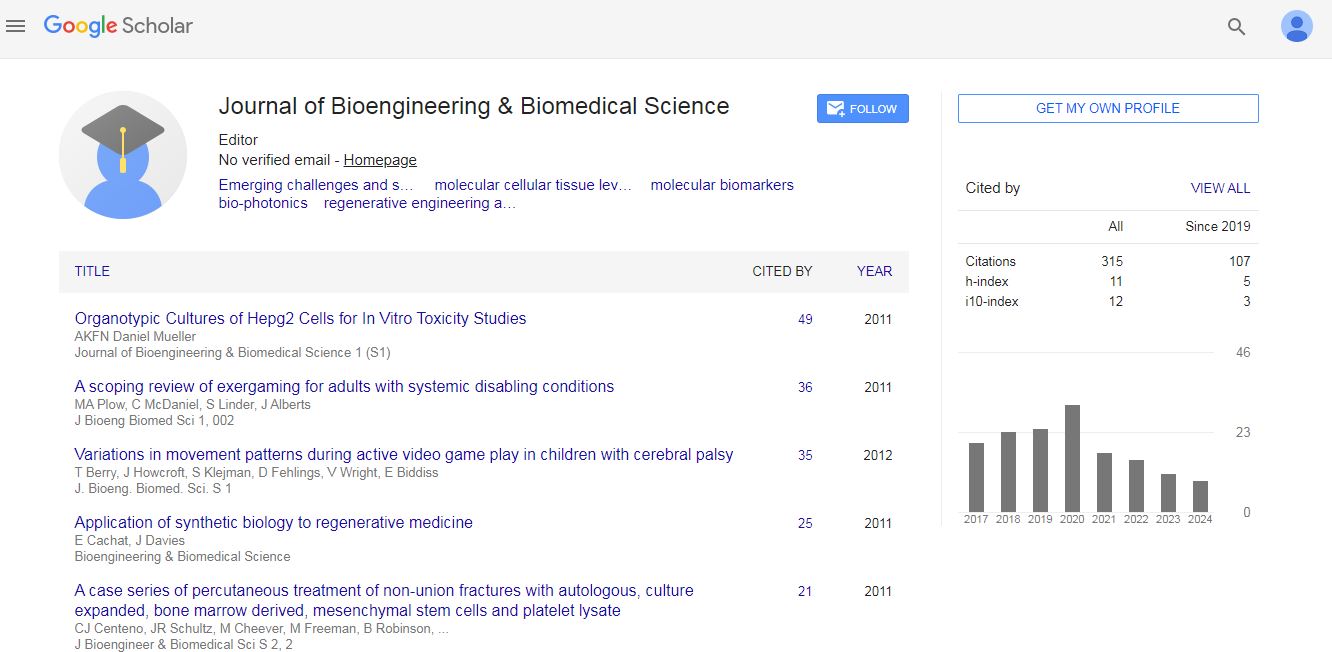
Journal of Bioengineering & Biomedical Science received 307 citations as per Google Scholar report