Commentary - (2025) Volume 15, Issue 3
Received: 01-May-2025, Manuscript No. jtese-26-184228;
Editor assigned: 05-May-2025, Pre QC No. P-184228;
Reviewed: 19-May-2025, QC No. Q-184228;
Revised: 22-May-2025, Manuscript No. R-184228;
Published:
29-May-2025
, DOI: 10.37421/2165-8064.2025.15.653
Citation: Carter, Emily. ”Biodegradable Textiles: Diverse Applications and Future Potential.” J Textile Sci Eng 15 (2025):653.
Copyright: © 2025 Carter E. This is an open-access article distributed under the terms of the Creative Commons Attribution License, which permits unrestricted use, distribution and reproduction in any medium, provided the original author and source are credited.
The burgeoning field of biodegradable fibers is poised to revolutionize the textile industry, offering a sustainable alternative to conventional materials and addressing the significant environmental impact of fashion [1].
These next-generation fibers are crucial for developing eco-friendly apparel and technical textiles, marking a pivotal shift towards a circular economy approach for textile waste management [1].
Biodegradable fibers present a promising solution for end-of-life scenarios, moving away from traditional linear production models that contribute to landfill waste [1].
Advancements in processing and enhanced biodegradability mechanisms are key to their widespread adoption, though challenges in scaling production and achieving comparable performance to conventional fibers remain [1].
The exploration of diverse natural and synthetic biodegradable fibers highlights their unique properties and potential applications across various textile sectors [1].
Cellulose-based biodegradable fibers, such as lyocell and modal, are demonstrating impressive performance and durability in different textile applications, driven by modifications in their production processes [2].
These fibers offer reduced water usage and a lower chemical footprint compared to conventional cotton and polyester, representing a significant step towards more sustainable textile manufacturing [2].
Novel bio-based polymers derived from agricultural waste, like polylactic acid (PLA) and polyhydroxyalkanoates (PHAs), are being investigated for their inherent biodegradability and potential to reduce reliance on fossil fuels [3].
Improving their processability, dyeability, and mechanical properties is essential for meeting the demands of the textile industry [3].
Protein-based fibers, including silk and wool, are also being explored for their natural biodegradability and potential in sustainable textiles, with methods focused on enhancing their properties and ensuring effective degradation in natural environments [4].
These fibers, when blended with other biodegradable materials, can achieve desired performance characteristics, harnessing their natural biodegradability for eco-conscious production [4].
The integration of functional properties into biodegradable textile fibers is another critical area of research, aiming to impart characteristics like water repellency and antimicrobial activity through surface modifications and composite structures [5].
This research is vital for creating high-performance textiles that are environmentally friendly and reduce the need for chemical treatments [5].
Assessing the end-of-life pathways for these fibers, particularly composting and marine biodegradation, is essential to ensure their biodegradability translates into actual ecological benefits and does not contribute to microplastic pollution [6].
Understanding the rate and efficiency of degradation under various conditions is key to effective waste management [6].
Developing biodegradable composite fibers by incorporating natural fillers like nanocellulose and chitin is an innovative approach to enhance mechanical properties and reduce costs, creating high-strength, biodegradable textiles [7].
These composite fibers aim to achieve performance levels competitive with conventional textiles through synergistic effects of different biodegradable materials [7].
A comprehensive life cycle assessment (LCA) of biodegradable textile fibers is crucial for quantifying their environmental impacts compared to conventional materials, providing critical data for informed decision-making [8].
The LCA findings underscore the ecological advantages of biodegradable alternatives when managed appropriately, covering aspects from raw material production to end-of-life scenarios [8].
Addressing the challenges and opportunities in the industrial-scale production of biodegradable textile fibers is vital for their widespread commercial adoption, examining advancements in biorefining and polymerization techniques [9].
These advancements are necessary to increase output, reduce costs, and ensure consistent fiber properties through robust quality control [9].
Finally, understanding consumer perception and market acceptance of biodegradable textiles is crucial for their successful integration into the mainstream market, investigating consumer awareness, purchasing drivers, and brand initiatives [10].
The realm of biodegradable fibers for textiles is expanding rapidly, with research focusing on their multifaceted properties and applications. A comprehensive review highlights the growing importance of these fibers in tackling the environmental challenges posed by the fashion industry, exploring a wide spectrum of natural and synthetic options and their potential in creating sustainable apparel and technical textiles [1].
Key developments include advancements in processing techniques and a deeper understanding of biodegradability mechanisms, although scaling production and achieving parity with conventional fiber performance remain areas for continued focus [1].
The concept of a circular economy is central to the effective management of textile waste, with biodegradable fibers offering a viable solution for the end-of-life phase of garments [1].
Cellulose-based biodegradable fibers, such as lyocell and modal, are gaining traction due to their enhanced performance and durability, offering a more sustainable alternative to synthetic polymers [2].
Modifications in their production processes significantly influence their mechanical strength, moisture management capabilities, and aesthetic appeal, while also contributing to reduced water usage and a smaller chemical footprint compared to conventional materials like cotton and polyester [2].
The utilization of agricultural waste to create bio-based and biodegradable polymers, specifically polylactic acid (PLA) and polyhydroxyalkanoates (PHAs), presents another promising avenue for textile applications, reducing reliance on fossil fuels [3].
Ongoing research aims to improve the processability, dyeability, and mechanical characteristics of these bio-polymers to align with industry standards, positioning them as a sustainable choice for functional and eco-friendly textiles [3].
Protein-based fibers, including natural materials like silk and wool, are being investigated for their inherent biodegradability and their potential to contribute to sustainable textile production [4].
Efforts are concentrated on methods to enhance their physical properties and ensure their effective degradation in natural ecosystems, with explorations into blending them with other biodegradable materials to achieve specific performance requirements [4].
The functionalization of biodegradable fibers to incorporate desirable characteristics such as water repellency, antimicrobial activity, and UV protection is a key area for innovation, aiming to reduce the need for additional chemical treatments and extend garment lifespan [5].
Techniques like surface modifications and the development of composite structures are being employed to imbue these fibers with high-performance capabilities while maintaining their environmental credentials, pointing towards the future of smart and sustainable textiles [5].
Crucially, the end-of-life management of biodegradable textile fibers is being rigorously assessed, with studies focusing on their behavior during composting and in marine environments [6].
These analyses aim to provide a clear understanding of their degradation rates and efficiencies under different conditions, ensuring that their biodegradability leads to genuine ecological benefits and does not result in microplastic pollution [6].
The development of biodegradable composite fibers, which combine biodegradable polymers with natural fillers like nanocellulose and chitin, is an innovative strategy to improve mechanical strength and reduce overall costs [7].
These composites, produced through advanced extrusion and spinning techniques, show potential for creating high-strength textiles that are also environmentally friendly, leveraging synergistic effects between different materials [7].
Life cycle assessments (LCAs) are providing essential data on the environmental footprint of biodegradable textile fibers in comparison to conventional alternatives, quantifying impacts across the entire value chain, from raw material sourcing to disposal [8].
These comprehensive assessments are vital for guiding manufacturers and consumers towards more sustainable choices, highlighting the ecological advantages of biodegradable materials when managed responsibly [8].
Challenges and opportunities associated with the industrial-scale production of biodegradable textile fibers are being addressed, with research exploring advancements in biorefining, chemical recycling, and novel polymerization methods to boost efficiency and lower costs [9].
Ensuring consistent fiber properties through stringent quality control and navigating complex supply chains are critical for transitioning these materials into widespread commercial use [9].
Finally, the successful market integration of biodegradable textiles hinges on consumer perception and industry acceptance, with studies examining consumer awareness, purchasing motivations, and how brands are communicating their sustainability efforts [10].
This collection of research highlights the growing importance and diverse applications of biodegradable textile fibers. Studies explore natural and synthetic biodegradable options, including cellulose-based fibers like lyocell and modal, and bio-based polymers from agricultural waste such as PLA and PHAs. Protein-based fibers like silk and wool are also examined for their natural biodegradability. Innovations focus on enhancing fiber properties through functionalization and composite development, aiming for high-performance sustainable textiles. Critical aspects covered include the end-of-life assessment of these fibers in composting and marine environments, comprehensive life cycle analyses comparing their environmental impact to conventional materials, and the challenges and opportunities in industrial-scale production. Consumer perception and market acceptance are also investigated as key factors for widespread adoption, emphasizing the move towards a circular economy in the textile industry.
None
None
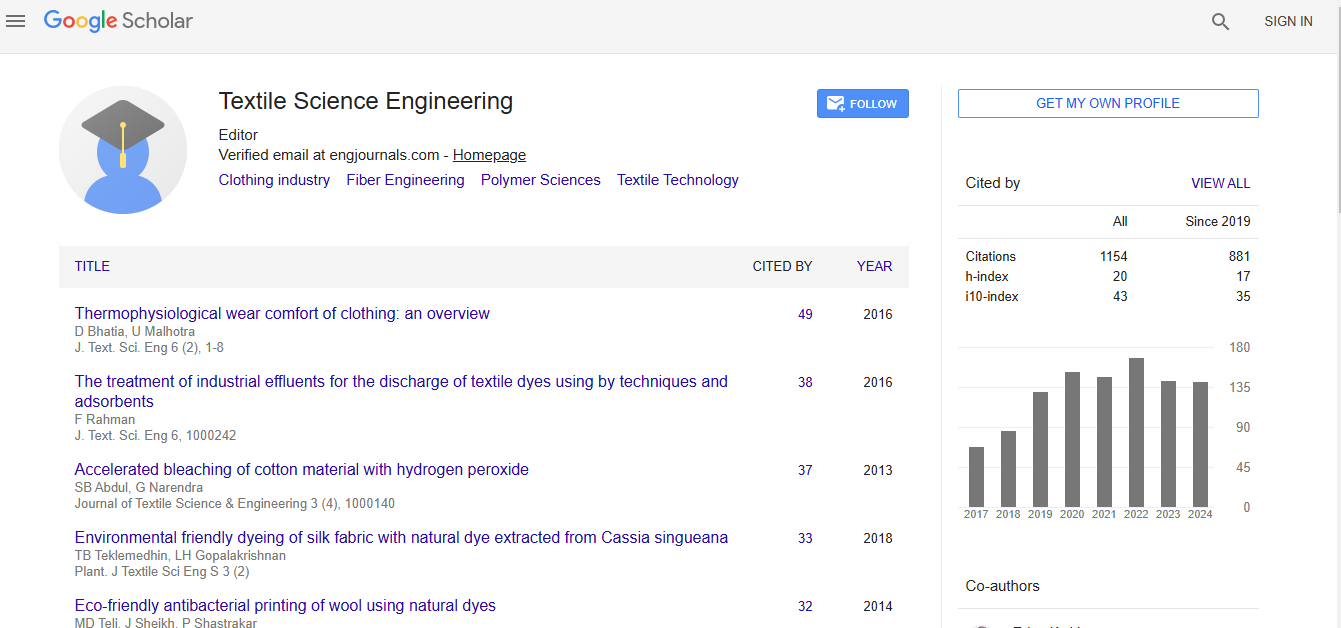
Journal of Textile Science & Engineering received 1008 citations as per Google Scholar report