Commentary - (2025) Volume 17, Issue 4
Received: 01-Aug-2025, Manuscript No. jbabm-26-182344;
Editor assigned: 03-Aug-2025, Pre QC No. P-182344;
Reviewed: 17-Aug-2025, QC No. Q-182344;
Revised: 24-Aug-2025, Manuscript No. R-182344;
Published:
31-Aug-2025
, DOI: 10.37421/1948-593X.2025.17.502
Citation: Takeda, Hiroshi. ”Bioanalytical Method Validation: Core Parameters and Platforms.” J Bioanal Biomed 17 (2025):502.
Copyright: © 2025 Takeda H. This is an open-access article distributed under the terms of the Creative Commons Attribution License, which permits unrestricted use, distribution and reproduction in any medium, provided the original author and source are credited.
Establishing robust and reliable bioanalytical methods is a cornerstone of successful drug development and comprehensive clinical research. These methods are indispensable for generating accurate and reproducible data that underpins critical decisions throughout the research and development lifecycle. This article will explore the fundamental strategies and current practices in bioanalytical method validation, emphasizing key performance characteristics such as accuracy, precision, specificity, and stability, as outlined in seminal works by Zhang et al. [1].
The rigorous validation of analytical techniques ensures the scientific integrity and regulatory acceptability of data generated. For instance, the validation of liquid chromatography-tandem mass spectrometry (LC-MS/MS) methods for small molecule quantification in biological matrices is a complex but essential process, requiring meticulous attention to selectivity, linearity, range, accuracy, and precision, as detailed by Khan et al. [2].
Beyond chromatographic techniques, ligand-binding assays (LBAs) present a distinct set of validation challenges, particularly when quantifying large molecules like proteins and antibodies. Key considerations include appropriate reference standard selection, thorough antibody characterization, and stringent assessment of assay sensitivity and specificity, as discussed by Dubois et al. [3].
Ensuring the stability of analytes within biological samples is paramount to maintaining data integrity throughout the analytical workflow. Comprehensive stability testing, encompassing various conditions such as freeze-thaw cycles, bench-top storage, and long-term storage, is critical for demonstrating analyte resilience, as highlighted by Chen et al. [4].
With the increasing use of molecular biology techniques in drug development, the validation of quantitative PCR (qPCR) assays has become equally important. This involves careful attention to primer and probe design, determination of amplification efficiency, and assessment of specificity and reproducibility for reliable biomarker quantification, as described by Brown et al. [5].
The growing trend towards multiplex assays, enabling the simultaneous measurement of multiple analytes, introduces unique validation hurdles. These include the assessment of cross-reactivity, inter-analyte matrix effects, and the overall complexity of data interpretation to ensure the reliability of these sophisticated platforms, according to Kim et al. [6].
Analyzing samples collected as dried blood spots (DBS) introduces specific bioanalytical challenges. Method validation for DBS requires adaptation of standard protocols to address issues of sample homogeneity, extraction efficiency, and unique matrix effects inherent to this dried matrix format, as detailed by Miller et al. [7].
The critical role of biomarkers in the advancement of personalized medicine mandates the availability of highly validated bioanalytical methods for their precise measurement. The validation of assays for diverse biomarker classes, from small molecules to nucleic acids, must align with an evolving regulatory landscape and employ fit-for-purpose strategies tailored to specific research objectives, as reviewed by Johnson et al. [8].
For biotherapeutic proteins, the assessment of immunogenicity through validated assays is crucial. This involves understanding specific validation parameters for immunogenicity assays, including bridging strategies and the detection of neutralizing antibodies, emphasizing the importance of understanding assay mechanisms for appropriate validation, as discussed by Petrova et al. [9].
Finally, the integration of automation and high-throughput screening in bioanalytical laboratories necessitates the validation of automated processes. This involves addressing challenges related to system suitability, carryover, and complex data management to ensure the reliability of these sophisticated workflows, as examined by Lee et al. [10].
The fundamental requirement for any successful drug development program or clinical research endeavor lies in the establishment of bioanalytical methods that are both reliable and reproducible. Zhang et al. [1] underscore that accuracy, precision, specificity, and stability are not merely desirable attributes but essential pillars upon which the validity of bioanalytical data rests. Adherence to regulatory guidelines is paramount, and their effective implementation across diverse research settings ensures the integrity of pharmacokinetic, pharmacodynamic, and biomarker studies. When dealing with small molecules in complex biological matrices, LC-MS/MS offers a powerful quantitative tool. The validation of these methods, as described by Khan et al. [2], involves a meticulous process of establishing selectivity to differentiate the analyte from endogenous components, ensuring linearity across a defined concentration range, and assessing accuracy and precision through the analysis of quality control samples at various levels. Mitigating matrix effects, which can significantly impact ionization efficiency, is a critical step towards achieving robust results. Ligand-binding assays (LBAs) are indispensable for the quantification of large biomolecules, such as proteins and antibodies, but their validation presents unique challenges compared to chromatographic methods. Dubois et al. [3] emphasize the importance of selecting appropriate reference standards, thoroughly characterizing critical reagents like antibodies, and rigorously assessing assay sensitivity and specificity. The goal is to ensure that these assays provide reliable quantification within the context of biopharmaceutical development. The integrity of bioanalytical data is intrinsically linked to the stability of the analytes within the collected samples. Chen et al. [4] provide a comprehensive overview of various stability testing paradigms, including freeze-thaw stability, bench-top stability, and long-term storage stability. Demonstrating analyte stability under relevant storage and handling conditions is a non-negotiable aspect of method validation, safeguarding against analyte degradation and ensuring that the measurements reflect the true analyte concentrations. Quantitative PCR (qPCR) has emerged as a vital technique for measuring nucleic acid levels, particularly in biomarker research. Brown et al. [5] detail the validation requirements for qPCR assays, which include careful primer and probe design to ensure specificity, accurate determination of amplification efficiency for reliable quantification, and assessment of reproducibility. The use of appropriate controls and robust data analysis strategies are highlighted as crucial for obtaining dependable results. Multiplex assays, which enable the simultaneous measurement of multiple analytes from a single sample, offer significant advantages in terms of efficiency and sample conservation. However, their validation is complex, as noted by Kim et al. [6].
Key considerations include evaluating cross-reactivity between different analytes, assessing inter-analyte matrix effects, and managing the inherent complexity of data interpretation to ensure the overall reliability of these advanced platforms. Dried blood spots (DBS) are increasingly utilized as a minimally invasive sample collection method, but they introduce specific challenges for bioanalytical validation. Miller et al. [7] discuss the need to adapt standard validation protocols to account for DBS-specific issues such as potential variations in sample homogeneity, differences in extraction efficiency compared to liquid samples, and unique matrix effects that can arise from the dried matrix. Biomarkers are central to the paradigm of personalized medicine, driving the need for highly validated bioanalytical methods for their accurate and precise measurement. Johnson et al. [8] review the validation strategies for various biomarker classes, emphasizing the dynamic regulatory landscape and the necessity of adopting "fit-for-purpose" validation approaches that are specifically tailored to the intended research objectives and applications. Immunogenicity assays are critical for evaluating the immune response to therapeutic proteins, which can impact drug efficacy and safety. Petrova et al. [9] delve into the specific validation parameters relevant to these assays, including the use of bridging strategies to confirm assay performance across different runs and the capability to detect neutralizing antibodies. A thorough understanding of the underlying assay mechanisms is essential for ensuring appropriate validation. The drive towards greater efficiency and reduced turnaround times in bioanalytical laboratories has led to the widespread adoption of automation and high-throughput screening. Lee et al. [10] examine the validation approaches required for these automated bioanalytical processes. This includes addressing challenges such as system suitability criteria, potential carryover between samples, and the robust management of large datasets generated by automated workflows.
This collection of articles addresses the critical aspects of bioanalytical method validation across various platforms and sample types. It emphasizes the importance of accuracy, precision, specificity, and stability as core validation parameters, highlighting adherence to regulatory guidelines. Specific validation challenges and strategies are discussed for LC-MS/MS, ligand-binding assays, qPCR, multiplex immunoassays, and dried blood spots. The articles also cover analyte stability testing, biomarker assay validation for personalized medicine, immunogenicity assay validation, and the validation of automated bioanalytical processes for high-throughput analysis. The overarching theme is the necessity of rigorous validation to ensure the integrity and reliability of bioanalytical data in drug development and biomedical research.
None
None
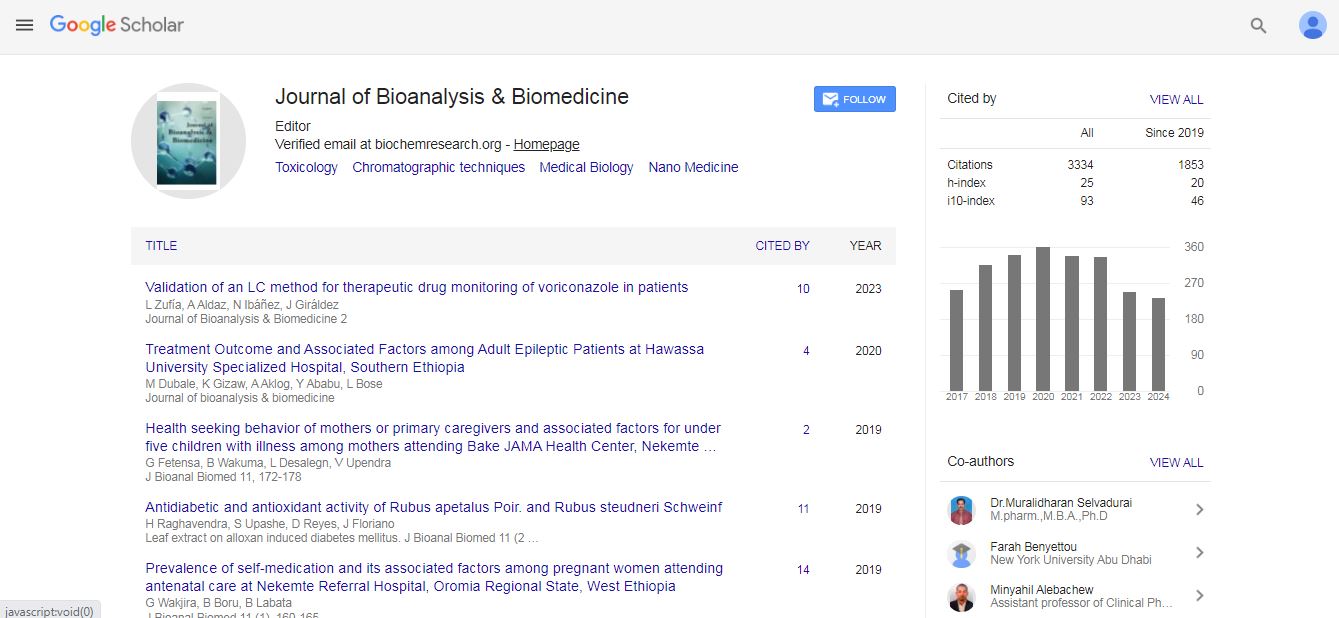
Journal of Bioanalysis & Biomedicine received 3099 citations as per Google Scholar report