Commentary - (2025) Volume 16, Issue 2
Received: 01-Mar-2025, Manuscript No. jhmi-26-178815;
Editor assigned: 03-Mar-2025, Pre QC No. P-178815;
Reviewed: 17-Mar-2025, QC No. Q-178815;
Revised: 24-Mar-2025, Manuscript No. R-178815;
Published:
31-Mar-2025
, DOI: 10.37421/2157-7420.2025.16.579
Citation: Zhang, Wei. ”Big Data Analytics: Revolutionizing Proactive Healthcare Strategies.” J Health Med Informat 16 (2025):579.
Copyright: © 2025 Zhang W. This is an open-access article distributed under the terms of the Creative Commons Attribution License, which permits unrestricted use, distribution and reproduction in any medium, provided the original author and source are credited.
The landscape of healthcare is undergoing a profound transformation, driven by the burgeoning field of big data analytics. This evolution marks a significant departure from traditional reactive approaches to patient care, ushering in an era of proactive and predictive strategies designed to enhance health outcomes and optimize resource utilization. The ability to process and interpret massive, diverse datasets is central to this paradigm shift, enabling deeper insights into disease patterns, patient responses, and operational efficiencies within healthcare systems. Big data analytics in healthcare is revolutionizing how we approach patient care, shifting the focus from reactive treatment to proactive and predictive strategies. This transformation is driven by the ability to process vast datasets from electronic health records, wearable devices, and genomic information. These insights are crucial for identifying at-risk populations, predicting disease outbreaks, and personalizing treatment plans, ultimately leading to more effective and efficient healthcare delivery [1].
The integration of sophisticated analytical techniques, particularly machine learning algorithms, with large-scale health data is proving instrumental in the early detection of chronic diseases. By meticulously analyzing intricate patterns embedded within patient histories, lifestyle factors, and genetic predispositions, these advanced systems are capable of flagging individuals who exhibit a higher likelihood of developing prevalent conditions such as diabetes or cardiovascular disease, thereby facilitating timely and crucial interventions and encouraging beneficial lifestyle modifications [2].
Furthermore, the application of predictive modeling, powered by the vast potential of big data, is playing a critical role in the optimization of essential hospital resource allocation and the streamlining of patient flow. A comprehensive understanding of intricate patient admission patterns, the typical length of stay, and the potential for complications allows healthcare facilities to more effectively manage critical resources such as staffing levels, bed availability, and vital equipment, ultimately leading to a significant reduction in patient wait times and an overall improvement in operational efficiency [3].
Genomic big data, when subjected to rigorous and effective analysis, offers unparalleled and profound insights into an individual's susceptibility to specific diseases and their unique response to various therapeutic interventions. This capability underpins the advancement of personalized medicine, a revolutionary approach where treatment strategies are meticulously tailored to align with an individual's distinct genetic makeup, thereby leading to demonstrably more effective patient outcomes and a notable reduction in the occurrence of adverse reactions [4].
In the realm of public health, surveillance systems are experiencing substantial enhancements through the strategic implementation of big data analytics. The real-time monitoring of diverse data streams, including social media activity, search engine queries, and news reports, provides an agile mechanism for the early detection and tracking of disease outbreaks, often surpassing the capabilities of traditional methods, thereby enabling a more rapid and precisely targeted public health response [5].
Wearable technology has emerged as a significant contributor to the generation of continuous streams of physiological data. When this data is meticulously analyzed in aggregate, it offers invaluable insights into both individual and broader population health trends. Such analysis holds the potential to predict potential health issues before they manifest symptomatically, thereby empowering the development and implementation of highly personalized preventive care strategies [6].
The application of big data analytics is also proving to be a powerful tool in the ongoing efforts to improve patient engagement and enhance adherence to prescribed treatment plans. By systematically identifying the various factors that can influence patient behavior, it becomes possible to customize interventions in a manner that provides more effective support to individuals in their proactive management of specific health conditions [7].
In the critical field of drug discovery and development, big data analytics assumes a pivotal role by facilitating the analysis of extensive biological and clinical datasets. This analytical power accelerates the identification of promising drug targets, enhances the prediction of drug efficacy, and assists in the design of more efficient and robust clinical trials, collectively contributing to a faster delivery of novel and life-saving therapies to patients [8].
Despite the immense promise and transformative potential of big data analytics in healthcare, paramount importance must be placed on addressing the associated ethical considerations and ensuring stringent data privacy. The implementation of robust security measures and the establishment of transparent data governance frameworks are absolutely essential to maintain patient trust and ensure full compliance with all relevant regulations, thereby fostering an environment of responsible innovation [9].
The transformative impact of big data analytics on healthcare is multifaceted, fundamentally reshaping patient care through the adoption of proactive and predictive methodologies. This strategic shift away from purely reactive treatment models is underpinned by the unprecedented ability to process and derive meaningful insights from massive and complex datasets encompassing electronic health records, data from wearable devices, and detailed genomic information. These derived insights are indispensable for identifying vulnerable patient populations, forecasting potential disease outbreaks with greater accuracy, and crafting highly personalized treatment plans, all of which contribute to a more effective and efficient healthcare delivery system [1].
Machine learning algorithms are proving to be exceptionally valuable when integrated with large-scale health data, enabling the early detection of chronic diseases. These systems meticulously analyze patterns within patient histories, lifestyle choices, and genetic predispositions to identify individuals at higher risk for conditions like diabetes or cardiovascular disease, thereby facilitating timely interventions and promoting essential lifestyle modifications [2].
Predictive modeling, leveraging the power of big data, is instrumental in enhancing the efficiency of hospital resource allocation and optimizing patient flow. By thoroughly analyzing patient admission trends, expected lengths of stay, and potential complications, healthcare facilities can more effectively manage staffing needs, bed availability, and equipment deployment, leading to reduced wait times and improved overall operational efficiency [3].
Genomic big data, through sophisticated analytical approaches, provides deep insights into individual disease susceptibility and response to therapies. This enables the realization of personalized medicine, where treatments are customized based on an individual's genetic profile, leading to improved efficacy and a reduction in adverse drug reactions [4].
Public health surveillance systems are significantly enhanced by big data analytics. Real-time monitoring of various data sources, including social media, search trends, and news reports, allows for earlier detection and tracking of disease outbreaks compared to traditional methods, enabling a faster and more targeted public health response [5].
Wearable technology continuously generates vast amounts of physiological data. When aggregated and analyzed, this data offers crucial insights into individual and population health trends, enabling the prediction of health issues before symptoms appear and supporting the development of personalized preventive care strategies [6].
Big data analytics is also pivotal in improving patient engagement and adherence to treatment plans. By identifying key factors influencing patient behavior, tailored interventions can be developed to better support individuals in managing their health conditions [7].
The application of big data analytics is accelerating drug discovery and development. By analyzing extensive biological and clinical datasets, the process of identifying potential drug targets, predicting drug efficacy, and designing clinical trials is expedited, ultimately leading to faster delivery of new therapies [8].
Ethical considerations and data privacy are of utmost importance when employing big data analytics in healthcare. Robust security measures and transparent data governance are essential to maintain patient trust and comply with regulations, ensuring responsible innovation in the field [9].
The ongoing development of interoperable health information systems is fundamental for the effective utilization of big data analytics in healthcare. Standardized data formats and seamless data exchange between different systems are crucial for creating comprehensive patient records and enabling robust analytical capabilities, which are vital for advancing healthcare insights and practices [10].
Big data analytics is revolutionizing healthcare by enabling a shift from reactive to proactive and predictive strategies. It allows for the processing of vast datasets from electronic health records, wearables, and genomics to identify at-risk populations, predict outbreaks, and personalize treatments. Machine learning aids in early chronic disease detection, while predictive modeling optimizes hospital resources and patient flow. Genomic data fuels personalized medicine, and public health surveillance benefits from real-time data monitoring for outbreak detection. Wearable technology provides continuous health insights for preventive care, and analytics improve patient engagement and treatment adherence. The field also accelerates drug discovery and development. However, ethical considerations and data privacy are paramount, necessitating robust security and transparent governance. Interoperable health information systems are crucial for effective data analysis and comprehensive patient records.
None
None
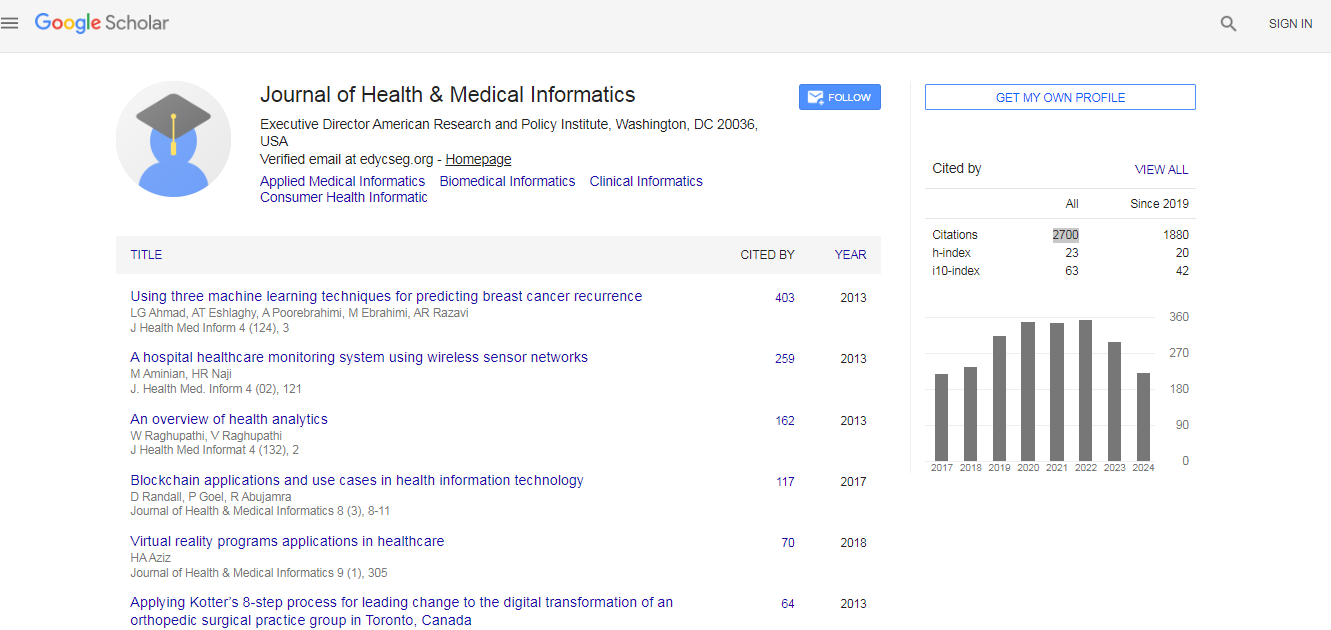
Journal of Health & Medical Informatics received 2700 citations as per Google Scholar report