Opinion - (2025) Volume 16, Issue 3
Received: 29-May-2025, Manuscript No. gjto-25-175447;
Editor assigned: 02-Jun-2025, Pre QC No. P-175447;
Reviewed: 16-Jun-2025, QC No. QC-175447;
Revised: 23-Jun-2025, Manuscript No. R-175447;
Published:
30-Jun-2025
, DOI: 10.37421/2229-8711.2025.16.451
Citation: Holm, Eirik. ”Big Data Analytics: Impact and Challenges.” Global J Technol Optim 16 (2025):451.
Copyright: © 2025 Holm E. This is an open-access article distributed under the terms of the Creative Commons Attribution License, which permits unrestricted use, distribution
and reproduction in any medium, provided the original author and source are credited.
Big Data Analytics (BDA) has emerged as a pivotal technology, reshaping how organizations approach decision-making and innovation across an impressive array of domains. The sheer volume, velocity, and variety of data generated today necessitate advanced analytical capabilities to extract meaningful insights. This collection of reviews and research papers collectively highlights the pervasive impact and the evolving landscape of BDA applications, techniques, and the significant challenges that accompany its widespread adoption. In the healthcare sector, BDA systematically transforms patient care, operational efficiency, and medical research. Key application areas include predictive analytics for disease outbreaks, personalized medicine, and improved clinical decision-making. Significant challenges like data privacy, integration complexities, data quality, and the need for specialized skills are noted as hurdles to overcome, pushing towards more effective and ethical BDA implementation in this critical field [1].
Supply Chain Management (SCM) experiences a comprehensive enhancement through BDA, impacting demand forecasting, inventory optimization, logistics, and risk management. Existing literature synthesizes various analytical techniques and their applications, while also pinpointing research gaps. Future research emphasizes empirical studies and the impact of BDA on supply chain resilience and sustainability [2]. Financial markets see BDA technologies reshaping traditional practices, with applications in fraud detection, algorithmic trading, risk management, and personalized financial advisory services. Research categorizes the transformative potential of BDA to process vast, complex financial datasets for deeper insights. Challenges such as data security, regulatory compliance, and interpretability of complex models demand continued research [3]. The role of BDA in education is investigated, focusing on frameworks, applications, and challenges. BDA can personalize learning, improve educational outcomes through predictive analytics, and optimize administrative processes. Various frameworks are used to process educational data, with applications from student performance prediction to curriculum design. Critical challenges include data privacy, ethical concerns, data interoperability, and the need for educator training [4].
An in-depth look at BDA techniques and applications within the Internet of Things (IoT) ecosystem categorizes and explains methods like machine learning, deep learning, and statistical approaches crucial for extracting insights from IoT data. Application areas span smart homes, industrial IoT, smart cities, and healthcare, with discussions on architectural components and challenges concerning data volume, velocity, veracity, and security [5]. More broadly, research outlines significant challenges, opportunities, and future directions for BDA. Hurdles include data security, privacy, quality, integration, and computational intensity. However, BDA presents vast opportunities across industries for better decision-making, predictive capabilities, and innovation. A path for future research emphasizes robust ethical frameworks, advancements in analytical techniques for unstructured data, and scalable infrastructure [6]. Focusing specifically on smart cities, BDA improves urban living through applications in smart transportation, energy management, public safety, and environmental monitoring. BDA enables real-time decision-making and resource optimization by leveraging diverse data sources and analytical approaches. Challenges involve data heterogeneity, privacy, infrastructure, and effective data governance [7].
The ethical implications of BDA are critically examined, addressing data privacy breaches, algorithmic bias, transparency, accountability, and potential discrimination. Current research synthesizes these challenges across sectors, highlighting societal impact. There's an urgent need for robust ethical guidelines, regulatory frameworks, and responsible data governance to align BDA with human values [8]. In marketing, BDA maps the landscape, helping marketers gain deeper customer insights, optimize campaigns, personalize experiences, and predict market trends. Various BDA techniques find application in customer segmentation, sentiment analysis, and churn prediction. Challenges include data integration, privacy concerns, talent shortages, and translating insights into strategies [9]. Finally, the crucial integration of BDA with Cloud Computing is surveyed, highlighting how cloud platforms provide scalable infrastructure and on-demand resources for massive datasets. Advantages like cost-effectiveness and flexibility are discussed, alongside challenges such as data transfer bottlenecks, cloud security, privacy, and vendor lock-in. Optimizing this synergy is key for future research [10].
Big Data Analytics (BDA) offers a transformative approach to processing and interpreting vast datasets across numerous industries. For instance, in healthcare, BDA is instrumental in predictive analytics for disease outbreaks and fostering personalized medicine, leading to improved clinical decision-making [1]. This analytical power extends to supply chain management, where BDA enhances demand forecasting, optimizes inventory, refines logistics, and strengthens risk management capabilities [2]. In financial markets, BDA plays a critical role in detecting fraud, enabling advanced algorithmic trading strategies, and providing personalized financial advisory services [3]. The ability to process complex financial datasets offers deeper insights into market dynamics.
The Internet of Things (IoT) ecosystem heavily relies on BDA, utilizing techniques like machine learning, deep learning, and statistical methods to extract crucial insights from device-generated data. This underpins applications in smart homes, industrial IoT, and even broader smart city initiatives [5]. Within smart cities, BDA facilitates improvements in urban living through intelligent transportation systems, optimized energy management, enhanced public safety, and effective environmental monitoring, supporting real-time decision-making [7]. Education also benefits significantly, as BDA personalizes learning experiences, improves outcomes via predictive analytics, and streamlines administrative processes. It supports applications from student performance prediction to curriculum design [4]. Marketing leverages BDA to gain profound customer insights, optimize campaigns, personalize customer experiences, and predict market trends, employing techniques such as customer segmentation and sentiment analysis [9].
Despite its immense potential, the implementation of BDA faces substantial and recurring challenges across all sectors. Data privacy and security are paramount concerns, frequently cited as significant hurdles [1, 3, 4, 5, 6, 7, 8, 9, 10]. Data quality issues, integration complexities, and the sheer computational intensity needed to process massive datasets also pose considerable obstacles [1, 5, 6]. The integration of BDA with Cloud Computing, while providing scalable infrastructure and on-demand resources, introduces its own set of challenges, including data transfer bottlenecks, cloud-specific security risks, and the issue of vendor lock-in [10]. Addressing these technical and infrastructural challenges is crucial for effective BDA deployment.
Beyond technical difficulties, ethical implications form a critical area of concern for BDA. These include the potential for data privacy breaches, algorithmic bias leading to unfair outcomes, and questions of transparency and accountability in automated decision-making. Such issues can lead to discrimination and highlight the societal impact of BDA [4, 8]. There is an urgent need for robust ethical guidelines, comprehensive regulatory frameworks, and responsible data governance practices to ensure BDA technologies align with human values and societal well-being [6, 8]. Furthermore, a shortage of specialized analytical talent and difficulties in translating complex insights into actionable strategies remain significant challenges for organizations [4, 9].
Looking forward, future research directions for BDA emphasize the continuous need to overcome these identified hurdles. This includes developing more advanced analytical techniques, particularly for unstructured data, and establishing scalable infrastructure [6]. There is a strong call for empirical studies to validate theoretical models and explore the impact of BDA on broader concepts like supply chain resilience and sustainability [2]. The ongoing evolution of BDA will undoubtedly require sustained focus on ethical considerations, data interoperability, and continuous training for professionals to fully harness its transformative capabilities [4, 6, 8].
Big Data Analytics (BDA) is revolutionizing numerous sectors by transforming raw data into actionable insights. In healthcare, BDA promises to enhance patient care, improve operational efficiency, and advance medical research through predictive analytics for disease outbreaks and personalized medicine [1]. Similarly, supply chain management benefits from BDA for demand forecasting, inventory optimization, logistics, and risk management [2]. Financial markets leverage BDA for fraud detection, algorithmic trading, and risk management, processing complex datasets for deeper insights [3]. Education sees BDA as a tool to personalize learning, predict student performance, and optimize administrative tasks [4]. The Internet of Things (IoT) ecosystem relies heavily on BDA techniques, including machine learning and deep learning, to extract insights from vast device-generated data, supporting smart homes, industrial applications, and smart cities [5]. Smart cities themselves utilize BDA for transportation, energy management, public safety, and environmental monitoring, enabling real-time decision-making [7]. BDA also plays a crucial role in marketing, providing deeper customer insights, campaign optimization, and trend prediction through techniques like customer segmentation and sentiment analysis [9]. Despite the immense opportunities, significant challenges consistently emerge across these applications. These include fundamental issues like data privacy and security, data quality and integration complexities, and the computational intensity required for processing massive datasets [1, 3, 4, 5, 6, 7, 8, 9, 10]. Ethical implications, such as algorithmic bias and the need for transparency and accountability, are also critical concerns, necessitating robust ethical guidelines and regulatory frameworks [4, 8]. Furthermore, the effective deployment of BDA often requires specialized skills and addresses data interoperability and transfer bottlenecks [4, 5, 6, 10]. Integrating BDA with Cloud Computing offers scalable infrastructure to tackle some of these challenges while introducing new ones like cloud security and vendor lock-in [10]. Future research directions consistently emphasize overcoming these hurdles, developing advanced analytical techniques, and establishing sound governance practices to fully realize BDA’s transformative potential across all domains.
<p>None</p>
None
Mohammed AAA, Abdullah SA, Sultan HA. "Big data analytics in healthcare: A systematic review and future research directions".J Biomed Inform 102 (2020):103348.
Indexed at, Google Scholar, Crossref
Md. M, Md. II, Muhammad FA. "Big data analytics in supply chain management: A review and research agenda".J Bus Res 125 (2021):365-377.
Indexed at, Google Scholar, Crossref
Abdellah A, Youssef EA, Abdelaziz H. "Big data analytics in financial markets: A systematic literature review".J Big Data 9 (2022):121.
Indexed at, Google Scholar, Crossref
Muhammad B, Ahmad A, Muhammad S. "Big data analytics in education: A systematic review of frameworks, applications, and challenges".Educ Inf Technol 27 (2022):2269-2303.
Indexed at, Google Scholar, Crossref
Muhammad A, Muhammad F, Waqas N. "Big Data Analytics techniques and applications for the IoT: A review".J Netw Comput Appl 175 (2021):102919.
Indexed at, Google Scholar, Crossref
Mohammed SA, Sultan QA, Abdullah MA. "Big data analytics: Challenges, opportunities, and future directions".J King Saud Univ Comput Inf Sci 35 (2023):101487.
Indexed at, Google Scholar, Crossref
Syed FH, Muhammad B, M. NK. "Big Data Analytics for Smart Cities: A Systematic Review".IEEE Access 8 (2020):147817-147831.
Indexed at, Google Scholar, Crossref
Anupam S, V. PS, G. SLNR. "Ethical implications of big data analytics: A systematic review".Int J Inf Manage 56 (2021):102263.
Indexed at, Google Scholar, Crossref
Muhammad M, Usman Y, Muhammad A. "Big data analytics in marketing: A systematic literature review and future research agenda".J Bus Res 154 (2023):113350.
Indexed at, Google Scholar, Crossref
Ali D, Fida H, Muhammad R. "Integrating Big Data Analytics with Cloud Computing: A Survey".IEEE Access 8 (2020):22442-22462.
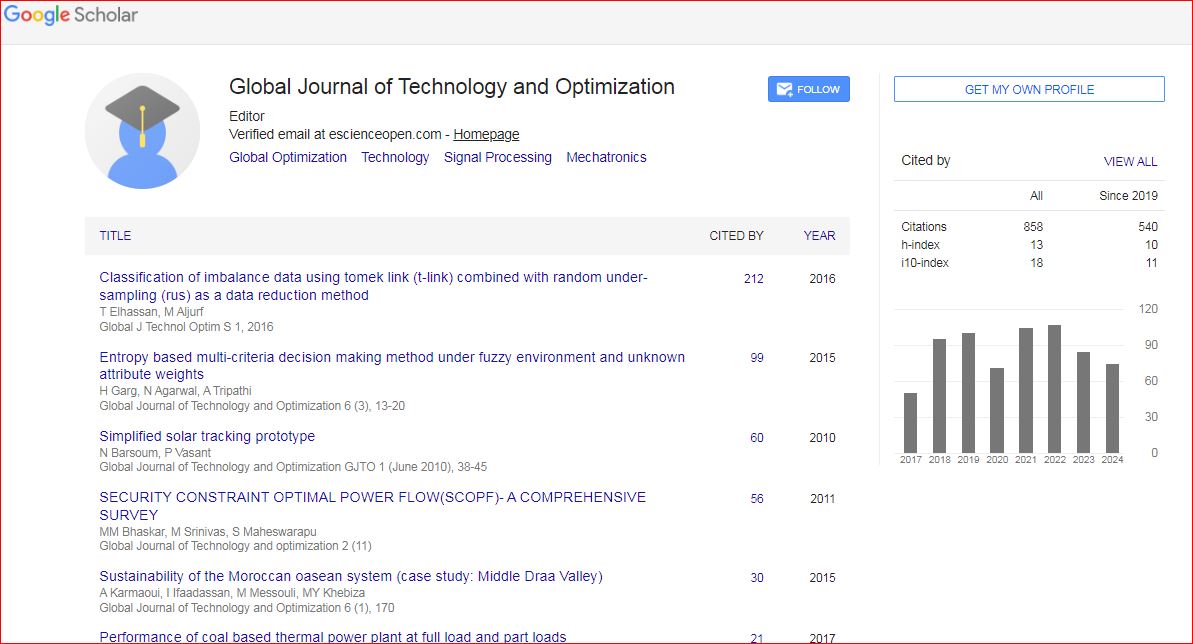
Global Journal of Technology and Optimization received 847 citations as per Google Scholar report