Opinion - (2025) Volume 9, Issue 4
Received: 01-Aug-2025, Manuscript No. ahbs-26-182496;
Editor assigned: 04-Aug-2025, Pre QC No. P-182496;
Reviewed: 18-Aug-2025, QC No. Q-182496;
Revised: 22-Aug-2025, Manuscript No. R-182496;
Published:
29-Aug-2025
, DOI: 10.37421/2952-8097.2025.9.328
Citation: Castillo, Ramon. ”Behavioral Indicators: Animal Pain
Assessment and Management.” J Anim Health Behav Sci 09 (2025):328.
Copyright: © 2025 Castillo R. This is an open-access article distributed under the terms of the Creative Commons Attribution License, which permits unrestricted use,
distribution and reproduction in any medium, provided the original author and source are credited.
The intricate field of animal welfare science consistently seeks to refine our understanding and management of pain in diverse species. Behavioral observation remains a cornerstone in this endeavor, offering direct insights into an animal's subjective experience. This review synthesizes current research, highlighting the critical role of observing nuanced behavioral shifts as indicators of pain across various animal populations, from domestic pets to livestock. Recent investigations have underscored the significance of identifying subtle behavioral changes in animals experiencing pain. Altered posture, locomotion, vocalizations, and a general reduction in activity are now recognized as crucial indicators that necessitate timely intervention. The development and validation of standardized observational pain scales are emphasized as essential tools for accurate pain assessment in different species, ensuring appropriate care [1].
Furthermore, the impact of chronic pain on an animal's behavior warrants particular attention. Persistent discomfort can profoundly influence social interactions, appetite, and exploratory behaviors, often leading to states resembling depression and cognitive deficits that can be masked by adaptive changes. Longitudinal behavioral monitoring is advocated as a vital strategy to detect chronic pain, which is frequently overlooked in routine clinical assessments [2].
In the realm of veterinary surgery, effective pain management is paramount. Studies evaluating multimodal analgesia in post-operative settings have demonstrated its efficacy in significantly reducing distress behaviors such as hiding and aggression. Behavioral observation plays a critical role in guiding analgesic adjustments to optimize patient welfare and recovery [3].
The influence of the environment on pain perception and the effectiveness of analgesia is another area of growing interest. Research suggests that environmental enrichment can modulate pain sensitivity and potentially decrease the reliance on pharmacological interventions by promoting natural coping mechanisms. This highlights the importance of considering the broader welfare context in pain management strategies [4].
Objective measurement of pain-related behaviors is also being advanced through technological innovation. Novel approaches, such as machine learning algorithms analyzing video data, are being developed to accurately quantify subtle changes in gait, posture, and facial expressions indicative of pain. These objective measures complement subjective assessments and hold significant implications for early detection and precise pain management [5].
Non-pharmacological interventions are gaining traction as valuable components of pain management strategies. Physical therapies, including hydrotherapy and therapeutic exercise, have shown promise in alleviating chronic pain in canine patients. Improvements in mobility, playfulness, and overall activity levels serve as key indicators of successful pain relief through these methods [6].
Understanding the human element in animal pain assessment is also crucial. Owner perception can significantly influence the recognition of pain and the effectiveness of analgesia, particularly in less commonly studied species. Education for owners and veterinary professionals on subtle pain behaviors is essential to ensure timely and appropriate treatment [7].
Social behavior provides another valuable lens through which to assess pain and analgesic responses, especially in group-housed animals. Changes in social dominance, interaction patterns, and social isolation preferences can serve as sensitive markers of pain. Analyzing social dynamics offers critical insights into animal welfare and the effectiveness of pain relief strategies [8].
Finally, the impact of analgesia on behavior during veterinary procedures is well-documented. Appropriate pain management can substantially reduce fear, anxiety, and aggressive behaviors, contributing to a safer and less stressful experience for both animals and veterinary teams. Behavioral observation is vital for evaluating the success of analgesia in these contexts [9].
In summary, this body of work collectively emphasizes that behavioral indicators are indispensable for assessing and managing pain in animals. From subtle shifts in posture to complex social dynamics, these observable changes provide critical information. Technological advancements and a comprehensive understanding of environmental and owner influences are further refining our ability to ensure optimal pain relief and welfare across a wide spectrum of animal species, including specialized cases like broiler chickens where continuous monitoring is being explored [10].
The behavioral responses of animals to pain are multifaceted and provide crucial insights for effective management. Subtle changes in posture, locomotion, vocalization, and activity levels serve as critical indicators that necessitate prompt intervention. The development and application of validated observational pain scales are emphasized as essential for accurate pain assessment across diverse species, ranging from livestock to companion animals [1].
Chronic pain presents a significant challenge, profoundly influencing an animal's behavior by affecting social interactions, appetite, and exploratory activities. Persistent discomfort can lead to depressive-like states and cognitive deficits, which may be masked by adaptive behavioral modifications. Longitudinal behavioral monitoring is therefore advocated for the detection of chronic pain, often missed in standard clinical evaluations [2].
In the context of post-operative care, multimodal analgesia has demonstrated significant efficacy in reducing distress behaviors such as hiding and aggression in cats. A combination of pharmacological agents proved more effective than monotherapy. The study highlights the indispensable role of behavioral observation in guiding analgesic adjustments to ensure optimal patient welfare [3].
The environment in which an animal resides can significantly modulate its pain perception and response to analgesia. Findings suggest that enriched environments can influence pain sensitivity and potentially reduce the need for pharmacological interventions by promoting natural coping behaviors. This underscores the importance of considering environmental modifications as an adjunct to medical treatment [4].
Advancements in technology are enabling more objective assessments of pain-related behaviors. Machine learning algorithms analyzing video data have been developed to quantify subtle changes in gait, posture, and facial expressions in horses, offering an objective measure to complement subjective assessments. This has significant implications for early pain detection and precise pain management in equine practice [5].
Non-pharmacological interventions, such as hydrotherapy and therapeutic exercise, are proving valuable in managing chronic pain in canine patients. Improvements in mobility, playfulness, and overall activity levels are linked to successful pain relief, demonstrating the efficacy of these approaches. Behavioral improvements are highlighted as primary outcome measures for physical rehabilitation [6].
The influence of owner perception on pain assessment and analgesic response is a critical factor, particularly in less commonly studied companion animals like rabbits. Owners may underestimate their pets' pain, leading to delayed treatment. The study emphasizes the need for enhanced veterinarian education on subtle pain behaviors and owner coaching to improve pain management outcomes [7].
Social behavior offers a sensitive indicator of pain and analgesic response in group-housed animals, such as pigs. Changes in social dominance, interaction patterns, and preference for social isolation are identified as key markers. The assessment of social dynamics provides valuable insights into the welfare of these animals and the effectiveness of pain relief strategies [8].
The impact of analgesia on animal behavior during veterinary procedures, such as dental extractions in dogs, is substantial. Appropriate pain management significantly reduces fear, anxiety, and aggressive behaviors, creating a calmer and safer experience. Behavioral observation is crucial for evaluating the success of analgesia in procedural contexts [9].
Continuous monitoring of behavioral indicators of pain is being explored through wearable sensor technology, particularly in production animals like broiler chickens. These systems detect subtle changes in activity patterns, feeding behavior, and vocalizations, providing objective data on pain levels. This has implications for improving welfare standards and refining analgesic strategies in poultry production [10].
This collection of research highlights the critical role of behavioral indicators in assessing and managing pain across various animal species. Subtle changes in movement, vocalization, social interaction, and activity levels serve as key indicators of pain, necessitating prompt intervention. The development of standardized observational tools and the application of technology, such as machine learning and wearable sensors, are enhancing objective pain assessment. Environmental enrichment and non-pharmacological therapies are also recognized as valuable adjuncts to medical treatment. The influence of owner perception and the importance of continuous monitoring are underscored, emphasizing a comprehensive approach to animal pain management for improved welfare.
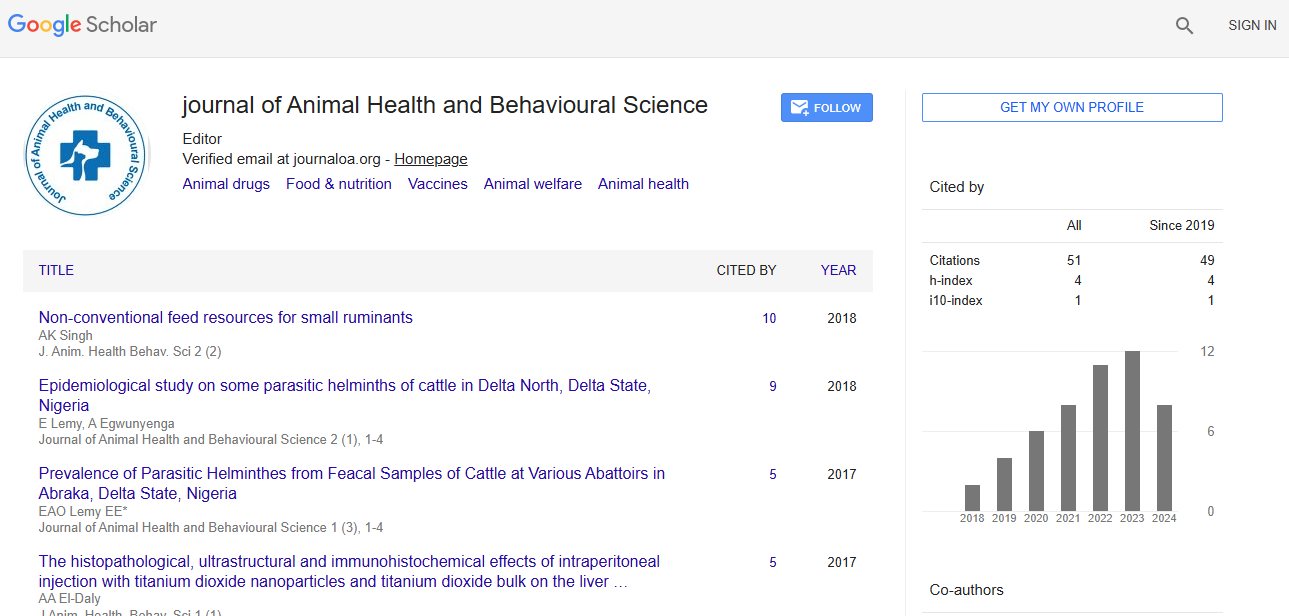
Journal of Animal Health and Behavioural Science received 38 citations as per Google Scholar report