Brief Report - (2025) Volume 14, Issue 3
Received: 01-Jun-2025, Manuscript No. jbfa-25-174140;
Editor assigned: 03-Jun-2025, Pre QC No. P-174140;
Reviewed: 17-Jun-2025, QC No. Q-174140;
Revised: 23-Jun-2025, Manuscript No. R-174140;
Published:
30-Jun-2025
, DOI: 10.37421/2167-0234.2025.14.529
Citation: Yusuf, Amara. ”Behavioral Biases: Shaping Investment Decisions and Outcomes.” J Bus Fin Aff 14 (2025):529.
Copyright: © 2025 Yusuf A. This is an open-access article distributed under the terms of the Creative Commons Attribution License, which permits unrestricted use, distribution and reproduction in any medium, provided the original author and source are credited.
Understanding the complexities of investment decision-making requires a deep dive into the psychological factors that often deviate from purely rational economic models. Behavioral finance, a field that integrates psychology with conventional economics, offers critical insights into why investors make certain choices. This body of research consistently demonstrates that various behavioral biases exert a significant influence on individual investment behavior, impacting both seasoned and novice participants across diverse financial markets. A systematic review highlights how a range of behavioral biases, including overconfidence, herding, and anchoring, fundamentally sway individual investment choices. Understanding these biases is paramount for making better financial decisions, underscoring the necessity for customized financial education to equip investors with the tools to navigate these psychological pitfalls [1].
Further studies delve into the specific role of behavioral biases, especially cognitive biases, in shaping investors' decisions concerning sustainable investments. This work emphasizes that psychological elements play a substantial part in the adoption and expansion of portfolios focused on Environmental, Social, and Governance (ESG) criteria, suggesting that sustainable finance is not immune to irrational human tendencies [2].
In emerging markets, the interplay between financial literacy and common behavioral biases is a vital area of investigation. Evidence suggests that a higher level of financial literacy can effectively mitigate the negative repercussions of certain biases, thereby leading to more rational and informed financial choices among investors in these dynamic regions. This finding offers a hopeful pathway for policy interventions [3].
The rapidly evolving and often volatile cryptocurrency markets present a unique environment to observe behavioral phenomena. Research has explicitly examined the presence of herding behavior within these markets, directly linking it to various behavioral biases. It illustrates that investors frequently mimic the actions of others, rather than relying on independent analysis, a tendency that can significantly amplify market movements and elevate risks in this nascent asset class [4].
Beyond individual biases, broader market psychology also plays a crucial role. One study meticulously analyzes how investor sentiment, a core concept in behavioral finance, affects stock market returns, particularly within emerging economies. The findings reveal that the collective mood of investors can substantially account for market anomalies and offers predictive insights into short-term market movements, demonstrating the power of collective psychology [5].
Delving deeper into specific biases, the pervasive nature of overconfidence bias and its profound effects on financial decision-making has been rigorously investigated. Through a moderated mediation analysis, this research demonstrates that individuals often inflate their assessment of their abilities and knowledge, which inevitably leads to suboptimal investment selections. The study also proposes potential factors that could help in mitigating this widespread bias, offering practical implications for investor education [6].
The influence of heuristic biases on investment performance is another critical area, with financial literacy once again highlighted for its mediating role. This research posits that while these cognitive shortcuts can indeed result in poor investment outcomes, a robust level of financial understanding can empower investors to overcome these biases. This leads to improved overall returns and more resilient financial strategies [7].
Another significant behavioral pattern, the disposition effect, has been specifically explored within cryptocurrency markets. This effect describes the common tendency to sell winning assets too early while holding onto losing assets for too long. The study provides concrete evidence of this biasâ??s prevalence among crypto investors, offering valuable insights into the market dynamics and the inherent irrationality that can characterize digital asset trading [8].
Behavioral biases also extend to explain individual differences in financial behavior. Research actively investigates how these biases contribute to observed gender disparities in financial risk tolerance. The findings suggest that while biological or broader social factors might play some part, specific cognitive biases disproportionately influence risk-taking behaviors, creating distinct patterns between men and women in various financial contexts [9].
Finally, anchoring biasâ??where individuals rely excessively on an initial piece of information when making subsequent judgmentsâ??is explored for its significant influence on investment decision-making from a cognitive perspective. This paper clearly demonstrates how this particular bias can lead investors down paths of choices that are far from rational, profoundly affecting pricing mechanisms and valuation judgments across markets [10].
Collectively, these studies underscore the profound and multifaceted impact of behavioral biases on financial decision-making. From individual asset allocation to broader market movements and even considerations like gender differences and sustainable investing, psychological factors are undeniably central. The recurring theme across this body of work is the critical need for enhanced financial literacy and targeted educational interventions. Such efforts could empower investors to recognize, understand, and potentially mitigate the adverse effects of these biases, fostering more rational and ultimately more successful financial outcomes in an increasingly complex global financial landscape.
The realm of finance, traditionally viewed through the lens of rationality, is significantly influenced by a spectrum of behavioral biases that sway individual and collective investment choices. A comprehensive review establishes that biases such as overconfidence, herding, and anchoring are not mere anomalies but fundamental drivers behind investor decisions. This underscores the critical importance of understanding these psychological predispositions for enhancing financial literacy and decision-making, advocating for tailored educational approaches to empower investors [1]. The insights gained from such research are crucial for recognizing the inherent human element in financial markets, moving beyond simplistic rational agent models.
Furthermore, the influence of behavioral biases extends into specialized investment domains, particularly sustainable investments. Cognitive biases are shown to play a considerable role in shaping investor decisions related to ESG-focused portfolios. This indicates that even in areas driven by ethical and environmental considerations, psychological factors are potent determinants in the adoption and growth of such investments, challenging the notion that sustainability motives alone drive these choices [2]. This perspective adds a layer of complexity to the understanding of responsible investing, suggesting that promoting ESG adoption may also require addressing underlying psychological barriers or accelerators.
A recurring theme across various studies is the powerful moderating effect of financial literacy. In emerging markets, for instance, a higher degree of financial literacy can substantially lessen the negative impact of behavioral biases. This leads to more rational financial choices among investors in these regions, providing a clear pathway for policy makers and educators to improve market efficiency and investor protection [3]. This role of financial literacy is echoed in other contexts where heuristic biases affect investment performance. While cognitive shortcuts often result in suboptimal outcomes, an elevated level of financial understanding can equip investors to navigate these biases, ultimately improving their returns and decision quality [7]. These findings collectively highlight financial education as a powerful antidote to irrational financial behavior.
The advent and rapid growth of cryptocurrency markets have provided a new, dynamic laboratory for observing behavioral biases. Research vividly illustrates herding behavior in these volatile markets, where investors frequently succumb to the actions of others rather than making independent decisions. This collective mimicry can exacerbate market movements and amplify risks in an already unpredictable asset class [4]. In a related vein, the disposition effect, characterized by the tendency to sell winners too soon and hold losers too long, is also strikingly prevalent among crypto investors. This bias offers clear evidence of investor irrationality in digital asset trading, contributing to market inefficiencies and individual losses [8]. The unique characteristics of crypto markets, with their rapid price swings and novel regulatory landscapes, seem to amplify these inherent human tendencies.
Beyond specific asset classes, collective investor sentiment, a cornerstone of behavioral finance, significantly impacts broader stock market returns, particularly within emerging economies. This collective mood of investors can explain numerous market anomalies and possess predictive power for short-term market movements [5]. Individually, biases like overconfidence are rampant. Studies confirm that individuals often overestimate their own abilities and financial knowledge, leading directly to suboptimal investment choices. Identifying factors that can mitigate this pervasive overconfidence is crucial for helping investors make better decisions [6]. Similarly, anchoring bias, where individuals over-rely on an initial piece of information, profoundly influences investment decision-making from a cognitive perspective. This bias distorts pricing and valuation judgments, leading to choices that are not fully rational [10].
Finally, behavioral biases are also implicated in explaining demographic differences in financial behavior. Research reveals how these biases contribute to observed gender disparities in financial risk tolerance. This work suggests that while broader societal or biological factors may play a part, specific cognitive biases disproportionately affect risk-taking inclinations between men and women in financial contexts [9]. These studies collectively offer a robust framework for understanding the deviations from perfect rationality in financial markets, reinforcing the need for continuous research and practical applications aimed at fostering more informed and resilient financial decision-making for all participants.
Behavioral biases fundamentally shape individual investment decisions across diverse financial landscapes. Studies consistently reveal that cognitive biases, including overconfidence, herding, and anchoring, significantly sway investor choices, frequently resulting in suboptimal financial outcomes [1]. Acknowledging these psychological factors is vital not only for general investment understanding but also for comprehending the growth and adoption of sustainable, ESG-focused investment portfolios [2]. A key mitigating factor identified is financial literacy, which can temper the adverse effects of these biases, fostering more rational financial choices, particularly within dynamic emerging markets [3, 7]. The inherent volatility of cryptocurrency markets makes them fertile ground for behavioral influences. Research points to widespread herding behavior, where investors often replicate the actions of others instead of forming independent judgments, thereby intensifying market fluctuations and associated risks [4]. Additionally, the disposition effect â?? the inclination to prematurely sell profitable assets and retain underperforming ones â?? is clearly evident among crypto investors, highlighting irrational tendencies in digital asset trading [8]. Beyond individual cognitive shortcuts, collective investor sentiment holds significant sway, helping to explain market anomalies and offering predictive power for short-term movements, especially noticeable in emerging economies [5]. Specific biases also draw focused attention. Overconfidence, a tendency for individuals to overestimate their capabilities and knowledge, often precipitates poor investment decisions, though research explores potential moderating factors [6]. Anchoring bias, characterized by an over-reliance on initial information, skews investment evaluations and valuation judgments from a cognitive standpoint [10]. Moreover, behavioral biases are shown to contribute to observable gender disparities in financial risk tolerance, suggesting that distinct cognitive factors differentially impact risk-taking behaviors between genders in financial contexts [9]. Overall, recognizing these pervasive behavioral influences is critical for enhancing financial decision-making and emphasizes the urgent need for tailored financial education initiatives.
None
None
Indexed at, Google Scholar, Crossref
Indexed at, Google Scholar, Crossref
Indexed at, Google Scholar, Crossref
Indexed at, Google Scholar, Crossref
Indexed at, Google Scholar, Crossref
Indexed at, Google Scholar, Crossref
Indexed at, Google Scholar, Crossref
Indexed at, Google Scholar, Crossref
Indexed at, Google Scholar, Crossref
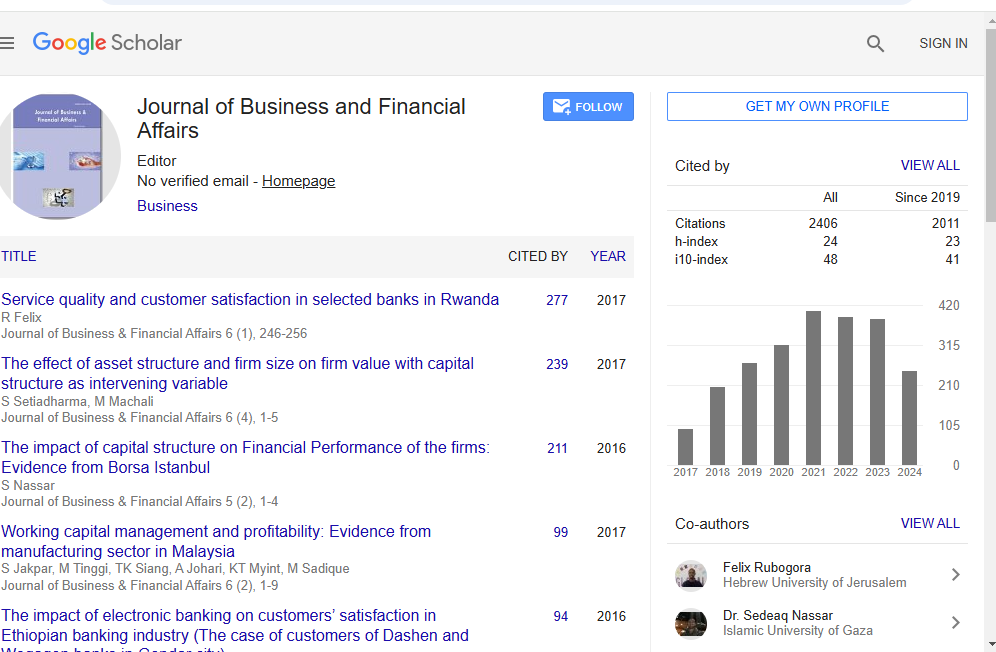
Journal of Business & Financial Affairs received 1726 citations as per Google Scholar report