Commentary - (2025) Volume 14, Issue 3
Received: 01-Jun-2025, Manuscript No. jbfa-25-174142;
Editor assigned: 03-Jun-2025, Pre QC No. P-174142;
Reviewed: 17-Jun-2025, QC No. Q-174142;
Revised: 23-Jun-2025, Manuscript No. R-174142;
Published:
30-Jun-2025
, DOI: 10.37421/2167-0234.2025.14.531
Citation: Dubois, Charlotte. ”Behavioral Biases: Investor Decisions and Market Outcomes.” J Bus Fin Aff 14 (2025):531.
Copyright: © 2025 Dubois C. This is an open-access article distributed under the terms of the Creative Commons Attribution License, which permits unrestricted use, distribution and reproduction in any medium, provided the original author and source are credited.
This paper offers a thorough look at how behavioral finance influences investor choices, covering key psychological biases like loss aversion and overconfidence. It emphasizes the critical need for investors to understand these inherent biases to make smarter financial decisions, moving beyond traditional rational models that often assume perfect rationality. [1].
This study critically examines how herding behavior affects investment choices, especially in dynamic emerging stock markets. It clearly highlights that investors frequently follow the crowd rather than diligently relying on their own detailed analysis, which often leads to significant market inefficiencies and instability. Understanding this powerful psychological bias is crucial for both policy-makers and individual investors seeking to navigate these markets. [2].
Research further investigates how overconfidence profoundly affects individual investor trading actions, utilizing extensive data from China. It starkly demonstrates that overconfident investors tend to trade more frequently, which unfortunately often leads to poorer performance due to excessive risk-taking and ignoring vital market signals. This highlights a crucial behavioral bias significantly impacting investment returns. [3].
Another study explores how prospect theory significantly influences investment decisions, specifically considering the moderating effect of financial literacy. It suggests that while investors generally exhibit behaviors consistent with prospect theory, such as notable loss aversion, a higher level of financial literacy can effectively help mitigate some of these irrational tendencies, ultimately leading to better decision-making. [4].
This paper investigates how subtle behavioral nudges strategically influence retirement savings decisions. It compellingly shows that subtle interventions, expertly leveraging psychological principles like default options and simplified choices, can significantly improve individuals' propensity to save for retirement, directly addressing common behavioral barriers to effective financial planning. [5].
A systematic review delves into the complex intersection of digitalization, behavioral biases, and investment decisions. It highlights how modern digital platforms, while offering undeniable convenience, can paradoxically amplify certain biases like overtrading or chasing trends by providing instant access to information and simplified trading mechanisms, fundamentally impacting investor behavior. [6].
This study examines the global impact of behavioral biases on stock market volatility. It clearly shows that psychological factors such as pervasive fear, rampant greed, and herd mentality contribute significantly to market fluctuations, often leading to irrational price movements that deviate substantially from fundamental values, emphasizing the profound role of human psychology in market dynamics. [7].
This paper investigates the intricate interplay between financial literacy, various behavioral biases, and investment intentions among millennials in Indonesia. It clearly reveals that while financial literacy positively influences investment intentions, pervasive behavioral biases like overconfidence and herd mentality can significantly distort these intentions, underscoring the vital need for targeted financial education programs. [8].
Further evidence highlights the disposition effect among investors, particularly in an emerging market. It unequivocally demonstrates that investors tend to hold on to losing stocks for too long and sell winning stocks too early, a critical behavioral bias that consistently leads to suboptimal portfolio performance. Understanding this specific bias is absolutely critical for improving overall investment outcomes. [9].
A systematic review charts the exciting rise of neurofinance, an interdisciplinary field that innovatively uses neuroscience to understand financial decision-making. It highlights how complex brain activity and physiological responses contribute directly to cognitive biases, offering deeper, biological insights into the fundamental underpinnings of investor behavior beyond traditional behavioral models. [10].
Behavioral finance offers a comprehensive lens through which to view investor decisions, moving past purely rational models. It highlights key psychological biases such as loss aversion and overconfidence, which significantly influence how individuals make financial choices [1]. These biases can lead to irrational tendencies, though higher financial literacy may help mitigate some of these effects, improving decision-making [4]. The field fundamentally emphasizes understanding these human elements for smarter financial strategies.
Specific biases, like herding behavior, are particularly impactful in volatile markets. Investors often follow the crowd rather than conducting independent analysis, leading to market inefficiencies and instability, especially in emerging stock markets [2]. Overconfidence is another prevalent bias; it causes investors to trade more frequently and take excessive risks, often resulting in poorer performance, as observed in studies of individual investors in China [3]. The disposition effect further complicates investor behavior, where individuals hold onto losing stocks too long and sell winning ones too early, consistently leading to suboptimal portfolio performance [9]. Understanding these specific manifestations is key to improving investment outcomes.
The influence of external factors and personal attributes on behavioral biases is also significant. For instance, financial literacy plays a crucial role not only in moderating behaviors consistent with prospect theory [4] but also in shaping investment intentions among demographic groups like millennials. However, biases such as overconfidence and herd mentality can still distort these intentions, underscoring the critical need for targeted financial education [8]. Digitalization, while offering convenience, can paradoxically amplify certain biases like overtrading or trend-chasing due to instant information access and simplified trading mechanisms [6]. These interactions highlight a complex landscape for investor behavior.
Beyond individual decisions, behavioral biases have a profound global impact on stock market volatility. Psychological factors like fear, greed, and collective herd mentality significantly contribute to market fluctuations, often driving irrational price movements that deviate from fundamental values [7]. This emphasizes the deep influence of human psychology on market dynamics. The emerging field of neurofinance further enriches this understanding, using neuroscience to uncover the biological underpinnings of cognitive biases, offering deeper insights into brain activity and physiological responses that drive investor behavior beyond traditional models [10]. This interdisciplinary approach promises to redefine our understanding of financial decision-making.
The understanding of behavioral finance isn't just theoretical; it also informs practical interventions. Behavioral nudges, for example, demonstrate how subtle interventions can leverage psychological principles, such as default options and simplified choices, to significantly improve individuals' propensity to save for retirement. These nudges effectively address common behavioral barriers to financial planning, showcasing the potential for applied behavioral economics to foster better financial habits [5]. Such applications offer tangible ways to guide individuals towards more beneficial long-term financial outcomes.
Behavioral finance profoundly shapes investor choices by highlighting key psychological biases like loss aversion and overconfidence, which move beyond traditional rational models [1]. Investors often fall prey to herding behavior, especially in emerging markets, leading to inefficiencies and instability as they follow the crowd rather than their own analysis [2]. Overconfident investors tend to trade excessively, leading to poorer returns and heightened risk [3]. Prospect theory, influenced by financial literacy, explains that while irrational tendencies like loss aversion are common, better financial knowledge can mitigate these effects [4]. Subtle behavioral nudges, using principles like default options, have shown success in improving retirement savings, tackling common planning barriers [5]. Digitalization introduces new complexities, as online platforms can amplify biases like overtrading and trend-chasing due to instant access and simplified trading [6]. These behavioral biases significantly contribute to stock market volatility globally, driving irrational price movements through fear, greed, and herd mentality [7]. In certain demographics, like Indonesian millennials, financial literacy can positively influence investment intentions, but biases such as overconfidence and herding still distort these plans, underscoring the need for targeted education [8]. The disposition effect, where investors hold losers too long and sell winners too early, is a well-documented bias that harms portfolio performance in emerging markets [9]. Finally, neurofinance offers a novel, interdisciplinary approach, using neuroscience to understand the biological roots of cognitive biases by examining brain activity and physiological responses, providing deeper insights into investor behavior beyond standard behavioral models [10]. Overall, understanding these multifaceted behavioral elements is critical for improving investment outcomes and market stability.
None
None
Indexed at, Google Scholar, Crossref
Indexed at, Google Scholar, Crossref
Indexed at, Google Scholar, Crossref
Indexed at, Google Scholar, Crossref
Indexed at, Google Scholar, Crossref
Indexed at, Google Scholar, Crossref
Indexed at, Google Scholar, Crossref
Indexed at, Google Scholar, Crossref
Indexed at, Google Scholar, Crossref
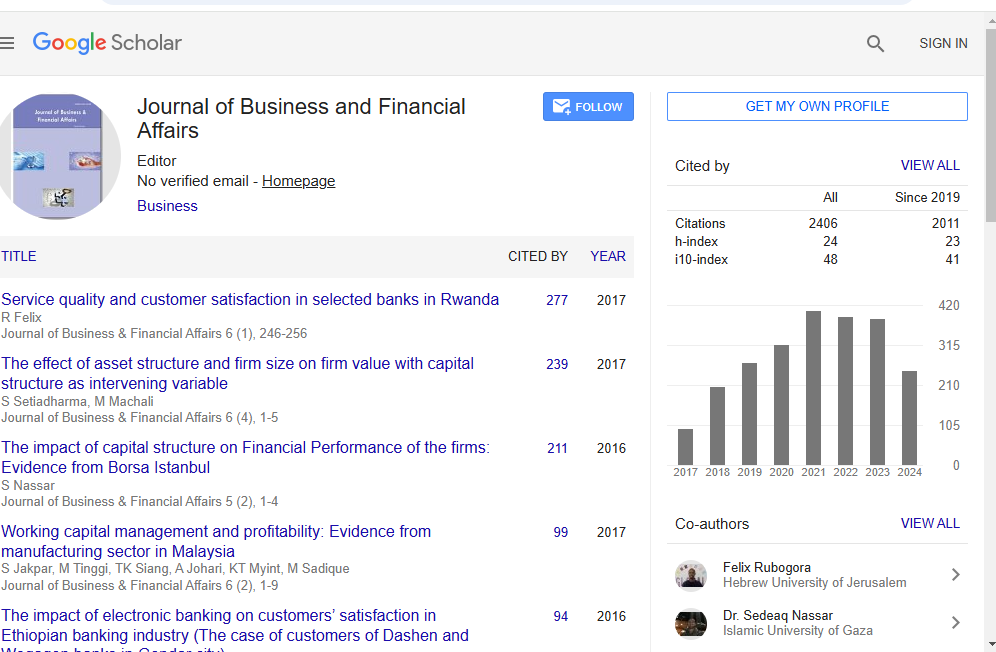
Journal of Business & Financial Affairs received 1726 citations as per Google Scholar report