Perspective - (2025) Volume 14, Issue 4
Received: 01-Aug-2025, Manuscript No. jhoa-26-187829;
Editor assigned: 04-Aug-2025, Pre QC No. P-187829;
Reviewed: 18-Aug-2025, QC No. Q-187829;
Revised: 22-Aug-2025, Manuscript No. R-187829;
Published:
29-Aug-2025
, DOI: 10.37421/2167-1095.2025.14.531
Citation: Costa, Beatriz. ”Barriers to Effective Hypertension Management: Patient and Systemic.” J Hypertens 14 (2025):531.
Copyright: © 2025 Costa B. This is an open-access article distributed under the terms of the Creative Commons Attribution License, which permits unrestricted use, distribution and reproduction in any medium, provided the original author and source are credited.
Effective hypertension management is a critical public health objective, yet it is frequently hampered by a complex array of challenges that span patient, healthcare system, and societal domains [1].
Patient-related issues are particularly prominent, with poor adherence to prescribed medications and lifestyle modifications constituting a significant barrier to achieving optimal blood pressure control [1].
These adherence issues often stem from a confluence of factors, including a lack of adequate awareness regarding the condition and its management, considerable financial constraints that limit access to necessary resources, and the sheer complexity of multifaceted treatment regimens [1].
Furthermore, the healthcare system itself presents substantial obstacles; limited access to timely and appropriate care, communication breakdowns between physicians and patients, and insufficient follow-up mechanisms all play a crucial role in perpetuating treatment inertia [1].
Compounding these issues are socioeconomic determinants, such as educational attainment, income levels, and the availability of social support networks, which further complicate the attainment and maintenance of therapeutic goals, underscoring the imperative for multifaceted and integrated interventions [1].
Addressing the persistent challenge of patient adherence to antihypertensive medications requires a comprehensive understanding of the psychological, social, and economic factors that influence it [2].
A systematic review and meta-analysis highlight the pivotal role of personalized treatment plans tailored to individual patient needs and circumstances [2].
Moreover, robust patient education initiatives are essential for empowering individuals to actively participate in their care and better understand the rationale behind their treatment regimens [2].
The intricate interplay of socioeconomic factors significantly impacts the successful management of hypertension, with lower socioeconomic status frequently correlating with reduced access to healthcare services, diminished health literacy, and elevated stress levels [3].
These interconnected elements collectively create substantial barriers that impede the achievement and sustained maintenance of target blood pressure levels [3].
Physician-patient communication, though critically important, is often an underemphasized aspect of comprehensive hypertension care, and its inadequacy can lead to significant misunderstandings regarding treatment protocols, diminished patient engagement, and ultimately, poorer clinical outcomes [4].
Therefore, the enhancement of communication strategies is vital for overcoming these pervasive treatment barriers [4].
The inherent complexity of medication regimens can substantially undermine adherence among individuals diagnosed with hypertension, leading to suboptimal blood pressure control [5].
Studies exploring treatment simplification and the strategic use of combination therapies suggest that these approaches can effectively mitigate such barriers, thereby improving patient compliance and enhancing overall treatment efficacy [5].
Health literacy, defined as the degree to which individuals have the capacity to obtain, process, and understand basic health information and services needed to make appropriate health decisions, emerges as a critical determinant influencing a patient's comprehension of hypertension and their subsequent adherence to prescribed treatments [6].
Low levels of health literacy pose a considerable impediment, often resulting in the misinterpretation of medical advice and leading to suboptimal self-management of the condition [6].
Access to healthcare, encompassing regular medical check-ups and consultations with specialists, is frequently curtailed by geographical limitations, prohibitive costs, and the sheer availability of essential services [7].
These access-related impediments disproportionately affect vulnerable populations, thereby hindering the effective diagnosis and management of hypertension within these communities [7].
Cultural beliefs and practices can profoundly influence an individual's perception of hypertension and their subsequent approach to managing the condition, creating potential obstacles to effective treatment and adherence [8].
A deficit in culturally sensitive healthcare delivery can introduce barriers to treatment compliance and efficacy, underscoring the necessity for interventions that are specifically tailored to diverse cultural contexts [8].
The financial burden associated with antihypertensive medications and the broader spectrum of related healthcare services represents a significant economic hurdle for a considerable number of patients, particularly those with limited financial resources [9].
High out-of-pocket expenses can directly contribute to non-adherence or the complete discontinuation of prescribed treatment regimens [9].
Finally, inadequate follow-up care and insufficient monitoring represent major obstacles to achieving and sustaining optimal blood pressure control, with regular assessments being crucial for treatment adjustments and adherence reinforcement [10].
Without these vital components, patients remain at an elevated risk of experiencing uncontrolled hypertension and its potentially severe complications [10].
The multifaceted nature of effective hypertension treatment is extensively documented, with patient-related factors identified as significant impediments to optimal management [1].
These patient-centric challenges encompass poor adherence to prescribed medication regimens and a reluctance or inability to implement necessary lifestyle changes, issues frequently rooted in a lack of comprehensive understanding, financial constraints that limit access to care and healthy living options, or the overwhelming complexity of treatment plans [1].
Complementing these individual struggles are systemic issues within healthcare delivery, including restricted access to medical services, communication gaps between healthcare providers and patients, and inadequate follow-up protocols, all of which contribute substantially to treatment inertia [1].
Furthermore, the pervasive influence of socioeconomic determinants, such as educational background, income level, and the presence of social support systems, complicates the ability of individuals to achieve and sustain effective hypertension management, thereby emphasizing the critical need for comprehensive and integrated interventions [1].
Patient adherence to antihypertensive medications remains a persistent and significant hurdle in the management of hypertension, necessitating a thorough examination of the psychological, social, and economic factors that govern this behavior [2].
Research underscores the paramount importance of developing personalized treatment plans that are specifically tailored to the unique circumstances and needs of each patient [2].
Moreover, investing in comprehensive patient education is crucial for empowering individuals with the knowledge and skills to effectively manage their condition and adhere to their treatment regimens over the long term [2].
The profound and intricate relationship between socioeconomic factors and hypertension management cannot be overstated, as individuals with lower socioeconomic status often face compounded challenges, including reduced access to essential healthcare services, lower levels of health literacy, and increased exposure to chronic stress, all of which create substantial barriers to achieving and maintaining adequate blood pressure control [3].
Physician-patient communication is an indispensable, albeit frequently overlooked, element of effective hypertension care, and its deficiency can precipitate misunderstandings about treatment directives, diminish patient engagement in their own care, and ultimately lead to suboptimal health outcomes [4].
Consequently, the deliberate enhancement of communication strategies is indispensable for surmounting these prevalent barriers to treatment success [4].
The burden imposed by complex medication regimens can significantly compromise adherence rates among hypertensive patients, negatively impacting their ability to achieve and maintain target blood pressure levels [5].
Investigations into the impact of treatment simplification and the judicious use of combination therapies indicate that these strategies can effectively alleviate such barriers, fostering improved patient compliance and leading to better blood pressure control [5].
Health literacy is recognized as a crucial determinant that influences a patient's understanding of hypertension and their subsequent adherence to prescribed therapeutic interventions [6].
Low health literacy presents a significant obstacle, often resulting in the misinterpretation of medical guidance and contributing to suboptimal self-management practices [6].
Therefore, the implementation of targeted interventions designed to enhance health literacy is of paramount importance [6].
Limited access to healthcare services, including routine check-ups and specialized consultations, frequently poses a barrier for individuals due to factors such as geographical distance, prohibitive costs, and the scarcity of available services [7].
These access-related impediments disproportionately affect certain populations, thereby hindering the effective diagnosis and comprehensive management of hypertension within these underserved groups [7].
Cultural beliefs and established practices can significantly shape an individual's perception of hypertension and their approach to managing the condition, potentially creating barriers to treatment adherence and overall efficacy [8].
A deficiency in culturally sensitive approaches within healthcare delivery can inadvertently introduce obstacles to patient compliance and treatment effectiveness, thus highlighting the critical need for culturally tailored interventions that respect and integrate diverse perspectives [8].
The substantial financial burden associated with acquiring antihypertensive medications and accessing related healthcare services represents a significant economic barrier for a large number of patients, particularly those with lower incomes [9].
Elevated out-of-pocket expenditures can directly lead to non-adherence to medication schedules or the complete cessation of treatment, thereby jeopardizing blood pressure control [9].
Lastly, inadequate follow-up care and insufficient monitoring protocols are identified as major obstacles to achieving sustained blood pressure control, as regular assessments are crucial for monitoring patient progress and making necessary adjustments to treatment plans [10].
Without consistent follow-up, patients face an increased risk of experiencing uncontrolled hypertension and its associated complications [10].
Effective hypertension management is hindered by patient-related issues such as poor medication adherence and lifestyle modification challenges, often due to lack of awareness, financial constraints, and complex regimens. Healthcare system factors, including limited access, poor communication, and inadequate follow-up, also contribute significantly. Socioeconomic determinants like education, income, and social support further complicate treatment. Psychological, social, and economic factors influence adherence, emphasizing the need for personalized plans and education. Lower socioeconomic status is linked to reduced healthcare access, poor health literacy, and increased stress. Physician-patient communication is vital for understanding treatment and engagement. Complex medication regimens impair adherence, suggesting simplification and combination therapies can improve compliance. Health literacy is critical for understanding hypertension and adhering to treatment. Limited access to care, driven by cost and availability, disproportionately affects certain populations. Cultural beliefs can impact management, necessitating culturally sensitive interventions. The financial burden of medications and healthcare services poses a significant barrier, especially for low-income individuals. Insufficient follow-up care hinders sustained blood pressure control.
None
None
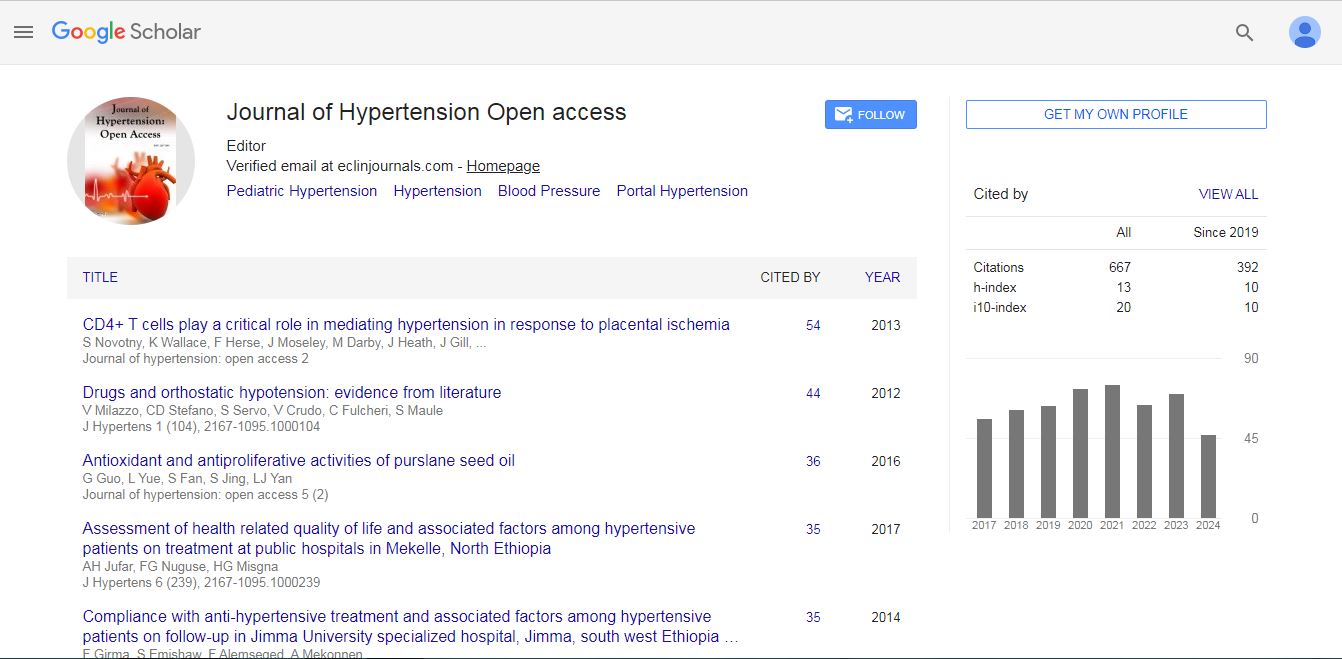
Journal of Hypertension: Open Access received 614 citations as per Google Scholar report