Opinion - (2025) Volume 12, Issue 5
Received: 01-Oct-2025, Manuscript No. jreac-26-185820;
Editor assigned: 03-Oct-2025, Pre QC No. P-185820;
Reviewed: 17-Oct-2025, QC No. Q-185820;
Revised: 22-Oct-2025, Manuscript No. R-185820;
Published:
29-Oct-2025
, DOI: 10.37421/2380-2391.2025.12.454
Citation: Novak, Viktor. ”Automated Sample Prep: Revolutionizing Environmental Analytical Chemistry.” J Environ Anal Chem 12 (2025):454.
Copyright: © 2025 Novak V. This is an open-access article distributed under the terms of the Creative Commons Attribution License, which permits unrestricted use, distribution and reproduction in any medium, provided the original author and source are credited.
The field of environmental analytical chemistry is undergoing a significant transformation driven by the widespread adoption of automated sample preparation techniques. These advanced methodologies are fundamentally altering how environmental samples are processed, leading to substantial improvements in efficiency, accuracy, and overall analytical capabilities. Robotic systems and hyphenated techniques are increasingly being integrated into laboratory workflows, addressing the challenges posed by complex environmental matrices and the demand for faster, more reliable data [1].
The integration of microfluidic devices with automated sample preparation systems presents a powerful paradigm for the analysis of trace contaminants in environmental water samples. These systems leverage small sample volumes and reduced reagent requirements, aligning with the principles of green chemistry and enabling lower detection limits for critical analytes [2].
Solid-phase extraction (SPE), a cornerstone technique for isolating analytes from environmental samples, has also seen substantial advancements through automation. Automated SPE systems are particularly effective for the analysis of pesticides and persistent organic pollutants in challenging matrices such as soil and sediment, offering enhanced reproducibility and reduced manual labor compared to traditional methods [3].
The synergy between automated sample preparation and sophisticated analytical instrumentation, such as gas chromatography-mass spectrometry (GC-MS) and liquid chromatography-mass spectrometry (LC-MS), is critical for achieving high-throughput environmental monitoring. The coupling of automated sample preparation robots with online SPE-LC-MS/MS systems exemplifies this trend, boosting efficiency and sensitivity for the detection of a broad spectrum of contaminants [4].
One of the ongoing challenges in this domain is the development of standardized automated protocols capable of handling diverse environmental matrices like wastewater and air samples. Research efforts are focused on creating versatile robotic platforms that can adapt to varying sample types and analytical targets, thereby ensuring the reliability and comparability of the generated data [5].
The application of automated sample preparation is proving indispensable for the environmental monitoring of emerging contaminants, including per- and polyfluoroalkyl substances (PFAS). Robotic systems facilitate the efficient and precise extraction of these compounds from large volumes of water, thereby enhancing detection capabilities and supporting regulatory initiatives [6].
Beyond analytical performance, automated sample preparation plays a vital role in reducing the environmental footprint of analytical laboratories. By significantly minimizing the consumption of solvents and reagents and decreasing waste generation, these technologies embody the core tenets of green analytical chemistry, promoting sustainability in the laboratory [7].
Furthermore, the development of portable and miniaturized automated sample preparation systems is paving the way for in-field environmental analysis. These innovative systems enable rapid pollutant screening directly at the source, circumventing the need for sample transportation and substantially reducing overall analysis time [8].
The implementation of automated sample preparation also leads to significant improvements in quality assurance and quality control (QA/QC). Robotic systems ensure the consistent application of extraction protocols, which directly translates to enhanced data reliability and a reduction in inter-laboratory variability, crucial for robust environmental studies [9].
Ultimately, the escalating adoption of automated sample preparation in environmental analytical chemistry is a direct response to the imperative for higher throughput and increased analytical accuracy. As analytical instrumentation continues to evolve with greater sensitivity, precise and efficient sample preparation becomes an indispensable prerequisite for fully harnessing the potential of these advanced techniques [10].
Automated sample preparation stands as a pivotal innovation in environmental analytical chemistry, fundamentally reshaping laboratory practices through enhanced throughput, precision, and safety. The deployment of robotic systems and hyphenated analytical techniques is becoming increasingly common to effectively manage complex environmental matrices, mitigate human error, and reduce the consumption of solvents. This transition facilitates more comprehensive environmental monitoring programs and enables swifter responses to pollution events [1].
Microfluidic devices, frequently integrated with autosamplers, offer a potent strategy for the automated preparation of environmental water samples, particularly for the analysis of trace contaminants. Their ability to operate with minimal sample volumes and reduced reagent usage contributes to the development of greener analytical methodologies while simultaneously improving the achievable detection limits [2].
Solid-phase extraction (SPE) has undergone significant automation for environmental sample analysis, demonstrating particular efficacy in the extraction of pesticides and persistent organic pollutants from complex matrices such as soil and sediment. The adoption of automated SPE systems provides superior reproducibility and a reduction in labor costs when contrasted with conventional manual extraction procedures [3].
The integration of automated sample preparation platforms with advanced mass spectrometry techniques, including gas chromatography-mass spectrometry (GC-MS) and liquid chromatography-mass spectrometry (LC-MS), is essential for the implementation of high-throughput environmental monitoring strategies. Exemplary systems involve automated sample preparation robots coupled with online SPE-LC-MS/MS configurations, which collectively enhance efficiency and sensitivity for the detection of a wide array of chemical contaminants [4].
A significant ongoing effort within the scientific community involves the development of standardized automated protocols tailored for complex environmental matrices, such as wastewater and atmospheric samples. Current research is concentrated on engineering versatile robotic platforms capable of adapting to diverse sample types and specific analytical targets, thereby ensuring the utmost reliability and comparability of analytical results [5].
The practical application of automated sample preparation techniques is of paramount importance for the environmental monitoring of emerging contaminants, with per- and polyfluoroalkyl substances (PFAS) serving as a prominent example. Robotic systems enable the efficient and precise extraction of these compounds from substantial volumes of water, thereby improving the sensitivity of detection and bolstering efforts in environmental regulation [6].
Beyond performance enhancements, automated sample preparation contributes significantly to diminishing the environmental impact of analytical laboratory operations. Through the substantial reduction in solvent and reagent consumption and the consequent decrease in waste generation, these technologies are fully aligned with the guiding principles of green analytical chemistry, fostering a more sustainable approach to chemical analysis [7].
Another critical development is the creation of portable and miniaturized automated sample preparation systems, which are enabling real-time, in-field environmental analysis. These compact systems allow for the rapid screening of pollutants directly at their source, thereby eliminating the logistical burdens associated with sample transportation and considerably shortening the overall analysis timeline [8].
The implementation of automated sample preparation also yields substantial improvements in the rigorous application of quality assurance and quality control (QA/QC) measures. Robotic systems ensure a consistent and standardized execution of extraction protocols, which directly leads to enhanced data reliability and a reduction in the variability observed between different laboratories undertaking environmental studies [9].
In summary, the increasing integration of automated sample preparation technologies within environmental analytical chemistry is primarily motivated by the escalating demand for higher analytical throughput and improved accuracy. As analytical instrumentation continues to advance in sensitivity and capability, the importance of precise and efficient sample preparation becomes increasingly paramount to fully leverage the potential offered by these cutting-edge techniques [10].
Automated sample preparation is revolutionizing environmental analytical chemistry by enhancing throughput, precision, and safety through robotic systems and hyphenated techniques. Microfluidic devices and automated solid-phase extraction (SPE) are improving trace contaminant analysis and pesticide detection in complex matrices. The integration with advanced instrumentation like GC-MS and LC-MS is crucial for high-throughput monitoring. Challenges remain in standardizing protocols for diverse matrices, but progress is being made in areas like PFAS analysis. Automation also promotes green analytical chemistry by reducing solvent and reagent use. Portable systems enable in-field analysis, while enhanced QA/QC ensures data reliability. The overall adoption is driven by the need for higher accuracy and efficiency, making precise sample preparation vital for advanced analytical instrumentation.
None
None
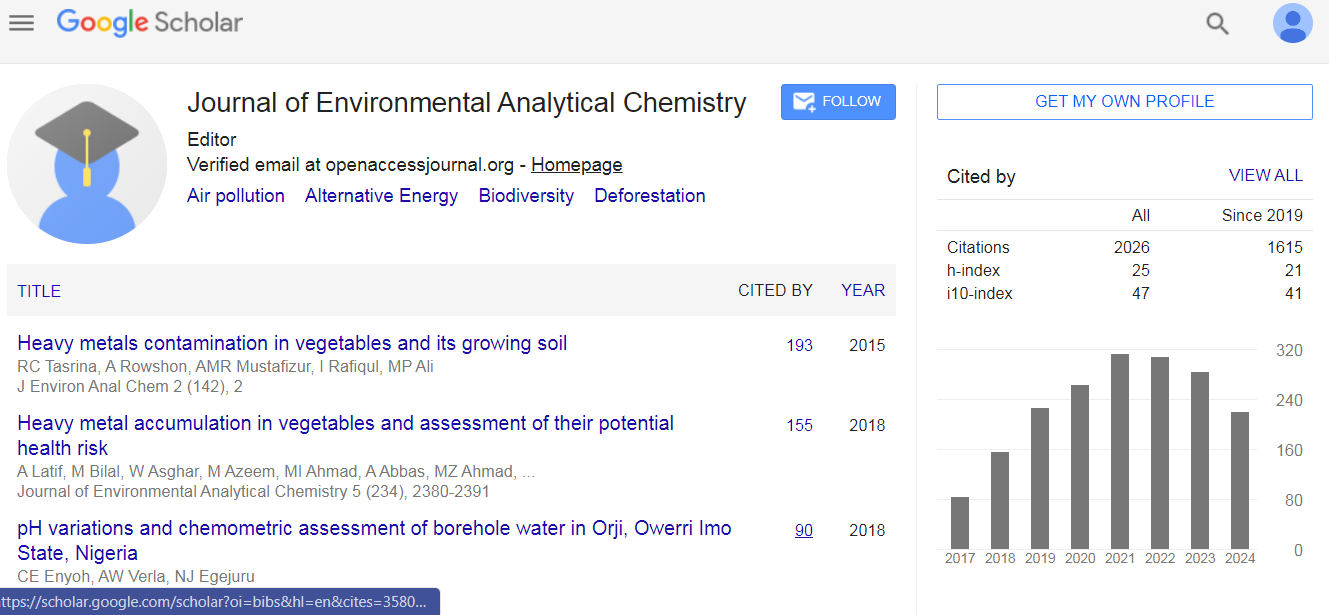
Journal of Environmental Analytical Chemistry received 1781 citations as per Google Scholar report