Commentary - (2025) Volume 16, Issue 6
Received: 01-Nov-2025, Manuscript No. assj-25-174906;
Editor assigned: 03-Nov-2025, Pre QC No. P-174906;
Reviewed: 17-Nov-2025, QC No. Q-174906;
Revised: 24-Nov-2025, Manuscript No. R-174906;
Published:
01-Dec-2025
, DOI: 10.37421/2151-6200.2025.16.694
Citation: Smith, Isabella. "Art's Power: Change, Healing, Decolonization." Arts Social Sci J 16 (2025):694
Copyright: © 2025 Smith I. This is an open-access article distributed under the terms of the Creative Commons Attribution License, which permits unrestricted use, distribution and reproduction in any medium, provided the original author and source are credited.
This article explores how participatory art effectively drives social change in urban settings. It focuses on case studies where collaborative artistic processes helped communities re-imagine and reclaim public spaces, fostering a sense of collective ownership and identity. The core idea is that when people actively create art together, it doesn't just beautify a place; it builds social capital and can spark tangible shifts in urban policy and community engagement [1].
This research delves into how photography serves as a powerful tool for social commentary, specifically by visualizing the often-overlooked struggles of migrant communities. The authors argue that photographic activism goes beyond mere documentation, actively shaping public perception and mobilizing support for migrant rights by making 'invisible' experiences visible and emotionally resonant [2].
Here's the thing: street art, far from being just vandalism, functions as a transformative educational approach for human rights. This study highlights how murals and graffiti in public spaces engage audiences in critical dialogues about social justice, offering alternative narratives and fostering empathy, especially among younger generations, by bringing complex issues directly into their daily environment [3].
This paper examines digital art as a medium for social commentary, particularly focusing on how artists critically engage with Artificial Intelligence (AI) in their creative practices. It reveals that artists are using AI not just as a tool, but as a subject, questioning its ethical implications, biases, and societal impact, thereby encouraging audiences to think critically about our increasingly algorithm-driven world [4].
This work explores how performance art effectively acts as a form of activism, powerfully reshaping public discourse, especially concerning human rights. It argues that live, embodied performances disrupt conventional narratives and challenge power structures, creating immediate, visceral experiences that compel audiences to confront societal injustices and envision new possibilities for social change [5].
This piece discusses the potent role of eco-art in addressing the climate crisis and promoting environmental justice. It highlights how artistic interventions can raise awareness, foster emotional connections to nature, and critically comment on ecological degradation, thereby motivating publics to engage more deeply with environmental issues and advocate for sustainable practices [6].
This research explores art's capacity as a vital tool for social healing, particularly in contexts of collective trauma. It details how creative expression, whether visual or performative, provides a safe space for individuals and communities to process difficult experiences, build resilience, and collaboratively construct new narratives that foster recovery and reconciliation [7].
Let's break it down: this study highlights the enduring power of visual satire, specifically through cartoons and caricature, as a form of social commentary. It illustrates how these art forms, using humor and exaggeration, dissect complex political and societal issues, challenging authority and prompting critical reflection in ways that direct criticism might not achieve [8].
This article examines how feminist art actively subverts patriarchal narratives in contemporary visual culture. It shows that artists use diverse mediums to challenge gender stereotypes, expose inequalities, and offer alternative perspectives, thereby contributing significantly to ongoing discussions about gender roles, power dynamics, and societal transformation [9].
What this really means is that Indigenous art plays a crucial role as decolonial praxis. This study demonstrates how Indigenous artists challenge settler colonial narratives and dominant historical accounts through their visual culture. Their work not only reclaims cultural identity and knowledge but also serves as a powerful form of social commentary, asserting sovereignty and advocating for justice [10].
Art, in its multifaceted expressions, consistently emerges as a powerful force for social transformation and commentary. This phenomenon is particularly evident in urban settings, where participatory art actively drives change by empowering communities. When people collaboratively create art, they aren't just beautifying spaces; they are building social capital, re-imagining public areas, and fostering a sense of collective ownership. This engagement can even spark tangible shifts in urban policy and community involvement [1]. Similarly, photography serves as an incredibly effective tool for social commentary, especially when it visualizes the struggles of migrant communities. Photographic activism transcends mere documentation, actively shaping public perception and mobilizing support for migrant rights by making 'invisible' experiences resonate emotionally and become visible [2].
Here's the thing: street art, often misconstrued as vandalism, actually functions as a transformative educational approach for human rights. Murals and graffiti in public spaces engage audiences, including younger generations, in critical dialogues about social justice. They offer alternative narratives and foster empathy by bringing complex issues directly into daily environments [3]. Moving into the digital realm, digital art has become a significant medium for social commentary, particularly in its critical engagement with Artificial Intelligence (AI). Artists are using AI not merely as a tool but as a subject, questioning its ethical implications, biases, and broader societal impact, prompting audiences to critically examine our increasingly algorithm-driven world [4].
Performance art, on the other hand, acts as a potent form of activism, powerfully reshaping public discourse, especially regarding human rights. Live, embodied performances disrupt conventional narratives and challenge existing power structures, crafting immediate, visceral experiences. These experiences compel audiences to confront societal injustices and envision new possibilities for change [5]. Beyond human rights, eco-art plays a crucial role in addressing the climate crisis and promoting environmental justice. Artistic interventions raise awareness, foster emotional connections to nature, and critically comment on ecological degradation. What this really means is that they motivate publics to engage more deeply with environmental issues and advocate for sustainable practices [6].
Art also possesses a profound capacity for social healing, particularly in contexts of collective trauma. Creative expression, whether visual or performative, provides a safe space for individuals and communities. It allows them to process difficult experiences, build resilience, and collaboratively construct new narratives that foster recovery and reconciliation [7]. Let's break it down: visual satire, through mediums like cartoons and caricature, demonstrates an enduring power as social commentary. Using humor and exaggeration, these art forms dissect complex political and societal issues, challenging authority and prompting critical reflection in ways direct criticism might not achieve [8].
Finally, art serves as a critical agent in challenging dominant narratives and asserting marginalized identities. Feminist art actively subverts patriarchal narratives in contemporary visual culture. Artists employ diverse mediums to challenge gender stereotypes, expose inequalities, and offer alternative perspectives, significantly contributing to ongoing discussions about gender roles, power dynamics, and societal transformation [9]. What this really means is that Indigenous art plays a crucial role as decolonial praxis. Indigenous artists use their visual culture to challenge settler colonial narratives and dominant historical accounts. Their work not only reclaims cultural identity and knowledge but also serves as a powerful form of social commentary, asserting sovereignty and advocating for justice [10].
Art, in its diverse forms, acts as a powerful catalyst for social change, commentary, and healing across various contexts. Participatory art, for instance, drives urban social change by helping communities reclaim public spaces, fostering collective ownership and sparking policy shifts. Photography serves as a vital tool for social commentary, visualizing the struggles of migrant communities and shaping public perception to mobilize support for their rights. Street art, far from mere vandalism, functions as a transformative educational approach, engaging audiences in dialogues about social justice and fostering empathy by bringing complex issues into daily environments. Digital art, especially with Artificial Intelligence (AI), offers a unique medium for commentary, as artists question AI's ethical implications and societal impact. Performance art acts as activism, disrupting conventional narratives around human rights through visceral experiences that challenge power structures. Eco-art plays a crucial role in addressing the climate crisis, raising awareness, fostering connections to nature, and advocating for sustainable practices. Art also provides a vital tool for social healing, allowing individuals and communities to process trauma, build resilience, and construct new narratives for recovery. Visual satire, through cartoons and caricature, maintains its enduring power as social commentary, using humor to dissect political and societal issues and prompt critical reflection in ways that direct criticism might not achieve. What this really means is that Indigenous art functions as decolonial praxis, reclaiming cultural identity and knowledge while powerfully asserting sovereignty and advocating for justice against settler colonial narratives.
None
None
Indexed at, Google Scholar, Crossref
Indexed at, Google Scholar, Crossref
Indexed at, Google Scholar, Crossref
Indexed at, Google Scholar, Crossref
Indexed at, Google Scholar, Crossref
Indexed at, Google Scholar, Crossref
Indexed at, Google Scholar, Crossref
Indexed at, Google Scholar, Crossref
Indexed at, Google Scholar, Crossref
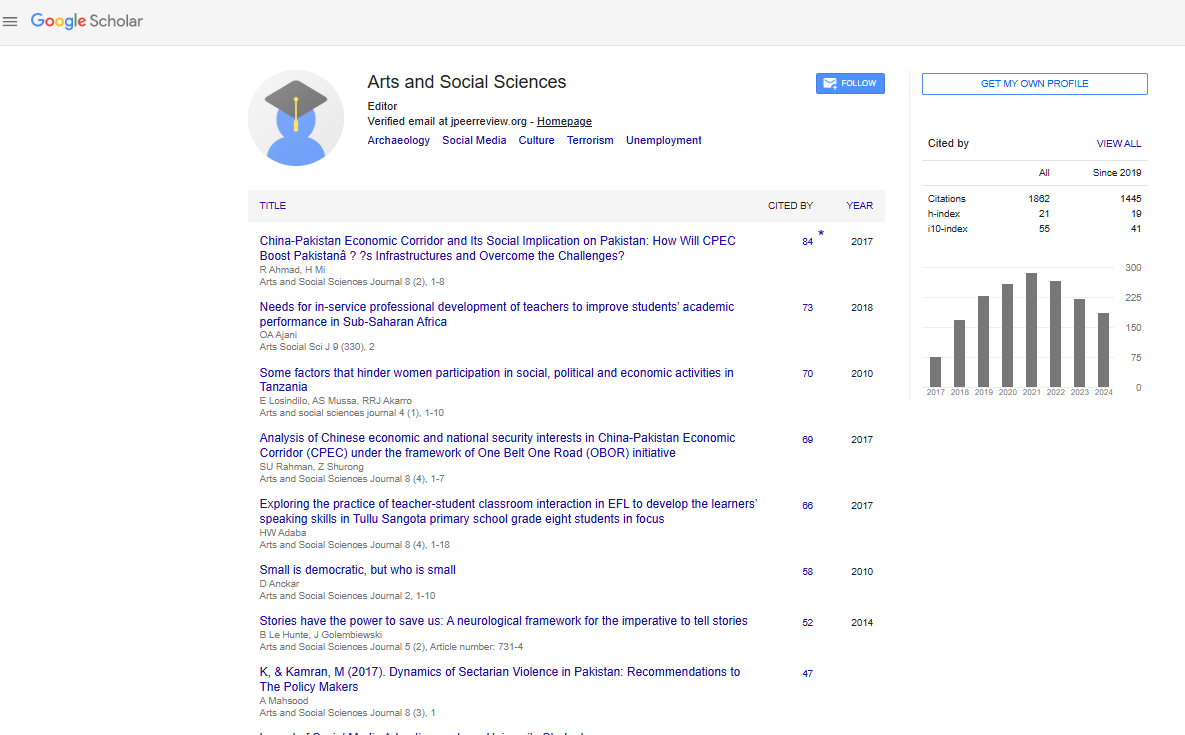
Arts and Social Sciences Journal received 1413 citations as per Google Scholar report