Commentary - (2025) Volume 16, Issue 6
Received: 01-Nov-2025, Manuscript No. assj-25-174905;
Editor assigned: 03-Nov-2025, Pre QC No. P-174905;
Reviewed: 17-Nov-2025, QC No. Q-174905;
Revised: 24-Nov-2025, Manuscript No. R-174905;
Published:
01-Dec-2025
, DOI: 10.37421/2151-6200.2025.16.693
Citation: Dubois, Hugo. "Art: Shaping Society, Driving Social Change." Arts Social Sci J 16 (2025):693.
Copyright: © 2025 Dubois H. This is an open-access article distributed under the terms of the Creative Commons Attribution License, which permits unrestricted use, distribution and reproduction in any medium, provided the original author and source are credited
Art, in its manifold expressions, consistently functions as a formidable medium for profound social commentary, incisive activism, and the critical examination of urgent contemporary issues. It transcends mere aesthetics, becoming a dynamic tool that directly responds to societal pressures and concerns. Across various global contexts, artists skillfully harness their creative practices to engage diverse audiences, provoking essential dialogue and challenging established norms. From navigating the complexities of environmental degradation to spearheading resistance against rapid urban transformations, these artistic endeavors underscore art's unparalleled capacity to illuminate complex problems, cultivate public engagement, and passionately advocate for meaningful societal change. A significant current in contemporary art directly addresses the Anthropocene, the current geological epoch shaped by human activity. Here, artistic practices aim to critically dismantle traditional human-nature binaries, fostering a heightened sense of ecological awareness. This vital work involves visually articulating intricate environmental challenges and actively encouraging public involvement in crucial climate change and sustainability debates [1].
In a related vein, the vibrant domain of street art has emerged as a particularly potent force for social commentary. This is evident in major urban centers like Berlin and London, where artists strategically utilize public spaces to powerfully protest the forces of gentrification. They adeptly employ visual rhetoric to mobilize local communities, thereby resisting unchecked urban transformation and vividly demonstrating artâ??s undeniable power as an essential tool for urban activism [2].
Extending this engagement into the digital sphere, digital art now represents a cutting-edge frontier for contemporary activism. Artists in this space skillfully leverage new media technologies to craft innovative resistance aesthetics, exploring diverse online platforms and interactive art forms that effectively challenge entrenched power structures and stimulate vital social dialogue within the digital realm [3].
Beyond the street and digital platforms, traditional cultural institutions are also undergoing significant transformation. Museums, for instance, are increasingly embracing crucial roles in curating contentious art and proactively engaging with profound social justice themes. These institutions are now thoughtfully navigating sensitive, often provocative, topics, actively challenging long-standing historical narratives, and deliberately fostering spaces for critical discussion and public discourse through their meticulously planned exhibitions and forward-thinking programming [4].
Furthermore, performance art, with its inherent immediacy and often ephemeral nature, acts as an extraordinarily potent vehicle for direct social commentary and political resistance. Through their bodies and live actions, artists deliberately challenge conventional societal norms, provoke deep thought, and engage audiences in critical examinations of pervasive power dynamics and persistent social inequalities [5].
Photography, too, maintains an enduring and crucial role in social commentary, proving especially impactful during times of crisis. Here, photographic practices serve as an indispensable means of witnessing, meticulously documenting, and vigorously advocating for change, effectively bringing often unseen realities to public attention and profoundly shaping collective memory [6].
The evolution of graffiti provides another compelling example, transforming from illicit street art into a widely recognized medium for profound social and political critique, frequently finding its way into established gallery spaces. This trajectory highlights how graffiti artists skillfully leverage public visibility to comment incisively on societal issues, urban politics, and cultural identity, fundamentally challenging prevailing perceptions of both art and public space [7].
Additionally, feminist art practices contribute profoundly to envisioning and shaping alternative social futures. Artists within this movement consciously address pervasive gender inequality, vigorously advocate for social justice, and challenge deeply embedded patriarchal structures through their diverse creative work, thereby fostering new and transformative perspectives on social organization [8].
The critical intersection of art and environmental justice forms another vital area of inquiry, where creative practices effectively engage communities in addressing ecological inequities. In this context, art serves to amplify marginalized voices, foster local agency, and promote innovative, sustainable solutions to pressing environmental challenges [9].
Finally, Indigenous art stands as an unequivocally powerful form of decolonial practice and social commentary. Indigenous artists expertly employ both traditional and contemporary mediums to assert cultural sovereignty, directly contest colonial narratives, and advocate tirelessly for self-determination and broader recognition within global discourse [10].
Artistic expression across various mediums consistently demonstrates its significant power in fostering social commentary and activism. This encompasses a broad spectrum of practices, from large-scale public interventions to intimate digital creations. The common thread is art's ability to act as a mirror to society, reflecting its challenges, injustices, and aspirations. These works often serve as catalysts for dialogue, challenging the status quo and inspiring action. Here's a breakdown of how different artistic forms contribute to this vital societal role.
A central theme across contemporary artistic endeavors is the profound engagement with environmental concerns and urban dynamics. Modern art is increasingly focused on the Anthropocene, using creative means to deconstruct human-nature binaries and cultivate a deeper ecological awareness [1]. This visual storytelling helps make complex environmental issues more accessible, encouraging public participation in crucial climate change and sustainability discussions. In parallel, urban landscapes become canvases for dissent through street art. This medium powerfully addresses issues like gentrification, where artists in cities such as Berlin and London mobilize communities through striking visual rhetoric to resist undesired urban transformation, proving art's effectiveness as a tool for urban activism [2]. The transformation of graffiti, once considered illicit, into a legitimate medium for social and political critique further emphasizes this, with works now being acknowledged in gallery spaces. Graffiti artists adeptly use public visibility to comment on societal issues, urban politics, and cultural identity, directly challenging established views of art and public space [7].
Technology and performance also play pivotal roles in contemporary social commentary. Digital art, leveraging new media technologies, provides an expansive avenue for activism, crafting what are termed 'resistance aesthetics.' This involves utilizing online platforms and interactive art forms to interrogate power structures and spark social dialogue within the digital sphere [3]. Complementing this, performance art stands out for its raw and immediate capacity for social commentary and political resistance. Artists harness their bodies and live actions to directly challenge societal norms, provoke critical thought, and engage audiences in nuanced examinations of power dynamics and pervasive social inequalities [5]. Moreover, photography maintains an enduring and critical role in social commentary, particularly evident during crises. It serves as an essential means of witnessing, documenting, and advocating for change, bringing often obscured realities into public consciousness and shaping collective memory [6].
Beyond direct political action, art also plays a crucial role in envisioning alternative futures and asserting cultural identities. Feminist art practices are instrumental in shaping new social futures, addressing gender inequality, advocating for social justice, and dismantling patriarchal structures through creative work. This fosters fresh perspectives on social organization and equity [8]. Similarly, Indigenous art functions as a powerful form of decolonial practice and social commentary. Through both traditional and contemporary mediums, Indigenous artists assert cultural sovereignty, challenge colonial narratives, and advocate tirelessly for self-determination and recognition, reclaiming their rightful place in global discourse [10]. The intersection of art with environmental justice provides yet another example of art's community-building power. Here, creative practices engage communities in addressing ecological inequities, amplifying marginalized voices, fostering local agency, and promoting sustainable solutions to environmental challenges [9].
Cultural institutions, such as museums, are not passive observers but active participants in this evolving landscape. They are increasingly taking on an evolving role in curating contentious art and directly engaging with social justice themes. This involves museums navigating sensitive topics, challenging historical narratives, and deliberately fostering spaces for critical dialogue through their innovative exhibitions and programming [4]. This institutional engagement ensures that art's power to provoke and question is given a broader platform, moving beyond individual artists to become a systemic force for societal reflection and progress.
Art serves as a vital instrument for social commentary and activism across diverse forms and contexts. Contemporary art engages with the Anthropocene, challenging human-nature binaries and fostering ecological awareness by visualizing environmental issues and encouraging public engagement with climate change debates. Street art, including graffiti, acts as a powerful tool for urban activism, protesting gentrification and commenting on urban politics and cultural identity in public and gallery spaces. Digital art leverages new media to create resistance aesthetics, using online platforms and interactive forms to challenge power structures and stimulate social dialogue. Performance art utilizes bodies and live actions to confront societal norms, provoke thought, and examine power dynamics and social inequalities. Photography plays a critical role in times of crisis, witnessing, documenting, and advocating for change by bringing unseen realities to public attention and shaping collective memory. Museums are also evolving, curating contentious art and engaging with social justice themes, fostering critical dialogue through exhibitions. Furthermore, feminist art practices contribute to imagining alternative social futures, addressing gender inequality, and challenging patriarchal structures. Art at the intersection of environmental justice engages communities in ecological inequities, amplifying marginalized voices and promoting sustainable solutions. Finally, Indigenous art stands as a powerful decolonial practice, asserting cultural sovereignty and advocating for self-determination. Collectively, these artistic expressions underscore art's profound capacity to reflect, critique, and actively shape societal understanding and progress.
None
None
Indexed at, Google Scholar, Crossref
Indexed at, Google Scholar, Crossref
Indexed at, Google Scholar, Crossref
Indexed at, Google Scholar, Crossref
Indexed at, Google Scholar, Crossref
Indexed at, Google Scholar, Crossref
Indexed at, Google Scholar, Crossref
Indexed at, Google Scholar, Crossref
Indexed at, Google Scholar, Crossref
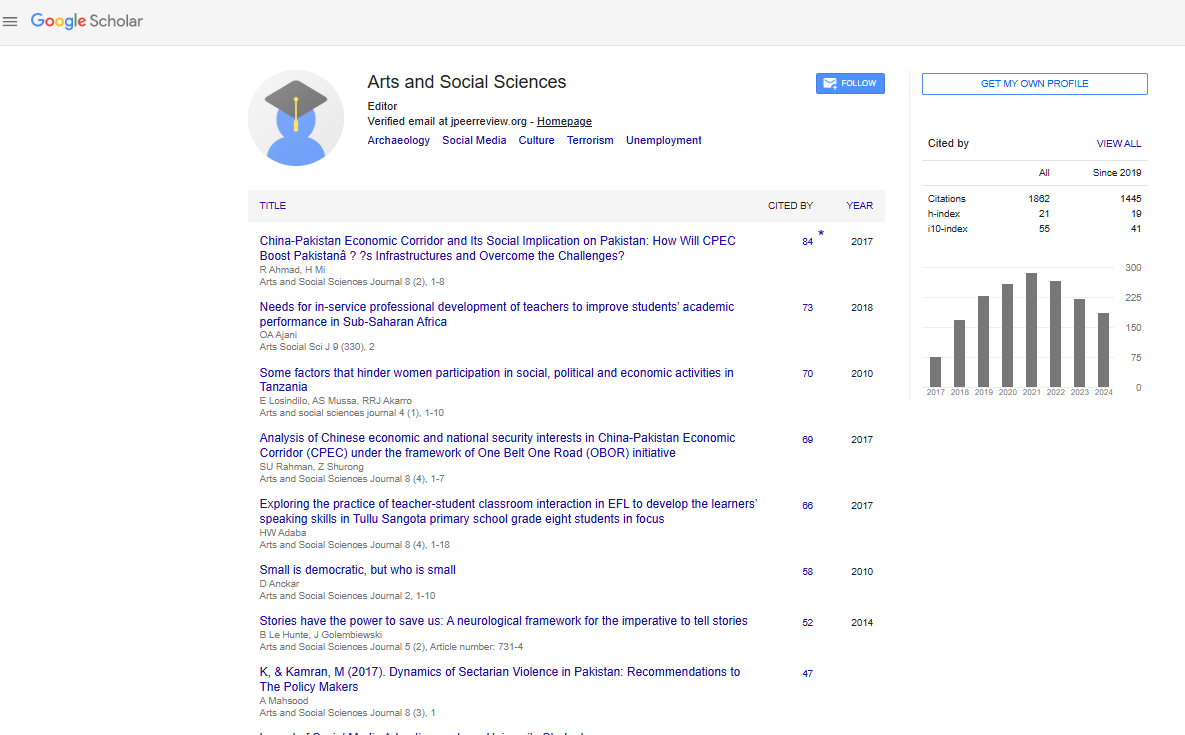
Arts and Social Sciences Journal received 1413 citations as per Google Scholar report