Opinion - (2025) Volume 10, Issue 1
Received: 01-Feb-2025, Manuscript No. arwm-25-165534;
Editor assigned: 03-Feb-2025, Pre QC No. P-165534;
Reviewed: 14-Feb-2025, QC No. Q-165534;
Revised: 19-Feb-2025, Manuscript No. R-165534;
Published:
26-Feb-2025
, DOI: 10.37421/2475-7675.2025.10.387
Citation: Sharmin, Ahmed. “Applications of Adsorption in Environmental Cleanup.’’ Adv Recycling Waste Manag 10 (2025): 387.
Copyright: © 2025 Sharmin A. This is an open-access article distributed under the terms of the Creative Commons Attribution License, which permits unrestricted use, distribution and reproduction in any medium, provided the original author and source are credited.
Adsorption is a physicochemical process in which molecules from a fluid phase (gas or liquid) adhere to the surface of a solid material, called the adsorbent. This process has garnered significant attention for its simplicity, efficiency, cost-effectiveness, and versatility in a wide array of applications, particularly in the field of environmental cleanup. The growing concerns about environmental pollution, stemming from industrialization, urbanization, and agricultural expansion, have prompted researchers and environmental agencies to explore sustainable and efficient technologies for mitigating pollution. Adsorption, being one of the most potent methods, has found applications in the remediation of air, water, and soil contaminated with various pollutants such as heavy metals, dyes, organic compounds, and emerging contaminants like pharmaceuticals and endocrine-disrupting chemicals.
One of the primary environmental challenges is water pollution. The discharge of industrial effluents containing heavy metals such as lead, mercury, cadmium, and arsenic into water bodies poses a severe threat to aquatic ecosystems and human health. These metals are non-biodegradable and can accumulate in living organisms, leading to bioaccumulation and bio magnification. Adsorption has emerged as a key technique for the removal of heavy metals from wastewater due to its high efficiency, low operational cost, and adaptability to various scales of operation. Materials such as activated carbon, zeolites, clay minerals, biosorbents, and synthetic polymers have been extensively studied and used for this purpose. Activated carbon, derived from carbonaceous materials like coconut shells, wood, and coal, is particularly effective due to its high surface area and porous structure, enabling it to capture a wide range of contaminants [1].
In addition to heavy metals, organic pollutants such as dyes from textile industries, pesticides from agricultural runoff, and pharmaceuticals from domestic and hospital waste are prevalent in water bodies. These contaminants not only degrade water quality but also pose carcinogenic and mutagenic risks to organisms. Adsorption has shown remarkable effectiveness in removing such organic compounds from aqueous solutions. Natural and modified adsorbents have been developed to enhance selectivity and adsorption capacity. For example, chitosan, a biopolymer derived from chitin, has been modified with functional groups to improve its affinity for dyes and pharmaceuticals. Nanomaterials, such as graphene oxide and carbon nanotubes, have also been employed to achieve higher adsorption efficiencies due to their extraordinary surface properties and tunable chemistry [2].
Air pollution, another critical environmental issue, is characterized by the presence of harmful gases and particulates such as Volatile Organic Compounds (VOCs), Sulfur Dioxide (SOâ??), Nitrogen Oxides (NOâ??), and Carbon Monoxide (CO). These pollutants originate from vehicular emissions, industrial processes, and combustion of fossil fuels. Adsorption technologies are widely used in air purification systems to capture and remove these contaminants. Activated carbon filters are commonly installed in air purifiers and industrial exhaust systems to adsorb VOCs and odors. Metal-Organic Frameworks (MOFs), a class of crystalline materials with high porosity, have shown promising results in capturing specific gas molecules due to their customizable pore structures and functional groups. Similarly, zeolites have been utilized for their ion-exchange properties and thermal stability in removing acidic gases like SOâ?? and NO [3,4].
Soil contamination, resulting from the indiscriminate disposal of hazardous chemicals, leakage from storage tanks, and agricultural activities, poses long-term risks to terrestrial ecosystems and groundwater quality. Adsorption is employed in soil remediation to immobilize contaminants and reduce their bioavailability. Materials such as biochar, a carbon-rich product obtained from the pyrolysis of organic waste, are applied to contaminated soils to adsorb heavy metals and organic pollutants. Biochar not only adsorbs contaminants but also improves soil fertility and microbial activity, making it a dual-purpose amendment. Modified clays and Layered Double Hydroxides (LDHs) are also effective in stabilizing heavy metals in soils by adsorbing them onto their surfaces or incorporating them into their crystal structures [5]. The application of adsorption extends beyond traditional pollutants to include the remediation of emerging contaminants, which are synthetic or naturally occurring compounds not commonly monitored but known to cause adverse environmental and health effects.
The effectiveness of adsorption in environmental cleanup is influenced by several factors, including the characteristics of the adsorbent (surface area, pore size distribution, surface functional groups), the nature of the contaminant (molecular size, polarity, solubility), and operational conditions such as pH, temperature, and contact time. Efforts have been made to optimize these parameters to maximize removal efficiency. Additionally, the regeneration and reuse of adsorbents are crucial for the sustainability and economic viability of adsorption processes. Various regeneration techniques, including thermal treatment, solvent washing, and microwave irradiation, have been developed to restore the adsorption capacity of spent materials.
A notable trend in adsorption research is the development of low-cost and sustainable adsorbents derived from agricultural and industrial wastes. These include materials like rice husk ash, sawdust, peanut shells, and fly ash, which are abundant and often underutilized. By converting these wastes into value-added adsorbents, it is possible to address two environmental issues simultaneously: waste management and pollution control. Moreover, the use of bio-based adsorbents aligns with the principles of green chemistry and circular economy, promoting resource efficiency and environmental sustainability. Another innovative approach involves the use of hybrid materials that combine different adsorption mechanisms or functionalities to enhance performance.
Google Scholar Cross Ref Indexed at
Google Scholar Cross Ref Indexed at
Google Scholar Cross Ref Indexed at
Google Scholar Cross Ref Indexed at
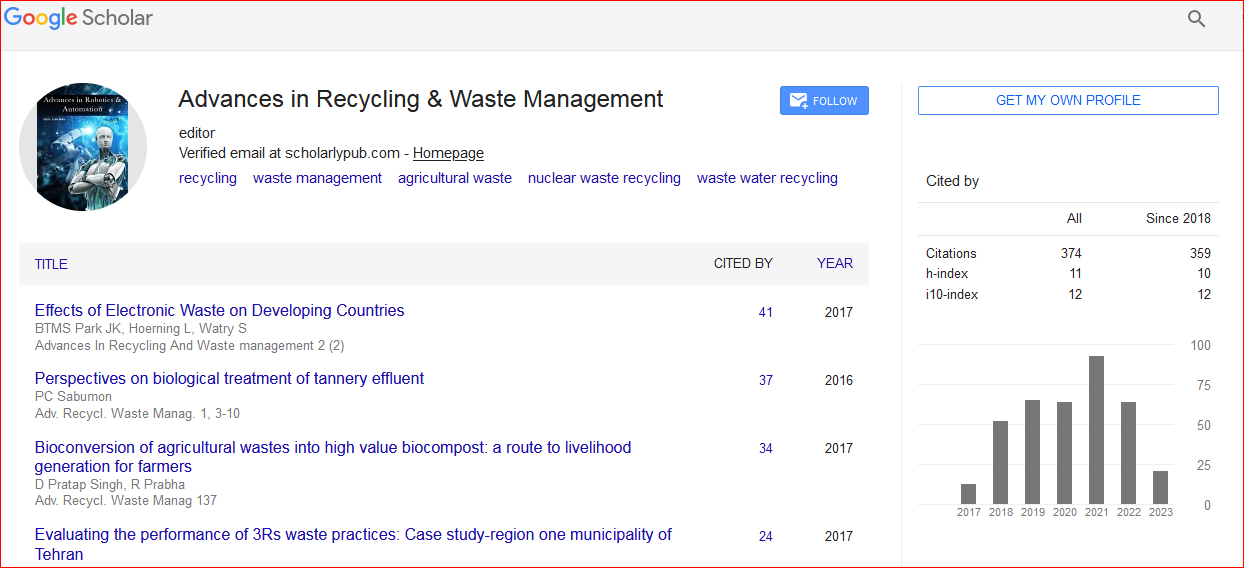
Advances in Recycling & Waste Management received 438 citations as per Google Scholar report