Brief Report - (2025) Volume 14, Issue 5
Received: 01-Oct-2025, Manuscript No. jnc-25-173979;
Editor assigned: 03-Oct-2025, Pre QC No. P-173979;
Reviewed: 17-Oct-2025, QC No. Q-173979;
Revised: 22-Oct-2025, Manuscript No. R-173979;
Published:
29-Oct-2025
, DOI: 10.37421/2167-1168.2025.14.727
Citation: Mbatha, Grace. ”Antimicrobial Stewardship: Optimizing Use, Improving Outcomes.” J Nurs Care 14 (2025):727.
Copyright: © 2025 Mbatha G. This is an open-access article distributed under the terms of the Creative Commons Attribution License, which permits unrestricted use, distribution and reproduction in any medium, provided the original author and source are credited.
This study found that a pharmacist-led antimicrobial stewardship intervention focusing on empiric antibiotic choices for community-acquired pneumonia significantly reduced the duration of therapy and improved clinical outcomes without increasing adverse events. What this really means is that pharmacists are critical in optimizing antibiotic use in hospital settings[1].
The research demonstrates that consistent antimicrobial stewardship programs can lead to a sustained reduction in antibiotic consumption and an improvement in local antimicrobial resistance patterns over time in a tertiary hospital setting. Here's the thing: these programs offer long-term benefits for managing antibiotic resistance[2].
This systematic review and meta-analysis reveals that antimicrobial stewardship interventions in intensive care units effectively reduce antibiotic consumption and improve resistance profiles. What this really means is that targeted stewardship efforts are critically important for high-risk patient populations like those in ICUs[3].
This meta-analysis indicates that antimicrobial stewardship interventions not only optimize antibiotic use but also significantly reduce the length of hospital stay for patients. Let's break it down: stewardship programs have a broader positive impact on both patient outcomes and how healthcare resources are used[4].
This scoping review identifies common barriers to implementing antimicrobial stewardship programs in low- and middle-income countries, including lack of resources, surveillance data, and trained personnel. Understanding these challenges is crucial for developing tailored and effective strategies in these specific settings[5].
This article describes a successful approach to developing and integrating an antimicrobial stewardship program within a long-term care facility. What this really means is that these programs can be adapted to specific healthcare settings, improving antibiotic prescribing among vulnerable elderly populations[6].
This systematic review and meta-analysis concludes that antimicrobial stewardship significantly improves clinical outcomes for hospitalized patients, including reduced mortality and length of stay. Here's the thing: it provides robust evidence supporting the widespread implementation of stewardship programs across various hospital settings[7].
This systematic review explores the impact of antimicrobial stewardship interventions in outpatient settings, finding them effective in reducing inappropriate antibiotic prescribing. What this really means is that it's important to expand stewardship efforts beyond hospitals to tackle antibiotic overuse in primary care[8].
This review emphasizes the crucial yet often underutilized role of nurses in antimicrobial stewardship. It outlines various ways nurses contribute, from patient education and monitoring to advocating for appropriate antibiotic use, suggesting their full integration is key to successful stewardship programs[9].
This systematic review highlights the increasing role of digital tools in antimicrobial stewardship, showing that electronic decision support systems and other digital interventions can effectively improve prescribing practices and patient outcomes. Let's break it down: leveraging technology is vital for scaling and enhancing stewardship efforts moving forward[10].
Pharmacist-led antimicrobial stewardship interventions are vital, demonstrating significant reductions in therapy duration and improved clinical outcomes for conditions such as community-acquired pneumonia in hospital settings [1]. These programs foster sustained reductions in antibiotic consumption and enhance local antimicrobial resistance patterns over time within tertiary hospitals, offering long-term benefits for managing antibiotic resistance [2]. Targeted stewardship efforts are also critically important for high-risk patient populations like those in Intensive Care Units, effectively reducing antibiotic consumption and improving resistance profiles [3].
Antimicrobial stewardship interventions extend their benefits beyond direct antibiotic optimization, significantly reducing the length of hospital stay for patients. This highlights a broader positive impact on both patient outcomes and how healthcare resources are used [4]. Moreover, robust evidence confirms that antimicrobial stewardship significantly improves overall clinical outcomes for hospitalized patients, including reduced mortality and length of stay. This supports the widespread implementation of such programs across various hospital settings [7].
Despite their widespread benefits, implementing antimicrobial stewardship programs faces specific challenges, particularly in low- and middle-income countries. Common barriers include a lack of essential resources, insufficient surveillance data, and a shortage of trained personnel. Addressing these challenges is crucial for developing tailored and effective strategies in these specific settings [5]. However, the adaptability of these programs is evident in successful approaches to developing and integrating antimicrobial stewardship within long-term care facilities, effectively improving antibiotic prescribing among vulnerable elderly populations [6].
The impact of antimicrobial stewardship extends beyond traditional hospital environments. Interventions in outpatient settings are effective in reducing inappropriate antibiotic prescribing, underscoring the importance of expanding stewardship efforts to tackle antibiotic overuse in primary care [8]. Furthermore, nurses play a crucial yet often underutilized role in antimicrobial stewardship. Their contributions range from patient education and monitoring to advocating for appropriate antibiotic use, suggesting that their full integration is key to successful stewardship programs [9].
Looking ahead, digital tools are playing an increasingly important role in antimicrobial stewardship. Electronic decision support systems and other digital interventions have been shown to effectively improve prescribing practices and patient outcomes. Leveraging technology is vital for scaling and enhancing stewardship efforts moving forward, ensuring broader reach and greater impact [10].
Antimicrobial stewardship interventions are pivotal for optimizing antibiotic use and improving patient outcomes across various healthcare settings. Pharmacist-led initiatives effectively reduce therapy duration and enhance clinical results for conditions like community-acquired pneumonia. Consistent stewardship programs in tertiary hospitals lead to sustained reductions in antibiotic consumption and improved resistance patterns, offering long-term benefits. These efforts are crucial in high-risk populations such as those in Intensive Care Units, where they reduce consumption and improve resistance profiles. Stewardship interventions not only optimize antibiotic use but also significantly reduce hospital length of stay, indicating a broader positive impact on patient care and resource utilization. While successful implementation examples exist in diverse settings like long-term care facilities, challenges persist in low- and middle-income countries due to resource limitations, inadequate surveillance data, and lack of trained personnel, necessitating tailored strategies. Expanding stewardship beyond hospitals to outpatient settings is important for tackling antibiotic overuse in primary care. Nurses play an often underutilized, yet crucial role in these programs through patient education and monitoring. Digital tools and electronic decision support systems are increasingly vital for scaling and enhancing stewardship efforts, demonstrating their effectiveness in improving prescribing practices and patient outcomes.
None
None
1. Michael PV, Ashley KM, Ashley BM. "Clinical Outcomes Associated With an Antimicrobial Stewardship-Driven Pharmacist-Led Intervention on Empiric Antibiotic Use for Community-Acquired Pneumonia".Clin Infect Dis 72 (2021):159-166.
Indexed at, Google Scholar, Crossref
2. Silvia M, Giulia M, Giancarlo C. "Sustained Impact of Antimicrobial Stewardship Interventions on Prescribing and Resistance Patterns in a Tertiary Hospital".Antibiotics (Basel) 11 (2022):109.
Indexed at, Google Scholar, Crossref
3. Xinyi T, Yanyan L, Hong L. "Impact of antimicrobial stewardship on antibiotic prescribing patterns and resistance in intensive care units: a systematic review and meta-analysis".J Glob Antimicrob Resist 20 (2020):227-236.
Indexed at, Google Scholar, Crossref
4. Laura EPKH, Judith VMGB, Erik MMvI. "The Effectiveness of Antimicrobial Stewardship Interventions in Reducing Hospital Length of Stay: A Systematic Review and Meta-Analysis".Clin Infect Dis 76 (2023):2038-2048.
Indexed at, Google Scholar, Crossref
5. Jessica MTvdW, Ann-Sofie B, Jörg JS. "Challenges in Implementing Antimicrobial Stewardship in Low- and Middle-Income Countries: A Scoping Review".Antibiotics (Basel) 11 (2022):1381.
Indexed at, Google Scholar, Crossref
6. Ashley AD, Andrea GD, Heather MJD. "Development and Implementation of an Antimicrobial Stewardship Program in a Long-Term Care Facility".J Am Med Dir Assoc 20 (2019):1471-1476.e1.
Indexed at, Google Scholar, Crossref
7. Jun M, Xue-Fei H, Kai-Ning W. "Effectiveness of Antimicrobial Stewardship on Clinical Outcomes in Hospitalized Patients: A Systematic Review and Meta-Analysis".Clin Infect Dis 70 (2020):361-368.
Indexed at, Google Scholar, Crossref
8. Laura RC, Lisa MM, Sara NC. "Impact of Outpatient Antimicrobial Stewardship Interventions on Antimicrobial Prescribing: A Systematic Review".Clin Infect Dis 70 (2020):1443-1454.
Indexed at, Google Scholar, Crossref
9. Patricia LWC, Helen BHC, S. JCC. "Nurses' Role in Antimicrobial Stewardship: A Scoping Review".J Clin Nurs 31 (2022):3051-3065.
Indexed at, Google Scholar, Crossref
10. Laura MCV, Eline MMvdV, Nicole GMDJMV. "Implementation and Impact of Digital Antimicrobial Stewardship Interventions: A Systematic Review".Clin Microbiol Infect 29 (2023):718-726.
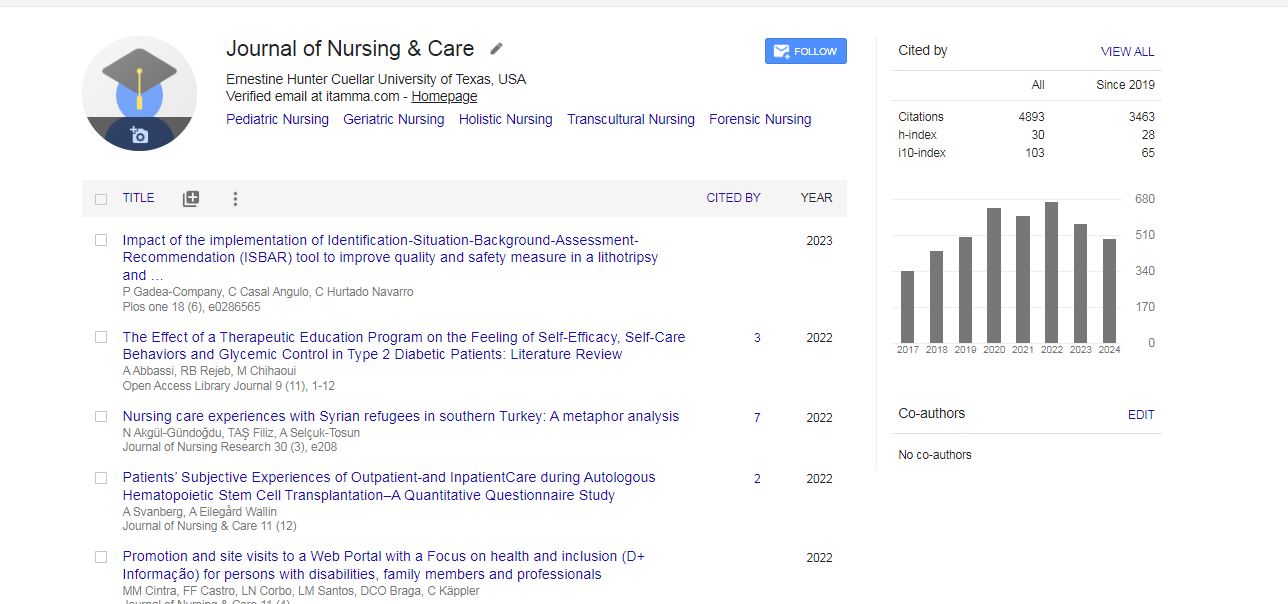
Journal of Nursing & Care received 4230 citations as per Google Scholar report