Brief Report - (2025) Volume 14, Issue 4
Received: 01-Jul-2025, Manuscript No. jmmd-26-184689;
Editor assigned: 03-Jul-2025, Pre QC No. P-184689;
Reviewed: 17-Jul-2025, QC No. Q-184689;
Revised: 22-Jul-2025, Manuscript No. R-184689;
Published:
29-Jul-2025
, DOI: 10.37421/2161-0703.2025.14.533
Citation: Okeke, Samuel. ”Antimicrobial Stewardship: Combating Resistance, Improving Outcomes.” J Med Microb Diagn 14 (2025):533.
Copyright: © 2025 Okeke S. This is an open-access article distributed under the terms of the Creative Commons Attribution License, which permits unrestricted use, distribution and reproduction in any medium, provided the original author and source are credited.
Antimicrobial stewardship programs (ASPs) are recognized as a cornerstone in the global effort to combat the escalating threat of antimicrobial resistance (AMR) [1].
These meticulously designed interventions are implemented to optimize the use of antimicrobial agents, a strategy that directly translates to improved patient health outcomes, a reduction in the financial burdens associated with healthcare, and a significant deceleration in the emergence of pathogens that have developed resistance to existing treatments [1].
A critical focus of effective ASPs lies in ensuring appropriate prescribing practices, facilitating the de-escalation of antibiotic therapy when clinically indicated, leveraging advanced diagnostics, and fostering a culture of education among healthcare professionals, all of which have demonstrably contributed to curbing resistance trends across diverse healthcare settings [1].
The implementation of well-structured and robust antimicrobial stewardship programs has a profound and measurable influence on the prevalence of multidrug-resistant organisms (MDROs) within healthcare facilities [2].
These programs actively promote the judicious use of broad-spectrum antimicrobial agents, encouraging healthcare providers to transition to narrower-spectrum antibiotics as soon as diagnostic data becomes available [2].
By diminishing the selective pressure exerted by widespread antibiotic use, ASPs directly counteract a primary driver of resistance development, a phenomenon that is particularly pronounced in hospital environments where concentrated antibiotic administration can accelerate the emergence and dissemination of resistant bacteria [2].
The pivotal role that diagnostics play within the framework of antimicrobial stewardship cannot be overstated, as it is fundamental to guiding therapeutic decisions [3].
The ability to rapidly and accurately identify causative pathogens and determine their susceptibility patterns to various antimicrobial agents empowers clinicians to initiate more targeted therapy. This precise approach minimizes the reliance on empirical broad-spectrum antibiotic use, a practice that often contributes to the selection and spread of resistant strains [3].
Consequently, an actively functioning ASP, supported by advanced diagnostics, becomes an indispensable tool in the fight against escalating resistance [3].
Furthermore, the successful engagement of prescribers through comprehensive education and consistent feedback mechanisms forms an essential pillar of effective antimicrobial stewardship [4].
When healthcare providers possess a clear understanding of the underlying rationale behind stewardship interventions and can observe the tangible impact of these efforts on resistance patterns, their adherence to established guidelines and best practices is significantly enhanced [4].
This collaborative approach, fostering a shared commitment to antimicrobial stewardship, is absolutely critical for fundamentally altering prescribing cultures and effectively mitigating the pervasive threat of AMR [4].
The economic repercussions associated with the proliferation of antimicrobial resistance are substantial and far-reaching, underscoring the vital role that ASPs play in cost containment strategies within healthcare systems [5].
By actively reducing the utilization of more expensive broad-spectrum antimicrobial agents and diligently preventing treatment failures, prolonged hospital stays, and the associated complications that arise from resistant infections, stewardship programs offer a clear and demonstrable return on investment [5].
Simultaneously, these programs are instrumental in preserving the efficacy of existing antibiotics for future therapeutic needs, thus safeguarding a critical public health resource [5].
In recent years, antimicrobial stewardship efforts have seen a significant expansion beyond traditional hospital settings, with an increasing integration into community healthcare environments [6].
The extension of these vital programs to primary care practices and long-term care facilities is recognized as an essential component of a comprehensive and holistic strategy to combat AMR [6].
This expansion is particularly crucial given that a substantial proportion of overall antibiotic prescribing occurs within these outpatient settings, making their inclusion vital for a unified approach to resistance mitigation [6].
The establishment and diligent implementation of national antimicrobial stewardship guidelines serve as an indispensable framework for ensuring consistency and effectiveness in practices across entire healthcare systems [7].
These authoritative guidelines consistently highlight the direct and undeniable correlation between adherence to established stewardship principles and a measurable reduction in antimicrobial resistance rates [7].
By providing a standardized approach, national guidelines facilitate a more unified and impactful response to the growing challenge of AMR on a broader scale [7].
A strategic approach that involves focusing on specific pathogens and their unique resistance patterns within an institutional setting allows for the development of highly tailored and effective stewardship interventions [8].
For instance, dedicated stewardship initiatives specifically targeting carbapenemase-producing Enterobacteriaceae (CPE), a group of highly resistant bacteria, have demonstrated notable success in reducing their prevalence through meticulously designed and implemented stewardship efforts [8].
This pathogen-specific focus allows for a more precise and impactful application of stewardship resources [8].
The integration of sophisticated electronic health record (EHR) systems and advanced clinical decision support tools has profoundly revolutionized the practice of antimicrobial stewardship [9].
These technological advancements empower healthcare providers with real-time monitoring capabilities for antibiotic use, enable automated alerts for potentially inappropriate prescribing, and facilitate the delivery of timely and actionable feedback to clinicians [9].
Collectively, these functionalities are instrumental in shaping prescribing behaviors at the point of care and are critical for driving reductions in antimicrobial resistance [9].
The sustained long-term success and enduring impact of antimicrobial stewardship programs are critically dependent on their inherent ability to adapt dynamically to evolving resistance patterns and the continuous emergence of new treatment guidelines [10].
Therefore, ongoing evaluation, rigorous assessment, and systematic refinement of existing stewardship interventions are not merely beneficial but absolutely necessary to maintain and enhance their effectiveness in slowing the emergence and spread of antimicrobial resistance [10].
This commitment to continuous improvement ensures that ASPs remain a potent weapon against AMR [10].
Antimicrobial stewardship programs (ASPs) are essential components in the global strategy to address the rising tide of antimicrobial resistance (AMR) [1].
These programs are meticulously designed to optimize the utilization of antimicrobial agents, which in turn leads to improved patient outcomes, reduced healthcare expenditures, and a slower development of resistant pathogens [1].
Key strategies within effective ASPs include promoting appropriate prescribing, facilitating the de-escalation of antibiotic therapy, integrating advanced diagnostics, and providing comprehensive education to healthcare professionals, all of which have demonstrated a positive impact on reducing resistance trends in various healthcare environments [1].
The successful implementation of comprehensive antimicrobial stewardship programs significantly influences the prevalence of multidrug-resistant organisms (MDROs) within healthcare settings [2].
By encouraging the judicious use of broad-spectrum antibiotics and promoting a timely transition to narrower-spectrum agents based on diagnostic findings, ASPs effectively reduce the selective pressure that drives resistance development [2].
This impact is particularly evident in hospitals where high antibiotic utilization can accelerate the emergence of resistance [2].
The integral role of diagnostics in antimicrobial stewardship cannot be overstated, as it directly enables more targeted therapeutic approaches [3].
Rapid and accurate identification of pathogens and their antimicrobial susceptibility profiles allows for the minimization of broad-spectrum antibiotic use, thereby directly contributing to slowing the selection and spread of resistant strains [3].
An active ASP, supported by robust diagnostic capabilities, is therefore crucial for controlling resistance [3].
Engaging healthcare prescribers through effective educational initiatives and consistent feedback is a fundamental element of successful antimicrobial stewardship [4].
When clinicians understand the rationale behind stewardship interventions and observe their impact on resistance patterns, they are more likely to adhere to recommended guidelines [4].
This collaborative effort is vital for modifying prescribing behaviors and effectively mitigating AMR [4].
The considerable economic burden associated with antimicrobial resistance highlights the crucial role of ASPs in cost containment [5].
By decreasing the use of expensive broad-spectrum antibiotics and preventing costly treatment failures and prolonged hospitalizations due to resistant infections, stewardship programs offer a clear financial benefit while simultaneously preserving antibiotic efficacy [5].
Antimicrobial stewardship efforts are increasingly being extended beyond hospital walls to encompass community healthcare settings, including primary care and long-term care facilities [6].
This expansion is considered essential for a comprehensive approach to combating AMR, as a significant volume of antibiotic prescriptions originates from these environments [6].
The development and dissemination of national antimicrobial stewardship guidelines provide a standardized framework for consistent and effective practices across healthcare systems [7].
These guidelines frequently underscore the direct relationship between adherence to stewardship principles and a reduction in antimicrobial resistance rates, emphasizing their importance for public health [7].
Focusing stewardship interventions on specific pathogens and their unique resistance profiles within an institution enables the implementation of highly targeted strategies [8].
For example, programs designed to combat carbapenemase-producing Enterobacteriaceae (CPE) have shown success in reducing their prevalence through dedicated and focused stewardship efforts [8].
The integration of electronic health records (EHRs) and clinical decision support systems has significantly enhanced antimicrobial stewardship practices [9].
These tools facilitate real-time monitoring of antibiotic use, provide automated alerts for inappropriate prescriptions, and deliver timely feedback, all of which are crucial for influencing prescribing habits and reducing resistance [9].
The sustained efficacy of antimicrobial stewardship programs depends on their adaptability to evolving resistance patterns and updated treatment guidelines [10].
Continuous evaluation and refinement of stewardship interventions are necessary to ensure their ongoing impact in slowing the emergence and spread of antimicrobial resistance [10].
Antimicrobial stewardship programs (ASPs) are critical for combating antimicrobial resistance (AMR). These programs optimize antimicrobial use to improve patient outcomes, reduce costs, and slow resistance. Key components include appropriate prescribing, de-escalation, diagnostics, and education. ASPs significantly influence the prevalence of multidrug-resistant organisms by reducing selective pressure and promoting judicious antibiotic use. Diagnostics are vital for targeted therapy, minimizing empirical broad-spectrum use. Engaging prescribers through education and feedback enhances adherence to stewardship guidelines. ASPs also play a crucial role in cost containment by reducing the use of expensive agents and preventing complications from resistant infections. Extending stewardship to community settings is essential for a comprehensive approach. National guidelines provide a framework for consistent practices and demonstrate a correlation with reduced resistance rates. Targeted interventions for specific pathogens have shown success. Electronic health records and decision support systems revolutionize stewardship by enabling real-time monitoring and alerts. Sustained success requires continuous adaptation to evolving resistance patterns and guidelines.
None
None
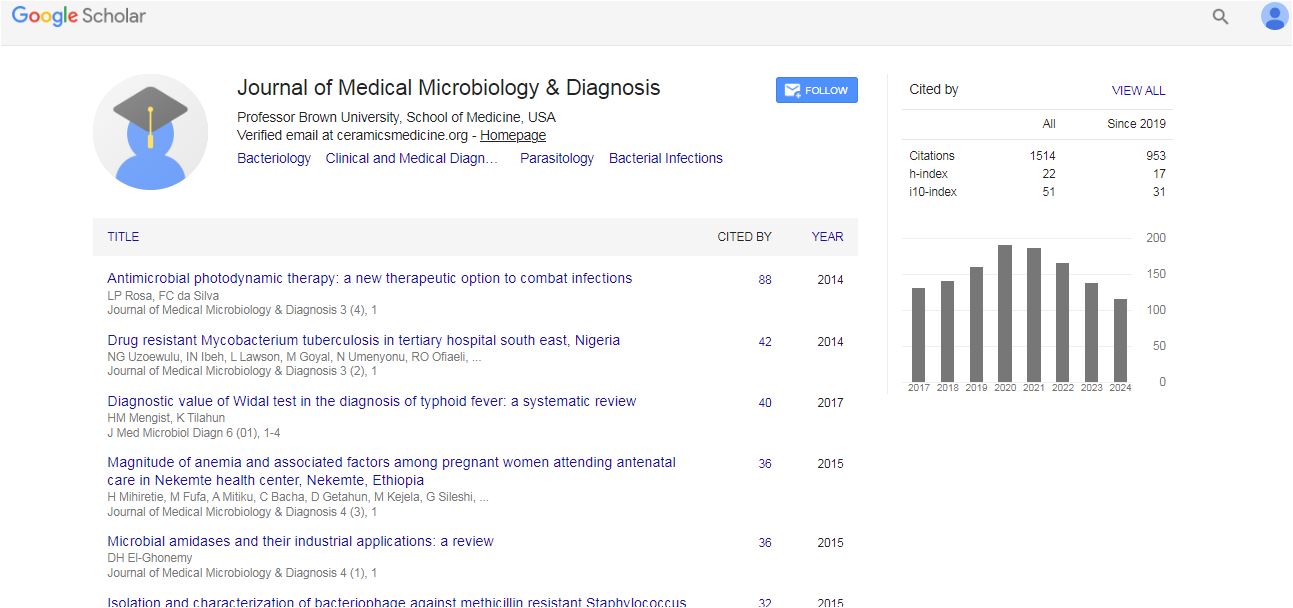
Medical Microbiology & Diagnosis received 14 citations as per Google Scholar report