Commentary - (2025) Volume 9, Issue 4
Received: 02-Jul-2025, Manuscript No. jcao-26-187148;
Editor assigned: 04-Jul-2025, Pre QC No. P-187148;
Reviewed: 18-Jul-2025, QC No. Q-187148;
Revised: 23-Jul-2025, Manuscript No. R-187148;
Published:
30-Jul-2025
, DOI: 10.37421/2684-6004.2025.9.304
Citation: Romero, Daniela. ”Anesthesia Innovations: Precision Medicine, Patient Outcomes.” J Clin Anesthesiol 09 (2025):304.
Copyright: © 2025 Romero D. This is an open-access article distributed under the terms of the Creative Commons Attribution License, which permits unrestricted use, distribution and reproduction in any medium, provided the original author and source are credited.
The field of anesthesia is undergoing a significant transformation driven by technological advancements and a growing emphasis on personalized patient care. Innovations in anesthesia are paving the way for precision perioperative medicine, aiming to optimize patient outcomes and enhance safety throughout the surgical journey. This evolution encompasses a broad spectrum of areas, from advanced drug delivery systems to sophisticated monitoring techniques and the integration of artificial intelligence. One prominent area of innovation is the development and application of advanced anesthetic agents. Novel pharmacological approaches are being explored to provide improved control over anesthetic depth, faster onset and offset of action, and a reduction in adverse effects. These emerging agents hold the promise of enhancing perioperative patient outcomes and expanding the options available to anesthesiologists [1].
Regional anesthesia techniques continue to evolve, playing a crucial role in modern pain management. Ultrasound guidance has revolutionized the precision of nerve blocks, leading to more effective analgesia and a reduction in opioid consumption. These advancements are being integrated into multimodal analgesia strategies to enhance postoperative recovery [2].
Furthermore, the integration of artificial intelligence (AI) and machine learning (ML) into anesthesia practice is becoming increasingly significant. AI algorithms are being developed to predict challenging airways, identify high-risk patients, and personalize anesthetic dosing, thereby enhancing safety and supporting clinical decision-making [4].
Total intravenous anesthesia (TIVA) techniques, particularly those utilizing target-controlled infusion (TCI) systems, are gaining prominence. Evidence supports TIVA's benefits in specific patient populations, offering advantages such as reduced postoperative nausea and vomiting and improved emergence from anesthesia [5].
The optimization of hemodynamic management is another critical aspect of advanced perioperative care. Techniques such as arterial waveform analysis and echocardiography are being employed to guide fluid management and vasopressor therapy, aiming to improve tissue perfusion and reduce postoperative complications [3].
Enhanced recovery after surgery (ERAS) protocols are increasingly incorporating advanced anesthetic strategies. The judicious use of regional anesthesia, multimodal analgesia, and the avoidance of certain anesthetic agents are key components that contribute to faster patient recovery and reduced hospital stays [6].
The role of volatile anesthetic agents extends beyond their anesthetic and analgesic properties, with research exploring their potential for neuroprotection and organ protection. Mechanisms by which these agents may protect against ischemia-reperfusion injury are being investigated [7].
Neuromuscular blocking agents (NMBAs) are essential in surgical anesthesia, and their optimal use is being refined through quantitative monitoring. Advancements in monitoring devices ensure adequate blockade and facilitate timely reversal, minimizing the risk of postoperative residual curarization [8].
Finally, patient safety remains a paramount concern in advanced anesthesia. Strategies for mitigating perioperative risks, including robust communication, team-based approaches, and simulation-based training, are crucial for creating a safer anesthetic environment [10].
The landscape of advanced anesthesia is characterized by a relentless pursuit of optimizing patient care through technological innovation and evidence-based practice. Emerging anesthetic agents represent a significant frontier, with research focusing on novel pharmacological agents designed to offer superior control over anesthetic depth, quicker onset and offset of action, and diminished side effects. These advancements are pivotal in improving perioperative outcomes and broadening the therapeutic arsenal available to anesthesiologists [9].
Regional anesthesia continues to be refined, with ultrasound guidance playing a central role in enhancing the precision of nerve blocks. This improved localization not only facilitates more effective postoperative pain management but also contributes to a reduction in opioid dependency. The integration of these techniques into multimodal analgesia protocols is a key strategy for accelerating patient recovery [2].
Artificial intelligence (AI) and machine learning (ML) are poised to revolutionize anesthetic practice. AI algorithms are being developed to predict difficult airways, identify patients at high risk of adverse events, and tailor anesthetic dosages to individual patient needs. These technologies promise to elevate patient safety and streamline clinical decision-making processes for anesthesiologists [4].
Total intravenous anesthesia (TIVA) techniques, particularly those employing target-controlled infusion (TCI) systems, are increasingly recognized for their benefits. Studies have demonstrated TIVA's efficacy in reducing postoperative nausea and vomiting and promoting smoother emergence from anesthesia in specific surgical contexts [5].
Advanced hemodynamic monitoring techniques, such as arterial waveform analysis and echocardiography, are instrumental in optimizing fluid management and guiding vasopressor therapy during surgical procedures. Proactive hemodynamic optimization can lead to improved tissue perfusion and a decreased incidence of postoperative complications [3].
Enhanced recovery after surgery (ERAS) pathways are increasingly being integrated with sophisticated anesthetic techniques. Strategies such as multimodal analgesia, strategic regional anesthesia, and the careful selection of anesthetic agents are crucial for achieving faster recovery, reduced pain, and shorter hospital stays within ERAS frameworks [6].
Volatile anesthetic agents are being studied for their potential beyond anesthesia and analgesia, specifically their neuroprotective and organ-protective effects. Research is exploring the mechanisms by which these agents may shield organs from ischemia-reperfusion injury [7].
Quantitative neuromuscular monitoring has become a cornerstone of advanced anesthetic practice, ensuring the appropriate administration and reversal of neuromuscular blocking agents (NMBAs). This technology is vital in preventing postoperative residual curarization and personalizing NMBA management [8].
Innovations in anesthesia, including the integration of AI and ML, are driving the field toward precision perioperative medicine. These advancements aim to optimize patient care through tailored anesthetic management strategies, improved safety profiles of anesthetic agents, and faster recovery times [1].
Patient safety remains a critical focus in the operating room. Strategies that emphasize robust communication protocols, collaborative team-based approaches, and the utilization of simulation for training are essential for mitigating perioperative risks and fostering a culture of safety in anesthesia [10].
This compilation of research explores the forefront of anesthetic advancements, emphasizing precision perioperative medicine and enhanced patient outcomes. Key areas include the development of novel anesthetic agents with improved safety profiles and faster recovery, alongside sophisticated regional anesthesia techniques guided by ultrasound for superior pain management. The integration of artificial intelligence and machine learning is highlighted for its potential in predicting risks and personalizing anesthetic care. Hemodynamic monitoring and total intravenous anesthesia techniques are discussed for optimizing patient management. Furthermore, the synergy between advanced anesthesia and Enhanced Recovery After Surgery (ERAS) protocols is examined, alongside research into the protective effects of volatile anesthetics and advancements in neuromuscular monitoring. Patient safety through risk mitigation strategies remains a central theme across these innovations.
None
None
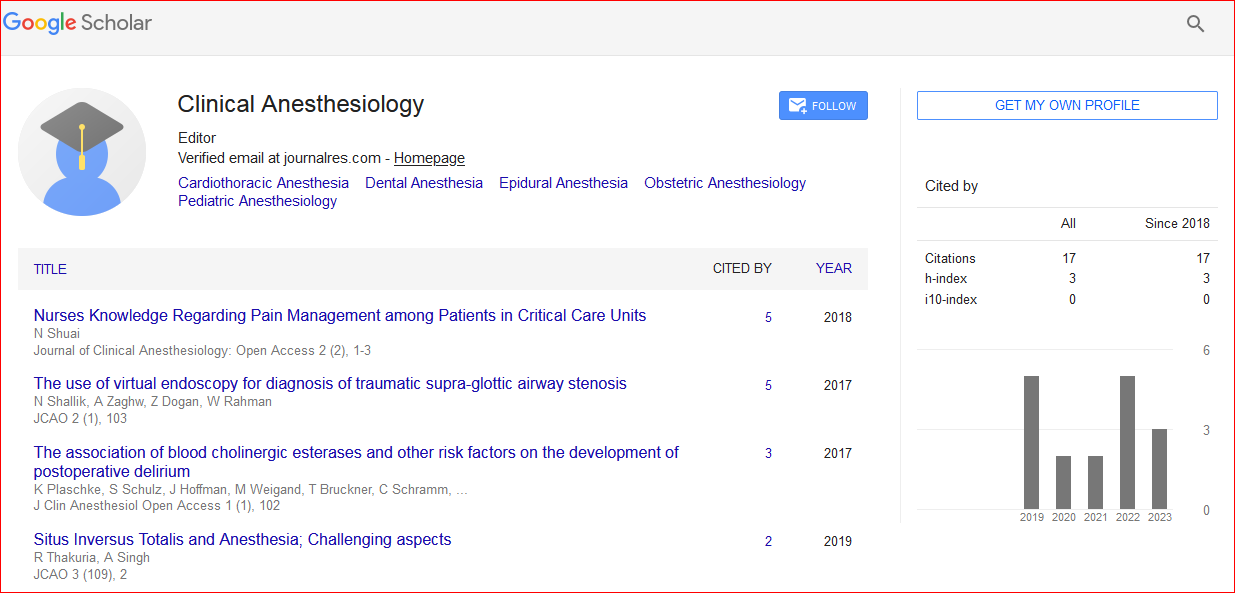
Journal of Clinical Anesthesiology: Open Access received 31 citations as per Google Scholar report