Short Communication - (2025) Volume 14, Issue 4
Received: 01-Jul-2025, Manuscript No. pbt-25-173768;
Editor assigned: 03-Jul-2025, Pre QC No. P-173768;
Reviewed: 17-Jul-2025, QC No. Q-173768;
Revised: 22-Jul-2025, Manuscript No. R-173768;
Published:
29-Jul-2025
, DOI: 10.37421/2167-7689.2025.14.497
Citation: Thorne, Emily R.. ”ANDA: Generics, Bioequivalence, Access, Innovation.” Pharmaceut Reg Affairs 14 (2025):497.
Copyright: © 2025 Thorne R. Emily This is an open-access article distributed under the terms of the Creative Commons Attribution License, which permits unrestricted use,
distribution and reproduction in any medium, provided the original author and source are credited.
The Abbreviated New Drug Application (ANDA) process is how generic drugs get approved in the United States. What this really means is that a generic drug doesn't need to repeat the extensive clinical trials done for the original brand-name drug. Instead, it proves it's identical in active ingredient, strength, dosage form, route of administration, and that it performs the same way in the body. This approach keeps drug development costs down and helps get affordable medicines to people faster.[1] Developing generic drugs comes with its own set of challenges, even with the streamlined ANDA pathway. We're talking about things like demonstrating bioequivalence for complex formulations, navigating intellectual property hurdles, and keeping up with evolving regulatory science. The FDA plays a crucial role here, not just in reviewing applications but also in fostering innovation and addressing these hurdles to ensure a steady supply of high-quality, affordable generics.[2] A key part of an ANDA is proving bioequivalence. This means demonstrating that the generic drug performs essentially the same way as the brand-name drug in terms of its absorption rate and extent within the body. Itâ??s not about being identical, but about being therapeutically equivalent. What this really means for patients is that they can expect the same safety and efficacy from a generic as they would from its brand-name counterpart, all backed by rigorous scientific studies.[3] Generic manufacturers often use what's called a Paragraph IV certification to challenge existing patents on brand-name drugs. This is a strategic move that can accelerate generic market entry if successful, potentially bringing more affordable options to patients sooner. Itâ??s a complex legal and regulatory dance, and its outcome significantly shapes the competitive landscape and accessibility of medications.[4] The Generic Drug User Fee Amendments (GDUFA) were enacted to speed up the review of generic drug applications and reduce the backlog. Essentially, generic drug manufacturers pay fees to the FDA, and those funds are used to hire more staff and improve technology for the ANDA review process. The goal is to get safe and effective generic drugs to market faster, benefiting both industry and patients.[5] Even after a generic drug is approved via an ANDA and hits the market, the FDA continues to monitor its safety and efficacy through postmarketing surveillance. This involves collecting and analyzing adverse event reports, conducting inspections, and ensuring manufacturing quality remains consistent. Itâ??s a crucial safety net, making sure that once a drug is out there, it continues to perform as expected for all patients.[6] While ANDAs simplify approval for many generics, some products are considered 'complex generics.' Think about drugs with intricate formulations, complex active ingredients, or specialized delivery systems, like inhaled products or injectables. These require more nuanced scientific and regulatory approaches to demonstrate bioequivalence and overall therapeutic equivalence, posing distinct challenges for both developers and regulators.[7] Generic drug approvals, facilitated by the ANDA pathway, translate into substantial economic benefits. By introducing competition, generics drive down prescription drug costs significantly for patients, healthcare systems, and governments. This cost savings allows more people to access necessary medications, improving public health outcomes and freeing up resources for other healthcare needs. It's a fundamental pillar of affordable healthcare.[8] Regulatory science for generic drugs is constantly evolving. What this means is that researchers and regulators are always looking for better ways to assess generic drug equivalence, especially for more complex products. This includes developing new analytical methods, in vitro tests, and modeling approaches to predict drug performance. These advancements in regulatory science help streamline the ANDA process, ensuring high standards of quality and efficiency.[9] Beyond national borders, there's a growing movement towards global regulatory convergence for generic drugs. This aims to harmonize standards and processes across different countries, making it easier for manufacturers to bring generics to multiple markets. By reducing redundant testing and reviews, global convergence can accelerate access to affordable medicines worldwide and foster a more efficient global pharmaceutical landscape.[10].
The Abbreviated New Drug Application (ANDA) process facilitates the approval of generic drugs in the United States. This pathway avoids repeating extensive clinical trials for original brand-name drugs; instead, it requires proof that the generic is identical in active ingredient, strength, dosage form, and route of administration, and performs identically in the body. This significantly lowers drug development costs and speeds up access to affordable medicines [1]. A key component of an ANDA is demonstrating bioequivalence, which means showing the generic drug performs essentially the same way as its brand-name counterpart in terms of absorption rate and extent within the body. The goal here is therapeutic equivalence, ensuring patients receive the same safety and efficacy [3].
Developing generic drugs presents unique challenges, even with the streamlined ANDA pathway. These include demonstrating bioequivalence for complex formulations, navigating intellectual property hurdles, and adapting to evolving regulatory science. The Food and Drug Administration (FDA) is vital in reviewing applications, fostering innovation, and addressing these hurdles to maintain a consistent supply of high-quality, affordable generics [2]. While the ANDA process simplifies approval for many generics, some are classified as 'complex generics.' These involve intricate formulations, complex active ingredients, or specialized delivery systems, such as inhaled products or injectables. Such products demand more nuanced scientific and regulatory approaches to establish bioequivalence and overall therapeutic equivalence, posing distinct challenges for both developers and regulators [7].
Generic manufacturers often utilize Paragraph IV certification to challenge existing brand-name drug patents. This strategic move can accelerate generic market entry if successful, bringing more affordable options to patients sooner, though it is a complex legal and regulatory process that shapes market competition and medication accessibility [4]. To further streamline generic drug application reviews and reduce backlogs, the Generic Drug User Fee Amendments (GDUFA) were enacted. Under GDUFA, generic drug manufacturers pay fees to the FDA, which are then used to bolster staff and technology for the ANDA review process. The core aim is to expedite the market availability of safe and effective generic drugs, benefiting both the industry and patients [5]. Ultimately, generic drug approvals, supported by the ANDA pathway, yield substantial economic benefits. By fostering competition, generics considerably reduce prescription drug costs for patients, healthcare systems, and governments. This cost savings enhances access to necessary medications, improving public health and freeing up resources for other healthcare needs, standing as a fundamental pillar of affordable healthcare [8].
After a generic drug gains approval through an ANDA and enters the market, the FDA maintains continuous postmarketing surveillance to monitor its safety and efficacy. This rigorous oversight includes collecting and analyzing adverse event reports, conducting inspections, and ensuring manufacturing quality remains consistent. This crucial safety net ensures that once a drug is available, it continues to perform as anticipated for all patients [6]. The regulatory science governing generic drugs is in a constant state of evolution. Researchers and regulators are actively seeking improved methods to assess generic drug equivalence, especially for more complex products. This involves developing new analytical methods, in vitro tests, and modeling approaches to predict drug performance. Such advancements in regulatory science help streamline the ANDA process, upholding high standards of quality and efficiency [9].
Beyond individual national frameworks, there is a growing global movement towards regulatory convergence for generic drugs. The objective is to harmonize standards and processes across various countries, thereby simplifying the pathway for manufacturers to introduce generics into multiple international markets. By minimizing redundant testing and reviews, global convergence has the potential to accelerate worldwide access to affordable medicines and cultivate a more efficient global pharmaceutical landscape [10].
The Abbreviated New Drug Application (ANDA) process is central to approving generic drugs in the United States, allowing them to bypass extensive clinical trials by demonstrating therapeutic equivalence to brand-name drugs. This approach significantly reduces development costs and enhances access to affordable medications. A core requirement for ANDA approval is proving bioequivalence, ensuring generics perform similarly to their counterparts in the body, guaranteeing equivalent safety and efficacy. Despite a streamlined pathway, generic drug development faces hurdles like complex formulations, intellectual property issues, and the need to keep up with regulatory science. The Food and Drug Administration (FDA) actively addresses these challenges, overseeing reviews and fostering innovation. Strategic moves like Paragraph IV certification can accelerate market entry, while initiatives such as the Generic Drug User Fee Amendments (GDUFA) expedite application reviews. Generic approvals bring substantial economic benefits, driving down costs and improving public health. Even post-market, the FDA monitors generic drugs for safety and efficacy through surveillance. Regulatory science is constantly evolving to improve equivalence assessment, especially for complex generics. Furthermore, global regulatory convergence aims to harmonize international standards, accelerating worldwide access to affordable medicines.
None
None
1. Sarah AG, Adam SG, Mark DG. "Generic Drug Application Review and Approval in the United States".Clin Pharmacol Ther 108 (2020):766-773.
Indexed at, Google Scholar, Crossref
2. Janet W, Donald DA, Douglas CT. "Challenges and Opportunities in Generic Drug Development: An FDA Perspective".N Engl J Med 381 (2019):1989-1992.
Indexed at, Google Scholar, Crossref
3. Donglu Z, Bin Z, Kun L. "Bioequivalence for Generic Drug Products: Challenges and Strategies".AAPS J 24 (2022):86.
Indexed at, Google Scholar, Crossref
4. Andrew PS, Kevin CS, Michael AJ. "The Impact of Paragraph IV Certifications on Generic Drug Market Entry".J Health Econ 76 (2021):102409.
Indexed at, Google Scholar, Crossref
5. Monica MM, Brian JS, David RJ. "Generic Drug User Fee Amendments: A Review of Their Impact on Generic Drug Approvals".J Clin Pharmacol 60 (2020):1301-1308.
Indexed at, Google Scholar, Crossref
6. Elizabeth SO, Peter LK, Laura MD. "Postmarketing Surveillance of Generic Drugs: A Regulatory Perspective".Pharmaceutics 14 (2022):360.
Indexed at, Google Scholar, Crossref
7. Dale PS, Robert KJ, Susan MC. "Regulatory Challenges for Complex Generic Drug Products".Int J Pharm 569 (2019):118625.
Indexed at, Google Scholar, Crossref
8. Mark DM, Sarah JD, Peter TG. "The Economic Benefits of Generic Drug Approvals: A Review of Evidence".Health Aff (Millwood) 40 (2021):1210-1216.
Indexed at, Google Scholar, Crossref
9. Christina TP, Brian MS, Amy HJ. "Advancing Generic Drug Regulatory Science to Improve Public Health".Clin Transl Sci 16 (2023):7-10.
Indexed at, Google Scholar, Crossref
10. David RG, Sarah EW, Michael PB. "Global Regulatory Convergence for Generic Drug Products".Drug Dev Ind Pharm 46 (2020):1573-1578.
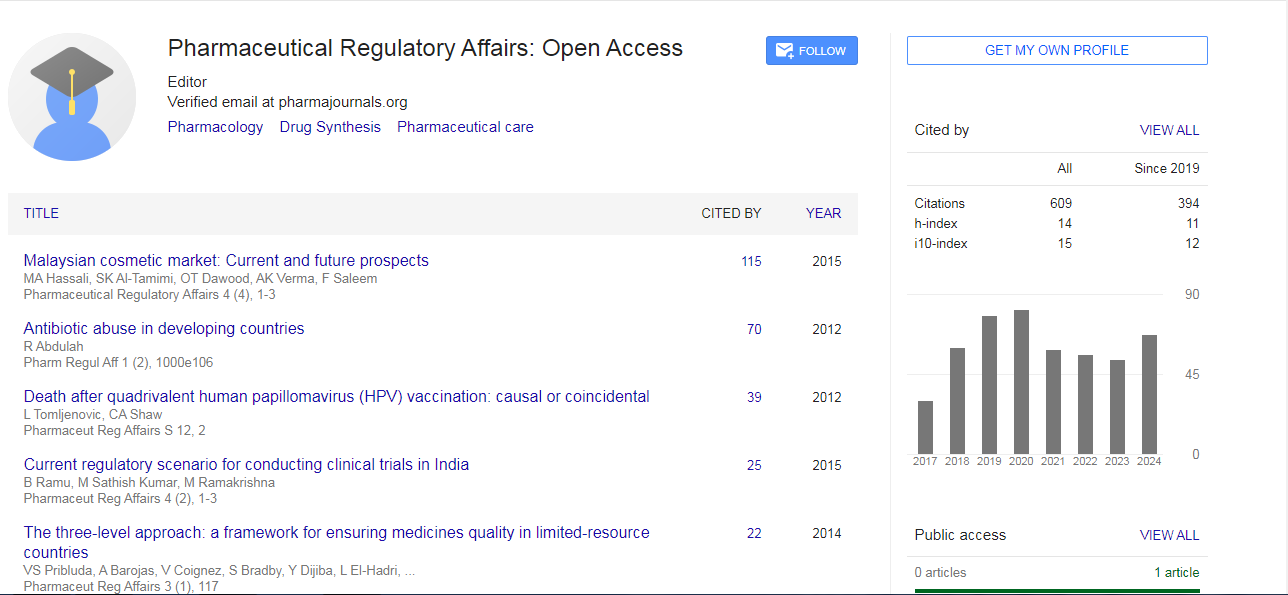
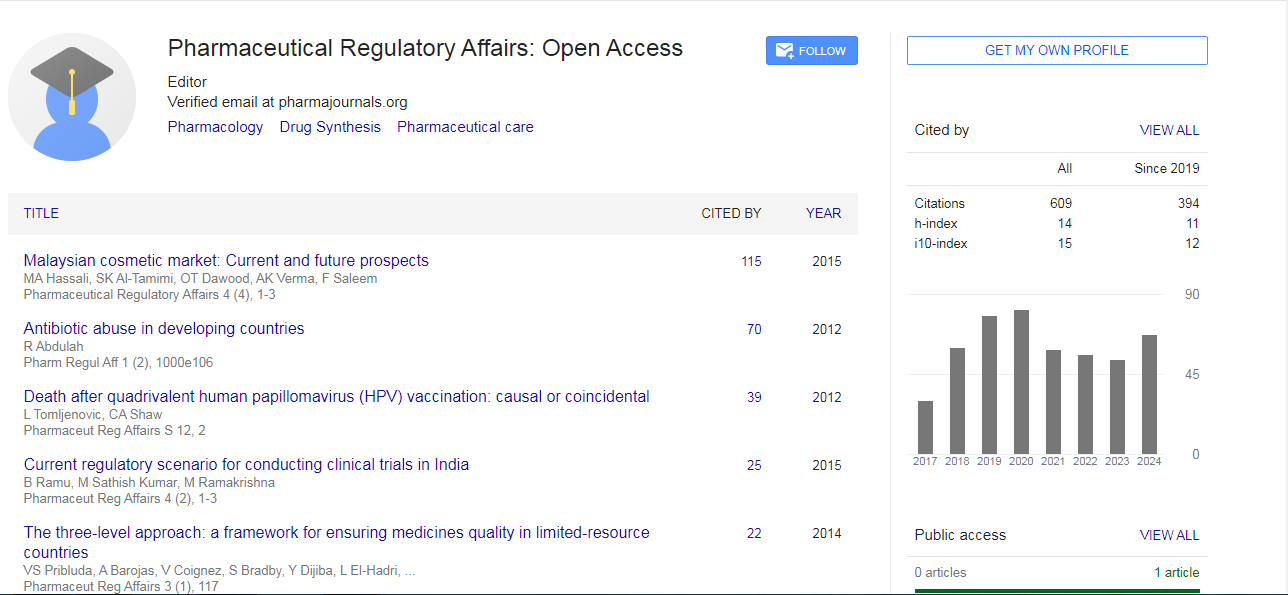
Pharmaceutical Regulatory Affairs: Open Access received 533 citations as per Google Scholar report