Commentary - (2025) Volume 12, Issue 4
Received: 01-Aug-2025, Manuscript No. jreac-26-185846;
Editor assigned: 04-Aug-2025, Pre QC No. P-185846;
Reviewed: 18-Aug-2025, QC No. Q-185846;
Revised: 22-Aug-2025, Manuscript No. R-185846;
Published:
29-Aug-2025
, DOI: 10.37421/2380-2391.2025.12.440
Citation: Ionescu, Gabriela. ”Analyzing PFAS: Advanced Techniques and Method Standardization.” J Environ Anal Chem 12 (2025):440.
Copyright: © 2025 Ionescu G. This is an open-access article distributed under the terms of the Creative Commons Attribution License, which permits unrestricted use, distribution and reproduction in any medium, provided the original author and source are credited.
The detection and quantification of per- and polyfluoroalkyl substances (PFAS) in various environmental matrices, including water and soil, present a formidable array of analytical challenges that necessitate sophisticated methodologies. These difficulties are deeply rooted in the inherent complexity of PFAS chemistry, encompassing a vast range of structurally diverse compounds, many of which exist at extremely low concentrations in the environment. Furthermore, the intricate nature of environmental samples, characterized by the presence of numerous interfering substances, often leads to significant matrix effects that can confound accurate analysis. Advancements in separation science, particularly the adoption of ultra-high-performance liquid chromatography (UHPLC), when coupled with highly sensitive detection techniques such as tandem mass spectrometry (MS/MS), have become indispensable for achieving the required specificity and sensitivity in PFAS analysis. The efficacy of sample preparation, a critical upstream step, heavily relies on techniques like solid-phase extraction (SPE). Careful optimization of SPE protocols is paramount to ensure the efficient extraction and cleanup of these persistent organic pollutants from diverse matrices while simultaneously minimizing the introduction of interfering compounds. The ongoing development and widespread adoption of standardized, validated analytical methods are crucial for ensuring the comparability of data across different laboratories and for meeting stringent regulatory requirements aimed at monitoring and controlling PFAS contamination. [1] This ongoing research effort highlights the critical and undeniable need for advanced analytical techniques capable of overcoming the multifaceted challenges inherent in PFAS analysis. A significant focus within this field is the meticulous optimization of solid-phase extraction protocols, particularly when dealing with complex soil matrices. The primary objective is to enhance the recovery rates of target PFAS compounds and to effectively mitigate matrix effects, which frequently compromise the reliability of detection. The central role of hyphenated techniques, most notably liquid chromatography coupled with tandem mass spectrometry (LC-MS/MS), is consistently emphasized for its dual capability in achieving both robust separation and definitive identification of an extensive spectrum of PFAS, including increasingly concerning short-chain and novel compounds. The limitations associated with traditional analytical methods are continuously discussed, and researchers are actively proposing pathways toward the development of more comprehensive and demonstrably reliable methods for PFAS quantification. [2] The ubiquitous presence of PFAS in vital drinking water sources underscores the urgent necessity for highly sensitive and accurate detection methodologies. This area of research delves deeply into the analytical performance characteristics of a variety of extraction and detection strategies specifically tailored for trace-level PFAS determination in potable water. A key aspect involves a comparative analysis of the efficacy of different solid-phase extraction sorbent materials and elution solvents, aiming to achieve optimal recovery rates across a broad range of PFAS compounds. Furthermore, significant scrutiny is applied to the impact that co-existing ions and dissolved organic matter can have on mass spectrometric detection. This emphasis highlights the profound importance of rigorous sample cleanup procedures to guarantee the accuracy and reliability of risk assessments associated with PFAS in drinking water. [3] This particular article directly addresses the emerging and increasingly complex challenge of analyzing fluorinated precursors and transformation products of PFAS. These compounds are of significant concern because they can readily convert to perfluorinated compounds within the environment, complicating the overall assessment of contamination. The research explores the application of advanced analytical approaches, including high-resolution mass spectrometry (HRMS), which is proving invaluable for the identification and quantification of these critical precursors. The authors meticulously detail the inherent difficulties associated with accurately differentiating between the parent PFAS compounds and their various degradation products. This underscores the critical need for the development and implementation of robust analytical protocols that are capable of capturing the complete and multifaceted scope of PFAS contamination, including these less directly measured species. [4] Matrix effects, particularly when analyzing PFAS in soil samples, represent a significant and persistent concern for analytical chemists. These effects can manifest as either suppressed or enhanced ionization in mass spectrometry, directly impacting the accuracy of quantitative measurements. This study meticulously investigates the nuanced impact of various soil properties, such as the organic carbon content and the specific clay composition, on the extraction efficiency and the subsequent analytical response observed for a diverse range of PFAS compounds. In response to these challenges, the researchers propose practical strategies, including the implementation of matrix-matched calibration and the judicious use of internal standardization, to effectively mitigate these detrimental matrix effects and thereby substantially improve the overall accuracy and reliability of the quantitative results obtained. [5] The imperative for the development of standardized and harmonized analytical methods for PFAS cannot be overstated, particularly given their crucial role in regulatory decision-making and the essential need for comparing data generated across diverse studies and laboratories worldwide. This paper provides a comprehensive review of the current landscape of analytical methodologies employed for PFAS determination. It critically discusses the existing guidelines and the practical challenges encountered during their implementation, offering valuable insights and suggesting specific areas for future method development. The authors place a strong emphasis on the pressing need for broader analyte coverage in standard methods, the achievement of lower and more reliable limits of quantification, and the enhancement of inter-laboratory comparability to ensure data integrity. [6] This particular study directs its focus towards the distinct analytical challenges associated with the detection of PFAS in complex wastewater matrices. The researchers systematically explore the effectiveness of a range of sample preparation techniques, critically evaluating different solid-phase extraction (SPE) cartridges and employing various derivatization methods. The primary goals of these techniques are to efficiently remove interfering substances commonly found in wastewater and to effectively concentrate the target PFAS analytes. Furthermore, the study meticulously assesses the performance of liquid chromatography coupled with high-resolution mass spectrometry (LC-HRMS) for the accurate identification and precise quantification of an extensive array of PFAS, including those exhibiting complex structural characteristics, within both treated and untreated wastewater samples. [7] The critical aspect of method validation for the accurate analysis of PFAS in diverse environmental samples is thoroughly examined in this paper. It provides a detailed discussion of the essential parameters that are necessary for establishing a robust, reliable, and defensible analytical method. These parameters include specificity, linearity of response, accuracy, precision, and the determination of appropriate limits of detection and quantification. The authors offer valuable insights into the specific challenges encountered when attempting to establish these critical validation parameters for a broad spectrum of PFAS compounds within varied matrices, such as both water and soil. The importance of employing appropriate reference materials and implementing rigorous quality control measures is strongly highlighted. [8] The ability to accurately and reliably detect and quantify newly emerging PFAS compounds represents a constant and evolving challenge within the field of environmental analysis. This research systematically introduces and rigorously validates a novel analytical approach specifically designed for a wide range of shorter-chain and fluorinated ether PFAS. The study provides a detailed account of the optimization process for key ultra-high-performance liquid chromatography coupled with high-resolution mass spectrometry (UHPLC-HRMS) parameters. It also describes the development of optimized solid-phase extraction (SPE) procedures specifically designed to enhance the recovery of these less extensively studied compounds from water samples. The authors underscore the critical significance of monitoring these emerging PFAS due to their potential toxicity and environmental persistence. [9] This article critically discusses the significant analytical implications associated with PFAS in the context of soil remediation efforts. It specifically focuses on the complex challenges encountered in effectively extracting PFAS from contaminated soils that have undergone various remediation technologies. These technologies can significantly alter the soil matrix, thereby affecting the mobility and extractability of the target PFAS analytes. The authors explore the application of advanced extraction techniques and the use of LC-MS/MS to both rigorously assess the effectiveness of different remediation strategies and to reliably monitor for residual PFAS levels. This provides crucial data essential for the successful management and long-term oversight of contaminated sites. [10]
The detection of per- and polyfluoroalkyl substances (PFAS) in water and soil systems is fraught with significant analytical challenges stemming from their diverse chemical structures, low environmental concentrations, and the complex matrix effects inherent in environmental samples. To address these issues, advancements in chromatography, particularly ultra-high-performance liquid chromatography (UHPLC), coupled with sensitive tandem mass spectrometry (MS/MS) techniques, are crucial for achieving the necessary specificity and sensitivity. Sample preparation, a vital step, often involves solid-phase extraction (SPE), which requires careful optimization to efficiently extract and clean up these persistent compounds from various matrices while minimizing interference. The development of standardized, validated methods is essential for inter-laboratory comparability and regulatory compliance in monitoring PFAS contamination. [1] This research underscores the critical need for advanced analytical techniques to overcome the inherent challenges in PFAS analysis. The study specifically focuses on optimizing solid-phase extraction protocols for complex soil matrices, with the aim of improving recovery rates and reducing matrix effects that often confound accurate detection. It highlights the indispensable role of hyphenated techniques, particularly LC-MS/MS, in providing both effective separation and definitive identification of a wide range of PFAS, including short-chain and novel compounds that are increasingly of concern. The authors critically discuss the limitations of traditional methods and propose a clear pathway toward the development of more comprehensive and reliable PFAS quantification strategies. [2] The pervasive presence of PFAS in drinking water sources necessitates the implementation of highly sensitive detection methods. This paper thoroughly investigates the analytical performance of various extraction and detection strategies for trace-level PFAS determination in potable water. It provides a comparative analysis of the efficacy of different SPE sorbent materials and elution solvents in achieving optimal recoveries across a broad spectrum of PFAS. The work further scrutinizes the impact of co-existing ions and organic matter on mass spectrometric detection, thereby emphasizing the paramount importance of rigorous sample cleanup procedures to ensure the accuracy of risk assessments. [3] This article addresses the complex and emerging challenge of analyzing fluorinated precursors and transformation products of PFAS, which have the potential to convert into perfluorinated compounds within the environment. The research explores the application of advanced analytical approaches, such as high-resolution mass spectrometry (HRMS), to effectively identify and quantify these precursors. The authors meticulously highlight the inherent difficulties associated with accurately differentiating between the parent compounds and their degradation products, underscoring the critical need for robust analytical protocols that can comprehensively capture the full scope of PFAS contamination. [4] Matrix effects in PFAS analysis, particularly when dealing with soil samples, represent a significant concern that can lead to suppressed or enhanced ionization in mass spectrometry, impacting quantitative accuracy. This study systematically investigates the impact of different soil properties, such as organic carbon content and clay composition, on the extraction efficiency and analytical response of various PFAS. To mitigate these effects and improve the accuracy of quantitative results, the researchers propose practical strategies, including the use of matrix-matched calibration and internal standardization. [5] The development of standardized and harmonized analytical methods for PFAS is of paramount importance for regulatory purposes and for enabling the comparison of data across different studies and laboratories. This paper reviews the current state of analytical methodologies, critically discusses existing guidelines and the challenges associated with their implementation, and suggests key areas for future method development. The authors strongly emphasize the need for broader analyte coverage in these methods, improved limits of quantification, and enhanced inter-laboratory comparability to ensure data reliability. [6] This study specifically focuses on the analytical challenges encountered when detecting PFAS in complex wastewater matrices. The authors thoroughly explore the effectiveness of various sample preparation techniques, including the use of different SPE cartridges and derivatization methods, aimed at removing interfering substances and concentrating the target analytes. They also rigorously assess the performance of LC-HRMS for the identification and quantification of a wide array of PFAS, including those with complex structures, in both treated and untreated wastewater samples. [7] The critical aspect of method validation for PFAS analysis in environmental samples is thoroughly examined in this paper. It discusses the essential parameters required for a robust and reliable analytical method, including specificity, linearity, accuracy, precision, and limits of detection and quantification. The authors provide valuable insights into the challenges of establishing these parameters for a broad range of PFAS in diverse matrices like water and soil, highlighting the importance of using appropriate reference materials and implementing stringent quality control measures. [8] The ability to accurately detect and quantify newly emerging PFAS is a constant analytical challenge. This research introduces and validates a novel analytical approach for a wide range of shorter-chain and fluorinated ether PFAS. The study details the optimization of UHPLC-HRMS parameters and the development of SPE procedures to enhance the recovery of these less studied compounds from water samples. The authors emphasize the significance of monitoring these compounds due to their potential toxicity and persistence in the environment. [9] This article discusses the analytical implications of PFAS in the context of soil remediation efforts. It focuses on the challenges of extracting PFAS from contaminated soils treated with various remediation technologies, which can alter the soil matrix and affect analyte mobility and extractability. The authors explore the use of advanced extraction techniques and LC-MS/MS to assess the effectiveness of remediation and monitor residual PFAS levels, providing critical data for the successful management of contaminated sites. [10]
Analyzing per- and polyfluoroalkyl substances (PFAS) in environmental samples like water and soil is complex due to their diverse structures, low concentrations, and interference from sample matrices. Advanced techniques such as UHPLC and LC-MS/MS are essential for accurate detection. Solid-phase extraction (SPE) is crucial for sample preparation, requiring careful optimization to effectively isolate PFAS and minimize interference. Developing standardized, validated methods is vital for comparable results and regulatory compliance. Research focuses on optimizing SPE for soil, enhancing LC-MS/MS capabilities for broad-spectrum PFAS identification, and developing methods for trace-level detection in drinking water. Addressing fluorinated precursors and transformation products, as well as mitigating matrix effects in soil analysis through calibration strategies, are key areas of investigation. Standardization and harmonization of methods are crucial for regulatory purposes and data comparability. Wastewater analysis presents unique challenges requiring specific sample preparation and LC-HRMS techniques. Method validation parameters, including accuracy and sensitivity, are critical for reliable PFAS analysis in diverse environmental media. Emerging PFAS compounds require specialized UHPLC-HRMS methods and optimized SPE. Finally, assessing PFAS in remediated soils necessitates advanced extraction and LC-MS/MS to evaluate remediation effectiveness and monitor residual levels.
None
None
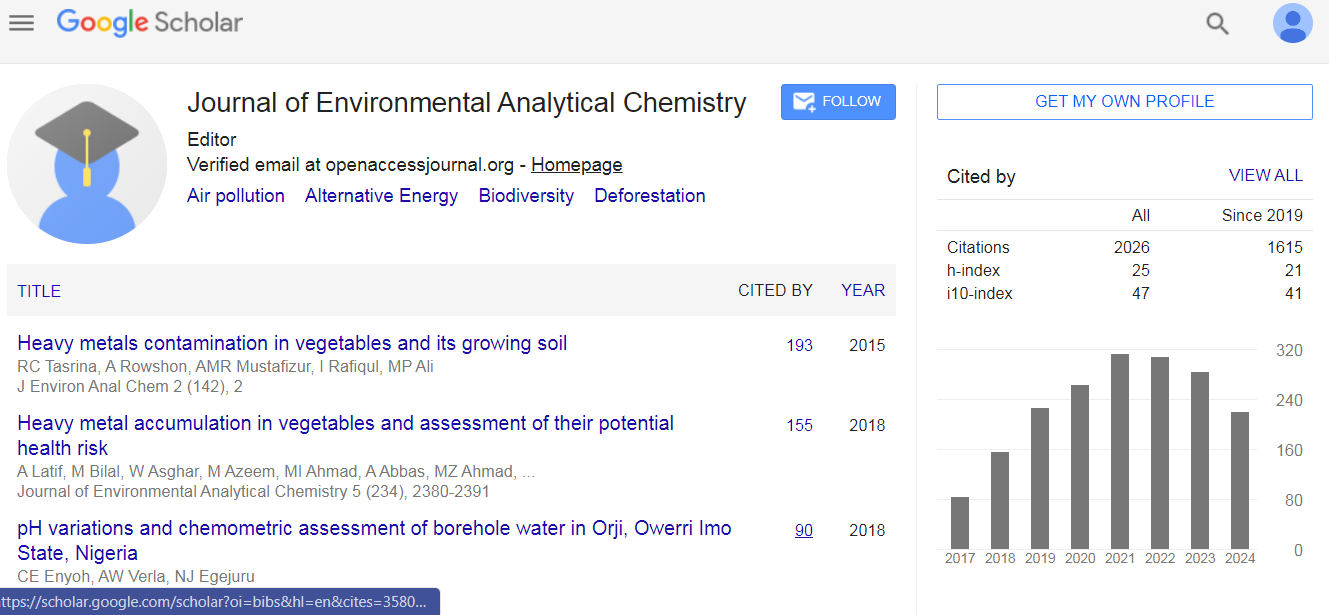
Journal of Environmental Analytical Chemistry received 1781 citations as per Google Scholar report