Short Communication - (2025) Volume 9, Issue 5
Received: 01-Sep-2025, Manuscript No. jma-26-184627;
Editor assigned: 03-Sep-2025, Pre QC No. P-184627;
Reviewed: 17-Sep-2025, QC No. Q-184627;
Revised: 22-Sep-2025, Manuscript No. R-184627;
Published:
29-Sep-2025
, DOI: 10.37421/2684-4265.2025.09.406
Citation: Figueira, Bruno Martins. ”Amphibian Reproductive Morphology: Diversity and Adaptation.” J Morphol Anat 09 (2025):406.
Copyright: © 2025 Figueira M. Bruno This is an open-access article distributed under the terms of the Creative Commons Attribution License, which permits unrestricted use, distribution and reproduction in any medium, provided the original author and source are credited.
The intricate morphology of amphibian reproductive systems exhibits remarkable variations across different species, offering a window into evolutionary adaptations. Key insights highlight diverse adaptations in gonadal structure, sperm morphology, and reproductive tract development, which are closely correlated with varied breeding strategies and distinct environmental pressures. This underscores the significant evolutionary plasticity inherent in these systems, providing a comparative anatomical perspective that is crucial for a comprehensive understanding of amphibian biology and their conservation needs. [1] Focusing specifically on urodeles, current research explores the detailed anatomy of their reproductive organs, encompassing the gonads, vasa deferentia, and cloaca. The paper thoughtfully discusses how particular morphological features, such as the presence of cloacal glands and the specific structure of the testes, are intrinsically linked to internal fertilization mechanisms and the parental care behaviors observed in certain salamander species. This work serves to provide a foundational understanding of urodele reproductive anatomy. [2] Recent studies investigate the ultrastructure of amphibian spermatozoa, revealing a significant degree of diversity in head shape, midpiece structure, and tail morphology. These observed variations are presented as adaptations tailored to different reproductive environments, ranging from fully aquatic to predominantly terrestrial settings. Furthermore, they are discussed in relation to their impact on fertilization success and the dynamics of sperm competition. This paper offers a detailed examination of the micro-anatomical features characterizing amphibian gametes. [3] Further research examines the reproductive morphology of caecilians, a group of limbless amphibians, detailing the unique adaptations present within this order. The focus is placed on their internal reproductive organs, the characteristic presence of a cloaca facilitating copulation, and the specific structural characteristics of their gonads. This research importantly contributes to a more complete and nuanced understanding of amphibian reproductive diversity by systematically including this often-overlooked group. [4] Another significant area of investigation involves the sexual dimorphism present in the reproductive morphology of several amphibian species. This research meticulously details the differences observed in the size and structure of gonads, alongside secondary sexual characteristics that are directly related to reproduction. These include features such as vocal sacs and breeding tubercles, with the study linking these morphological disparities to specific mating behaviors and reproductive strategies. [5] The morphology of the cloaca in amphibians is a subject of dedicated examination in current work, highlighting its multifaceted roles in reproduction, excretion, and, in some species, respiration. The paper meticulously details the structural variations observed in the cloacal lips, glands, and chambers across different amphibian orders. Crucially, it correlates these features with specific reproductive behaviors, such as amplexus and internal fertilization mechanisms. [6] An in-depth analysis of the morphology of amphibian ovaries and testes is provided in this research, with a particular focus on their histological structure and cellular composition. The study discusses how variations in follicular arrangement, germ cell development, and the presence of interstitial cells are intricately related to reproductive cycles and the subsequent production of hormones. This research offers a critical microscopic perspective on amphibian gamete production. [7] The developmental trajectory of the reproductive system in both larval and post-metamorphic amphibians is the central theme of this study. It systematically traces the morphological changes occurring in the gonads and reproductive tracts during the transformative process of metamorphosis. The research highlights the critical endocrine control mechanisms and cellular processes that are involved in these ontogenetic shifts, making it essential for understanding changes in reproductive anatomy. [8] Exploring the morphological diversity of external reproductive structures in anurans, such as vocal sacs and breeding appendages, is the focus of this article. It provides an analysis of how these features, which are often sexually dimorphic, have become adapted for critical functions like species recognition, mate attraction, and effective signaling within various acoustic and visual environments. The research strongly emphasizes the functional morphology of these externally visible reproductive traits. [9] Finally, this paper diligently examines the morphology of the oviducts and accessory glands present in female amphibians. The focus is on the structures that play a vital role in egg transport, fertilization processes, and the subsequent protection of developing embryos. It offers detailed histological characteristics of these tissues and discusses their significant contribution to overall reproductive success, including mechanisms for sperm storage and the formation of protective jelly layers around eggs. [10]
This article delves into the intricate morphology of amphibian reproductive systems, presenting a comprehensive examination of variations across diverse species. Key insights derived from the study highlight significant adaptations in gonadal structure, sperm morphology, and the developmental pathways of reproductive tracts. These morphological characteristics are then correlated with distinct breeding strategies and the varied environmental pressures amphibians face, underscoring the remarkable evolutionary plasticity of these systems. The research offers a valuable comparative anatomical perspective that is fundamental for a deeper understanding of amphibian biology and essential for effective conservation efforts. [1] Focusing specifically on urodeles, this research undertakes a detailed exploration of the anatomy of their reproductive organs. This includes a thorough examination of the gonads, the vasa deferentia, and the cloaca. The paper thoughtfully discusses how specific morphological features, such as the presence of specialized cloacal glands and the unique structure of the testes, are intrinsically linked to the internal fertilization mechanisms employed by these amphibians. Furthermore, it connects these anatomical traits to the parental care behaviors observed in certain salamander species, thereby providing a foundational understanding of urodele reproductive anatomy. [2] This study provides a detailed investigation into the ultrastructure of amphibian spermatozoa, revealing a notable degree of diversity in their head shape, midpiece structure, and tail morphology. These variations are interpreted as adaptive responses to different reproductive environments, ranging from aquatic to terrestrial settings. The findings are further discussed in relation to their impact on fertilization success and the dynamics of sperm competition. The paper thus offers a granular, micro-anatomical perspective on amphibian gametes. [3] Examining the reproductive morphology of caecilians, a group of limbless amphibians, this paper elucidates the unique adaptations characteristic of this order. The research concentrates on their internal reproductive organs, emphasizing the presence of a cloaca that facilitates copulation, and the specific structural attributes of their gonads. By including this often-overlooked group, the study makes a significant contribution to a more holistic understanding of amphibian reproductive diversity. [4] This paper investigates the phenomenon of sexual dimorphism within the reproductive morphology of several amphibian species. It provides a detailed account of the differences observed in the size and structural organization of gonads, as well as in secondary sexual characteristics that are directly related to reproductive functions. These include features such as vocal sacs and breeding tubercles. The study effectively links these morphological disparities to distinct mating behaviors and diverse reproductive strategies employed by these species. [5] The morphology of the cloaca in amphibians is explored in this work, with a particular emphasis on its multifaceted role in reproduction, excretion, and, in certain species, respiration. The paper meticulously details the structural variations observed in the cloacal lips, associated glands, and internal chambers across different amphibian orders. Crucially, it correlates these anatomical features with specific reproductive behaviors, including amplexus and the mechanisms of internal fertilization. [6] An in-depth analysis of the morphology of amphibian ovaries and testes is presented in this research, focusing on their histological structure and cellular composition. The study elucidates how variations in follicular arrangement, germ cell development, and the presence of interstitial cells are intimately connected to the animals' reproductive cycles and the hormonal regulation of reproduction. This research provides a critical microscopic perspective on the processes of amphibian gamete production. [7] The ontogeny of the reproductive system in amphibians, encompassing both larval and post-metamorphic stages, is the central subject of this study. It systematically traces the morphological transformations occurring in the gonads and reproductive tracts during metamorphosis, highlighting the critical endocrine control mechanisms and cellular processes involved. This paper is indispensable for comprehending the ontogenetic shifts in reproductive anatomy. [8] This article explores the morphological diversity of external reproductive structures found in anurans, such as vocal sacs and breeding appendages. It provides an analysis of how these features, which often exhibit sexual dimorphism, have evolved as adaptations for crucial functions including species recognition, mate attraction, and effective signaling within various acoustic and visual environments. The research strongly emphasizes the functional morphology of these observable external reproductive traits. [9] Finally, this paper meticulously examines the morphology of the oviducts and accessory glands in female amphibians, with a specific focus on the structures involved in egg transport, fertilization, and protection. It details the histological characteristics of these tissues and discusses their significant contribution to overall reproductive success, including the mechanisms for sperm storage and the formation of protective jelly layers around eggs. [10]
This collection of research explores the diverse morphology of amphibian reproductive systems across various species, including anurans, urodeles, and caecilians. Studies investigate internal and external reproductive organs, gonadal structure, sperm ultrastructure, and sexual dimorphism, correlating these features with breeding strategies and environmental adaptations. The research also covers the cloaca's functions, oviduct morphology, and the ontogeny of reproductive systems during metamorphosis. Histological examinations provide insights into gonad structure and gamete production, while functional morphology links external traits to reproductive behaviors. Overall, the data emphasizes the evolutionary plasticity and functional significance of amphibian reproductive anatomy.
None
None
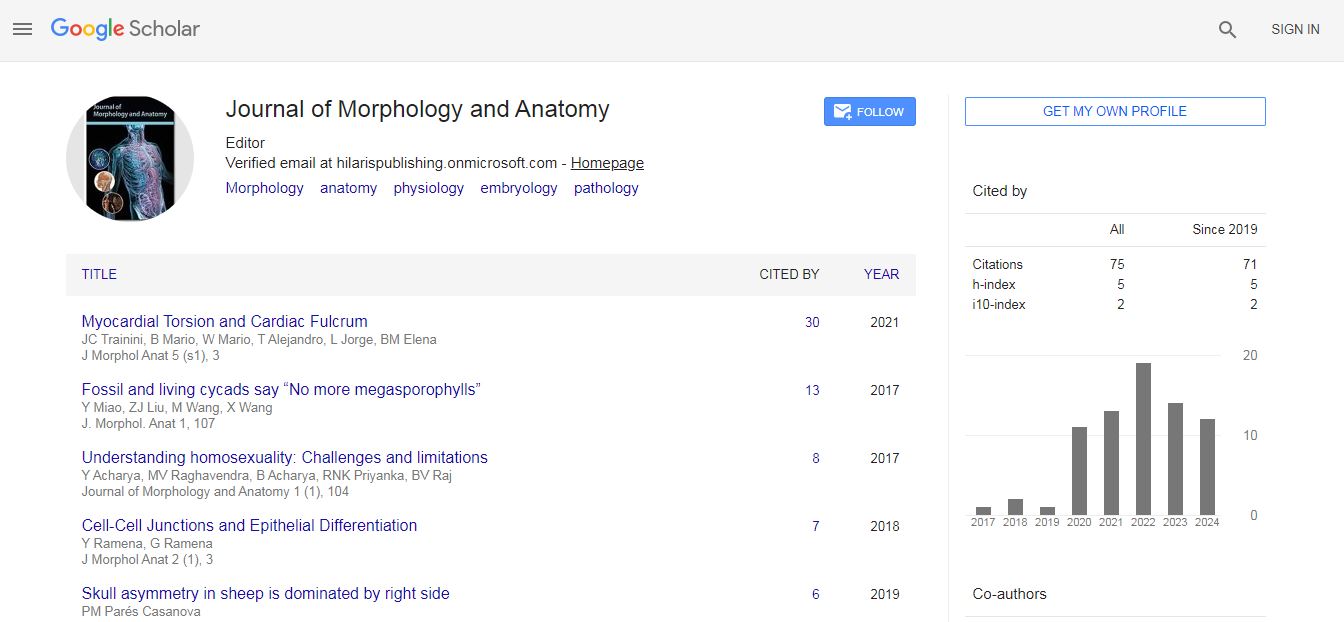
Journal of Morphology and Anatomy received 63 citations as per Google Scholar report