Short Communication - (2025) Volume 11, Issue 5
Received: 02-Oct-2025, Manuscript No. jpnp-25-175533;
Editor assigned: 06-Oct-2025, Pre QC No. P-175533;
Reviewed: 20-Oct-2025, QC No. Q-175533;
Revised: 23-Oct-2025, Manuscript No. R-175533;
Published:
30-Oct-2025
, DOI: 10.37421/2472-0992.2025.11.389
Citation: Ana Pereira. ”Alkaloids: Diverse Bioactivity, Therapeutics, Production.” J Pharmacogn Nat Prod 11 (2025):389.
Copyright: © 2025 P. Ana This is an open-access article distributed under the terms of the Creative Commons Attribution License, which permits unrestricted use, distribution and reproduction in any medium, provided the original author and source are credited.
Alkaloids represent a vast group of natural products with significant pharmacological potential. This review explores their diverse biological activities, from anticancer to antimicrobial effects, while also diving into their complex biosynthetic pathways. It points towards sustainable production strategies, balancing their therapeutic promise with ecological considerations [1].
These compounds possess immense structural diversity, which directly connects to their broad spectrum of biological activities and therapeutic applications [10].
Understanding how structural nuances dictate pharmacological effects is key in drug discovery, where alkaloids are showing current trends and future perspectives across various therapeutic areas [8].
This involves discussions on screening methods, structural modifications, and synthetic approaches to harness their medicinal properties. Recent breakthroughs have significantly advanced the identification of alkaloids with potent antitumor properties. Comprehensive studies detail their intricate mechanisms of action, explore their remarkable structural diversity, and underscore their potential as lead compounds for developing new cancer therapies. These natural molecules demonstrate an ability to effectively target a wide array of cancer pathways, offering hope for novel treatments [2].
Parallel to this, research into their promising role in neuroprotection and the treatment of neurodegenerative diseases is expanding. Investigations reveal how specific alkaloid compounds can effectively mitigate neuronal damage, reduce inflammation, and enhance cognitive function, thereby opening new and exciting avenues for therapeutic development in neurological disorders [3].
In the face of growing antibiotic resistance, the antimicrobial potential of alkaloids has become particularly vital. Reviews compile extensive evidence on various alkaloids exhibiting potent antibacterial, antifungal, and antiviral activities, positioning them as exceptionally valuable candidates for the development of new anti-infective drugs [4].
Further reinforcing this therapeutic area, systematic reviews meticulously gather evidence on the antiviral efficacy of alkaloids against a range of human viruses. These studies discuss their diverse mechanisms, which include inhibiting viral replication and blocking viral entry, firmly establishing alkaloids as a significant area for future antiviral drug discovery efforts [7].
Beyond their direct effects on pathogens and specific diseases, alkaloids also demonstrate significant anti-inflammatory mechanisms. Extensive reviews summarize their ability to modulate inflammatory pathways, offering critical insights into their potential use for treating chronic inflammatory conditions and autoimmune diseases [6].
Concurrent with these therapeutic discoveries, there have been substantial advancements in understanding and engineering alkaloid biosynthesis. This includes the elucidation of enzymatic pathways, the application of sophisticated genetic manipulation techniques, and the adoption of synthetic biology approaches, all designed to enhance the efficient production of valuable alkaloids for both pharmaceutical and industrial applications [5].
Further enhancing production capabilities, the latest advancements in metabolic engineering specifically applied to plant alkaloids are transforming their accessibility. This field highlights how precise genetic modifications and innovative synthetic biology tools are being leveraged to optimize the production of medicinally important alkaloids within both plant systems and microbial hosts [9].
This integrated approach, spanning from fundamental understanding of structural diversity and biological activity to advanced engineering for sustainable production, positions alkaloids as a cornerstone in the ongoing quest for new therapeutic agents.
Alkaloids represent an expansive class of natural products with significant pharmacological potential. This review explores their diverse biological activities, from anticancer to antimicrobial effects, while also diving into their complex biosynthetic pathways. It points towards sustainable production strategies, balancing their therapeutic promise with ecological considerations [1]. These compounds also exhibit immense structural diversity, which directly connects to their broad spectrum of biological activities and therapeutic applications [10]. The current landscape and future directions for alkaloids in drug discovery are examined, covering their potential across various therapeutic areas and discussing screening methods, structural modifications, and synthetic approaches to harness their medicinal properties [8].
Recent breakthroughs highlight alkaloids with potent antitumor properties. Studies discuss their mechanisms of action, structural diversity, and potential as lead compounds for new cancer therapies, showing how these natural molecules can target various cancer pathways effectively [2]. Furthermore, various alkaloids show a promising role in neuroprotection and the treatment of neurodegenerative diseases. Research examines how specific alkaloid compounds can mitigate neuronal damage, reduce inflammation, and improve cognitive function, offering new avenues for therapeutic development [3].
With growing antibiotic resistance, the antimicrobial potential of alkaloids is increasingly important. Evidence compiles various alkaloids exhibiting antibacterial, antifungal, and antiviral activities, positioning them as valuable candidates for developing new anti-infective drugs [4]. Complementing this, a systematic review gathers evidence on the antiviral efficacy of alkaloids against a range of human viruses. It discusses their diverse mechanisms, from inhibiting viral replication to blocking viral entry, establishing alkaloids as a significant area for future antiviral drug discovery [7].
An extensive review summarizes the anti-inflammatory mechanisms and potential therapeutic applications of various alkaloids. It covers their ability to modulate inflammatory pathways, offering insights into their use for treating chronic inflammatory conditions and autoimmune diseases [6]. Beyond direct therapeutic applications, cutting-edge developments are seen in understanding and engineering alkaloid biosynthesis. This work discusses enzymatic pathways, genetic manipulation techniques, and synthetic biology approaches, aiming to enhance the production of valuable alkaloids for pharmaceutical and industrial uses [5].
Latest advancements in metabolic engineering techniques applied to plant alkaloids are critical for optimizing production. This research highlights how genetic modifications and synthetic biology tools are being used to enhance the output of medicinally important alkaloids in plants and microbial hosts [9]. This integrated approach, combining discovery, mechanistic understanding, and advanced production methods, ensures the continued relevance and development of alkaloids as a rich source for future therapeutic agents.
Alkaloids are a diverse class of natural products with significant pharmacological potential. Research extensively explores their biological activities, including anticancer, antimicrobial, neuroprotective, and anti-inflammatory effects, alongside detailed investigations into their complex biosynthetic pathways and sustainable production strategies. Recent breakthroughs highlight alkaloids with potent antitumor properties, discussing their mechanisms and structural diversity as lead compounds for new cancer therapies. Their promising role in neuroprotection and treating neurodegenerative diseases is also evident, as specific compounds mitigate neuronal damage and improve cognitive function. With growing antibiotic resistance, the antimicrobial potential of alkaloids is crucial, demonstrating antibacterial, antifungal, and antiviral activities, making them valuable candidates for new anti-infective drugs. Systematic reviews further confirm their antiviral efficacy against human viruses through diverse mechanisms. Significant advancements are occurring in understanding and engineering alkaloid biosynthesis, utilizing enzymatic pathways, genetic manipulation, and synthetic biology to enhance production for pharmaceutical and industrial uses. Metabolic engineering specifically optimizes plant alkaloid production in various hosts. An overview of their immense structural diversity connects directly to their broad spectrum of biological activities and therapeutic applications, underscoring their importance in drug discovery, where current trends focus on screening, structural modifications, and synthetic approaches to harness their full medicinal properties.
None
None
Yu-Fang L, Ya-Hong L, Jun-Jun L. "Alkaloids: An Update on Their Biological Activities, Biosynthesis, and Prospects for Sustainable Production".J Agric Food Chem 71 (2023):5743-5763.
Indexed at, Google Scholar, Crossref
Xin-Yu W, Zhi-Hong L, Zi-Wei Z. "Recent Advances in the Discovery of Alkaloids as Antitumor Agents".J Med Chem 65 (2022):4-37.
Indexed at, Google Scholar, Crossref
Meng W, Yan-Fei W, Wei-Wei F. "Alkaloids: Potential for Neuroprotection and Neurodegeneration Treatment".Molecules 26 (2021):7136.
Indexed at, Google Scholar, Crossref
Muhammad A, Saadat M, Aslam K. "Alkaloids as a Source of Antimicrobial Agents: A Review".Curr Microbiol 77 (2020):1109-1120.
Indexed at, Google Scholar, Crossref
Yu-Hua L, Li-Wen H, Lin-Hai X. "Recent advances in biosynthesis and engineering of alkaloids".Nat Prod Rep 41 (2024):82-114.
Indexed at, Google Scholar, Crossref
Maria SASC, Ana CSCT, Joana LCS. "Anti-Inflammatory Properties of Alkaloids: A Comprehensive Review".Pharmaceutics 15 (2023):669.
Indexed at, Google Scholar, Crossref
Zuzana K, Adéla B, Lucie C. "Alkaloids as promising antiviral agents: A systematic review".Phytomedicine 87 (2021):153574.
Indexed at, Google Scholar, Crossref
Yu-Xin W, Bing-Hua J, Hai-Yan S. "Alkaloids in drug discovery: current trends and future perspectives".Expert Opin Drug Discov 15 (2020):1-15.
Indexed at, Google Scholar, Crossref
Jia-Ning W, Yun-Xin W, Qian W. "Recent advances in metabolic engineering of plant alkaloids".J Adv Res 51 (2023):13-26.
Indexed at, Google Scholar, Crossref
Jian-Bo W, Mei-Juan Z, Wei-Juan L. "Alkaloids: structural diversity, biological activities, and therapeutic applications".Future Med Chem 11 (2019):2795-2810.
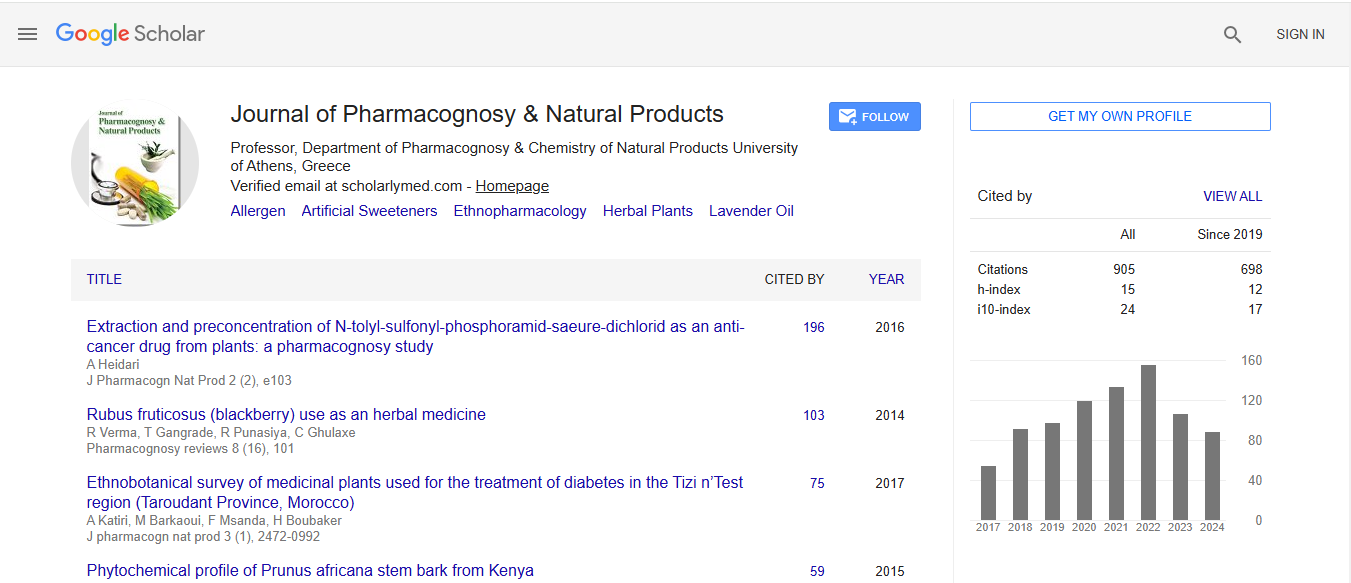
Journal of Pharmacognosy & Natural Products received 606 citations as per Google Scholar report