Commentary - (2025) Volume 18, Issue 5
Received: 31-Aug-2025, Manuscript No. jcsb-25-176446;
Editor assigned: 02-Sep-2025, Pre QC No. P-176446;
Reviewed: 16-Sep-2025, QC No. Q-176446;
Revised: 23-Sep-2025, Manuscript No. R-176446;
Published:
30-Sep-2025
, DOI: 10.37421/0974-7230.2025.18.603
Citation: Clarke, Emily. ”Algorithms Transform Biology for Precision Medicine.” J Comput Sci Syst Biol 18 (2025):603.
Copyright: © 2025 Clarke E. This is an open-access article distributed under the terms of the Creative Commons Attribution License, which permits unrestricted use, distribution and reproduction in any medium, provided the original author and source are credited.
Algorithmic biology is transforming single-cell analysis, offering a pathway to personalized medicine. It highlights the development of computational tools that interpret complex single-cell data, enabling a deeper understanding of cellular heterogeneity and disease mechanisms. The insights derived are crucial for tailoring treatments to individual patient profiles, moving beyond traditional bulk analysis [1].
Here's the thing about deep learning in genomics: it's making significant strides, driving advancements in how we interpret vast genomic datasets. This paper provides an overview of the key algorithmic innovations that are pushing the boundaries of what's possible, from predicting gene function to identifying disease-associated variants. What this really means is a faster, more accurate understanding of genetic information [2].
Let's break down how algorithms are applied to analyze biological networks. This review explores various graph algorithms, highlighting their utility in unraveling complex interactions within biological systems, from protein-protein interaction networks to gene regulatory pathways. It's about gaining clarity on how components work together, which is fundamental for systems biology [3].
Predicting RNA structure is a tough problem, but algorithmic biology is tackling it head-on. This article discusses the significant computational hurdles and the clever algorithmic solutions developed to accurately predict the intricate three-dimensional structures of RNA molecules. Understanding these structures is key to deciphering RNA's diverse biological functions and designing RNA-based therapies [4].
Integrating multi-omics data is essential for a comprehensive view of biological systems, and graph-based algorithms are proving invaluable here. This review examines how these algorithms facilitate the fusion and interpretation of diverse biological datasets, such as genomics, proteomics, and metabolomics. The result is a more holistic picture, allowing for discovery of new biomarkers and disease pathways [5].
Finding new drug targets, especially in cancer, is a critical bottleneck in drug discovery. This paper explores various algorithmic strategies that are accelerating the identification of therapeutic targets and streamlining the drug discovery process. It's all about using computational power to zero in on promising candidates, making drug development more efficient and effective [6].
Designing synthetic biological circuits is a complex task that benefits immensely from algorithmic advances. This article discusses the computational methods that aid in the rational design and optimization of artificial genetic circuits, crucial for applications in biotechnology and medicine. It's about engineering biology with precision, enabled by smart algorithms [7].
Metagenomic sequence analysis presents unique computational challenges due to the sheer volume and diversity of data. This review surveys various algorithmic approaches developed to process and interpret these complex sequences, offering insights into microbial communities and their functions. It's about making sense of the unseen world of microbes through sophisticated data processing [8].
Reconstructing ancestral gene orders provides a window into evolutionary history. This paper explores the algorithmic strategies employed to infer the arrangement of genes in ancestral genomes, offering valuable insights into genomic evolution and species divergence. It's about using computational methods to trace the genetic past and understand how life has changed over time [9].
Precision medicine, a highly individualized approach to healthcare, comes with its own set of algorithmic challenges and opportunities. This article outlines the computational hurdles in integrating diverse patient data and developing predictive models for treatment, while also highlighting the immense potential for algorithms to revolutionize patient care. It means moving towards smarter, more tailored medical interventions [10].
Algorithmic biology is fundamentally transforming how we approach complex biological problems, driving advancements across diverse fields from single-cell analysis to personalized medicine. It involves developing sophisticated computational tools to interpret vast and intricate biological datasets, moving beyond traditional bulk analysis to understand cellular heterogeneity and disease mechanisms at a finer resolution [1]. These algorithmic innovations are also making significant strides in genomics, enhancing the interpretation of genomic data, predicting gene function, and identifying disease-associated variants, which really means a faster and more accurate understanding of genetic information [2]. The utility of algorithms extends to unraveling complex interactions within biological networks, where various graph algorithms are employed to analyze protein-protein interaction networks and gene regulatory pathways, bringing clarity to how biological components function together in systems biology [3].
A major challenge in biology, such as predicting intricate RNA structures, is being tackled head-on by algorithmic biology. Here, clever computational solutions are developed to overcome significant hurdles in accurately predicting three-dimensional RNA structures, which is key to deciphering their diverse biological functions and designing RNA-based therapies [4]. Graph-based algorithms are proving invaluable for integrating multi-omics data, facilitating the fusion and interpretation of diverse biological datasets including genomics, proteomics, and metabolomics. This integration provides a more holistic picture, crucial for discovering new biomarkers and disease pathways [5].
Computational power is also being leveraged to address critical bottlenecks in drug discovery, particularly in identifying new drug targets for diseases like cancer. Various algorithmic strategies are accelerating the identification of therapeutic targets, streamlining the entire drug discovery process, and enabling researchers to zero in on promising candidates more efficiently [6]. Furthermore, designing synthetic biological circuits, a complex engineering task, benefits immensely from algorithmic advances. Computational methods aid in the rational design and optimization of artificial genetic circuits, enabling precision engineering in biotechnology and medicine [7].
The sheer volume and diversity of data in metagenomic sequence analysis present unique computational challenges. Algorithmic approaches are essential for processing and interpreting these complex sequences, offering valuable insights into microbial communities and their functions, essentially making sense of the unseen world of microbes through sophisticated data processing [8]. Beyond immediate biological applications, algorithms also offer a window into evolutionary history. Strategies are employed to reconstruct ancestral gene orders, inferring the arrangement of genes in ancestral genomes and providing insights into genomic evolution and species divergence, allowing us to trace the genetic past [9].
Ultimately, precision medicine, an individualized approach to healthcare, relies heavily on algorithmic capabilities. This field presents computational hurdles in integrating diverse patient data and developing predictive models for treatment, but algorithms offer immense potential to revolutionize patient care. This means moving towards smarter, more tailored medical interventions that are highly specific to individual patient profiles and needs [10].
Algorithmic biology stands as a cornerstone in modern biological research, offering crucial computational tools to decipher complex biological systems and advance medical applications. It fundamentally transforms single-cell analysis, enabling a deeper understanding of cellular heterogeneity and leading towards personalized medicine by interpreting intricate data and tailoring treatments to individual patient profiles. Deep learning, an advanced algorithmic approach, is driving significant advancements in genomics, making it possible to interpret vast genomic datasets, predict gene functions, and identify disease-associated variants with greater speed and accuracy. Furthermore, algorithms are pivotal in analyzing biological networks, utilizing graph theory to unravel complex interactions within systems like protein-protein networks and gene regulatory pathways, providing essential clarity for systems biology. They tackle challenges such as accurately predicting RNA structure, overcoming significant computational hurdles to understand RNA's diverse functions and design RNA-based therapies. Graph-based algorithms are also proving invaluable for integrating diverse multi-omics data, including genomics, proteomics, and metabolomics, offering a comprehensive and holistic view of biological systems crucial for discovering new biomarkers and disease pathways. In the realm of drug discovery, algorithmic strategies accelerate the identification of therapeutic targets, especially in cancer, streamlining the process and making drug development more efficient. Algorithms are also central to designing synthetic biological circuits with precision, aiding in the rational design and optimization of artificial genetic components for biotechnology and medicine. They are essential for processing and interpreting complex metagenomic sequences, providing insights into microbial communities, and for reconstructing ancestral gene orders, which offers a window into evolutionary history. Ultimately, algorithms are instrumental in realizing the potential of precision medicine, addressing computational challenges in data integration and predictive modeling to deliver smarter, tailored medical interventions.
None
None
Hongwu L, Rui G, Ying S. "An algorithmic biology approach to single-cell analysis and personalized medicine".Brief Bioinform 24 (2023):bbad218.
Indexed at, Google Scholar, Crossref
Gilles E, Mohammad L, Fabian JT. "Algorithmic advances in deep learning for genomics".Curr Opin Syst Biol 27 (2021):100373.
Indexed at, Google Scholar, Crossref
J. P, K. ML, J. PK. "Network analysis in systems biology: a review of graph algorithms and their applications".Brief Bioinform 24 (2023):bbad028.
Indexed at, Google Scholar, Crossref
Ronny L, Michael TW, Ivo LH. "Algorithmic challenges in RNA structure prediction".BMC Bioinformatics 21 (2020):602.
Indexed at, Google Scholar, Crossref
Xiaoyuan L, Kai H, Rui W. "Integrative analysis of multi-omics data using graph-based algorithms: a review".Brief Bioinform 24 (2023):bbad159.
Indexed at, Google Scholar, Crossref
Zhixiu M, Longchuan L, Qixia H. "Algorithmic approaches for target identification and drug discovery in cancer".Pharmacol Res 167 (2021):105553.
Indexed at, Google Scholar, Crossref
Siewert-Jan A, Matthew JWB, Andrew JM. "Algorithmic advances for designing synthetic biological circuits".Curr Opin Syst Biol 22 (2020):28-36.
Indexed at, Google Scholar, Crossref
Yunlong W, Ruibang L, Bingqiang R. "Algorithmic approaches for metagenomic sequence analysis: A review".Genomics 112 (2020):2901-2909.
Indexed at, Google Scholar, Crossref
Anna-Lena B, Daniel GF, David S. "Algorithmic approaches to reconstruct ancestral gene orders".BMC Bioinformatics 22 (2021):284.
Indexed at, Google Scholar, Crossref
Yuan J, Xiaoyu W, Xuhua X. "Algorithmic challenges and opportunities in precision medicine".Brief Bioinform 22 (2021):bbab205.
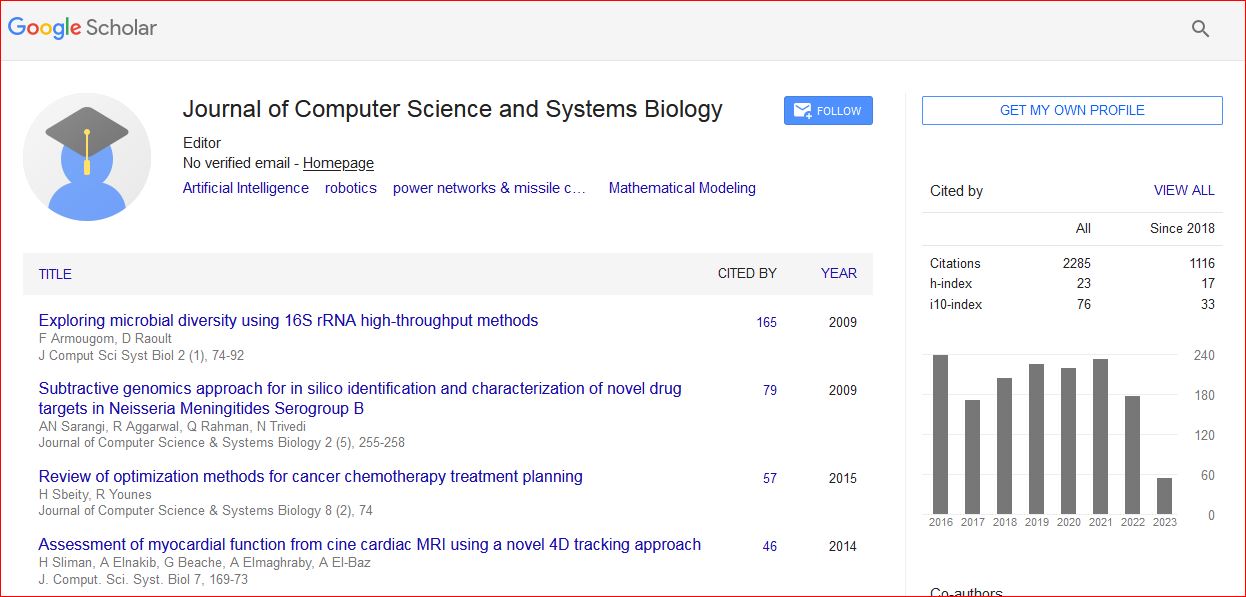
Journal of Computer Science & Systems Biology received 2279 citations as per Google Scholar report