Brief Report - (2025) Volume 11, Issue 5
Received: 02-Sep-2025, Manuscript No. ldt-25-178450;
Editor assigned: 04-Sep-2025, Pre QC No. P-178450;
Reviewed: 18-Sep-2025, QC No. Q-178450;
Revised: 23-Sep-2025, Manuscript No. R-178450;
Published:
30-Sep-2025
, DOI: 10.37421/2472-1018.2025.11.324
Citation: González, Maria. ”Airway Remodeling: Chronic Disease Hallmarks and Therapies.” J Lung Dis Treat 11 (2025):324.
Copyright: © 2025 González M. This is an open-access article distributed under the terms of the Creative Commons Attribution License, which permits unrestricted use, distribution and reproduction in any medium, provided the original author and source are credited.
Airway remodeling, a pervasive structural alteration within the airways, significantly escalates the severity and exacerbates the progression of chronic respiratory ailments such as asthma and chronic obstructive pulmonary disease (COPD). Addressing these intricate pathological processes, which encompass smooth muscle hypertrophy, basement membrane thickening, and increased vascularity, is paramount for the development of effective therapeutic interventions aimed at mitigating disease burden. This section delves into the foundational understanding of airway remodeling, highlighting its multifaceted nature and the critical need for targeted therapeutic strategies to reverse or halt these detrimental structural changes. The complex interplay of cellular and extracellular matrix components underlies the progressive nature of these diseases, necessitating a comprehensive approach to treatment that goes beyond symptom management. Understanding the intricate mechanisms driving these structural changes is the first step towards innovative therapeutic development. The persistence of these structural alterations underscores the challenge in managing chronic respiratory conditions, demanding novel strategies that address the root causes of disease progression. The focus on reversing or halting these changes offers a paradigm shift in how we approach the treatment of these debilitating conditions. The insights presented herein underscore the urgency of developing therapies that can effectively modify the underlying pathology of airway remodeling. The multifaceted nature of airway remodeling necessitates a deep understanding of its various components and their contributions to disease severity and progression. The exploration of therapeutic avenues targeting these specific structural changes offers a promising future for patients suffering from chronic respiratory diseases. The inherent complexity of airway remodeling presents significant challenges for clinicians and researchers alike, driving the search for more effective and targeted treatment modalities. The review of current and emerging strategies underscores the dynamic and evolving landscape of research in this critical area of respiratory medicine. The collective knowledge presented in this compilation of studies provides a robust foundation for future research and clinical application. The intricate mechanisms contributing to airway remodeling are a central focus, with a growing emphasis on understanding how these processes can be modulated to improve patient outcomes. The persistent structural changes associated with airway remodeling are a hallmark of chronic respiratory diseases, contributing significantly to their debilitating nature. The development of therapies aimed at reversing or halting these structural alterations is a key objective in improving the lives of affected individuals. The comprehensive understanding of airway remodeling is crucial for the development of effective therapeutic strategies that target the underlying pathological processes. The structural alterations that characterize airway remodeling have a profound impact on lung function and disease progression, making them a critical target for intervention. The research presented highlights the diverse cellular and molecular mechanisms involved in airway remodeling, offering multiple points for therapeutic targeting. The persistent and progressive nature of airway remodeling underscores the need for innovative treatment approaches that can modify the disease course. Targeting the key components of airway remodeling, such as smooth muscle hypertrophy and extracellular matrix deposition, is essential for developing effective therapies. The insights into current and emerging strategies provide a roadmap for future research and the development of novel treatments. The complexity of airway remodeling necessitates a multidisciplinary approach, integrating knowledge from various fields of study to develop comprehensive therapeutic solutions. The progressive nature of structural changes in the airways poses a significant challenge to patient management and underscores the importance of early and effective intervention. The relentless progression of airway remodeling necessitates the development of therapies that can not only manage symptoms but also modify the underlying disease process. The pursuit of therapeutic strategies that can reverse or halt airway remodeling represents a significant advancement in the management of chronic respiratory diseases. The diverse array of pathological changes involved in airway remodeling requires a nuanced understanding of the underlying molecular and cellular mechanisms. [1] Airway remodeling, a persistent structural change in the airways, significantly contributes to the severity and progression of chronic respiratory diseases like asthma and COPD. Targeting these complex pathological processes, which involve smooth muscle hypertrophy, basement membrane thickening, and increased vascularity, is crucial for effective therapeutic intervention. This summary highlights key insights into current and emerging strategies aimed at reversing or halting airway remodeling. [2] Inflammation plays a central role in driving airway remodeling. Understanding the specific inflammatory pathways, such as those involving eosinophils, neutrophils, and Th2 cytokines, allows for the development of targeted anti-inflammatory therapies. This section focuses on how modulating these pathways can impact airway structural changes. [3] The extracellular matrix (ECM) undergoes significant deposition and degradation in remodeled airways, contributing to tissue stiffening and altered lung function. Therapies that target matrix metalloproteinases (MMPs) or their inhibitors are being explored to normalize ECM composition and structure. [4] Epithelial cell dysfunction and metaplasia are hallmarks of airway remodeling. Therapies aimed at restoring epithelial integrity and function, including stem cell-based approaches, hold promise for reversing structural damage and improving airway defense mechanisms. [5] Airway smooth muscle (ASM) hyperreactivity and hypertrophy are key features of airway remodeling, leading to bronchoconstriction. Targeting signaling pathways that regulate ASM growth and contractility, such as those involving growth factors and calcium signaling, is a significant therapeutic avenue. [6] Genetic and epigenetic factors play a crucial role in the development and progression of airway remodeling. Understanding these mechanisms can lead to personalized treatment strategies and the identification of novel therapeutic targets. [7] The role of fibroblasts and myofibroblasts in airway remodeling, particularly in collagen deposition and airway wall thickening, is significant. Targeting these cells or their signaling pathways could offer a way to reduce fibrotic changes. [8] Vascular remodeling, including angiogenesis and vascular leakage, is an important aspect of airway remodeling that contributes to airway inflammation and edema. Targeting aberrant vascularization pathways may prove beneficial. [9] The role of the microbiome in influencing airway remodeling is an emerging area of research. Alterations in the airway and gut microbiomes may contribute to inflammatory processes that drive structural changes, suggesting a potential therapeutic target. [10] Novel therapeutic strategies, including biologics targeting specific cytokines (e.g., IL-13, IL-33) and small molecule inhibitors, are being developed to more precisely address the complex mechanisms of airway remodeling, aiming to achieve disease modification rather than just symptom control.
Airway remodeling, a persistent structural change in the airways, significantly contributes to the severity and progression of chronic respiratory diseases like asthma and COPD. Targeting these complex pathological processes, which involve smooth muscle hypertrophy, basement membrane thickening, and increased vascularity, is crucial for effective therapeutic intervention. This summary highlights key insights into current and emerging strategies aimed at reversing or halting airway remodeling. [1] Inflammation plays a central role in driving airway remodeling. Understanding the specific inflammatory pathways, such as those involving eosinophils, neutrophils, and Th2 cytokines, allows for the development of targeted anti-inflammatory therapies. This section focuses on how modulating these pathways can impact airway structural changes. [2] The extracellular matrix (ECM) undergoes significant deposition and degradation in remodeled airways, contributing to tissue stiffening and altered lung function. Therapies that target matrix metalloproteinases (MMPs) or their inhibitors are being explored to normalize ECM composition and structure. [3] Epithelial cell dysfunction and metaplasia are hallmarks of airway remodeling. Therapies aimed at restoring epithelial integrity and function, including stem cell-based approaches, hold promise for reversing structural damage and improving airway defense mechanisms. [4] Airway smooth muscle (ASM) hyperreactivity and hypertrophy are key features of airway remodeling, leading to bronchoconstriction. Targeting signaling pathways that regulate ASM growth and contractility, such as those involving growth factors and calcium signaling, is a significant therapeutic avenue. [5] Genetic and epigenetic factors play a crucial role in the development and progression of airway remodeling. Understanding these mechanisms can lead to personalized treatment strategies and the identification of novel therapeutic targets. [6] The role of fibroblasts and myofibroblasts in airway remodeling, particularly in collagen deposition and airway wall thickening, is significant. Targeting these cells or their signaling pathways could offer a way to reduce fibrotic changes. [7] Vascular remodeling, including angiogenesis and vascular leakage, is an important aspect of airway remodeling that contributes to airway inflammation and edema. Targeting aberrant vascularization pathways may prove beneficial. [8] The role of the microbiome in influencing airway remodeling is an emerging area of research. Alterations in the airway and gut microbiomes may contribute to inflammatory processes that drive structural changes, suggesting a potential therapeutic target. [9] Novel therapeutic strategies, including biologics targeting specific cytokines (e.g., IL-13, IL-33) and small molecule inhibitors, are being developed to more precisely address the complex mechanisms of airway remodeling, aiming to achieve disease modification rather than just symptom control. [10]
Airway remodeling, a persistent structural change in the airways, significantly contributes to the severity and progression of chronic respiratory diseases like asthma and COPD. Key pathological processes involve smooth muscle hypertrophy, basement membrane thickening, and increased vascularity. Inflammation, driven by pathways involving eosinophils, neutrophils, and Th2 cytokines, is central to remodeling. The extracellular matrix (ECM) undergoes deposition and degradation, leading to tissue stiffening. Epithelial cell dysfunction and metaplasia are hallmarks, with stem cell-based approaches showing promise. Airway smooth muscle (ASM) hyperreactivity and hypertrophy are targeted through signaling pathways regulating ASM growth and contractility. Genetic and epigenetic factors influence remodeling, enabling personalized treatments. Fibroblasts and myofibroblasts contribute to collagen deposition and airway wall thickening. Vascular remodeling, including angiogenesis, exacerbates inflammation and edema. Emerging research highlights the role of the microbiome in influencing inflammatory processes that drive structural changes. Novel therapeutic strategies, such as biologics and small molecule inhibitors, aim for disease modification.
None
None
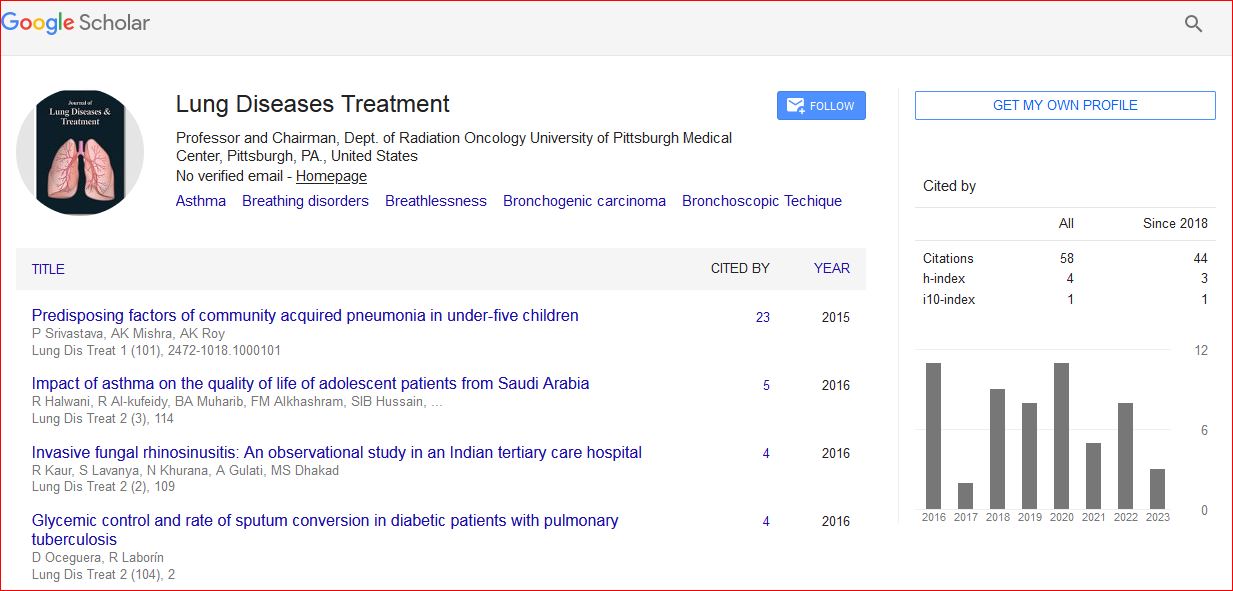
Journal of Lung Diseases & Treatment received 247 citations as per Google Scholar report