Brief Report - (2025) Volume 18, Issue 4
Received: 30-Jun-2025, Manuscript No. jcsb-25-176415;
Editor assigned: 02-Jul-2025, Pre QC No. P-176415;
Reviewed: 16-Jul-2025, QC No. Q-176415;
Revised: 23-Jul-2025, Manuscript No. R-176415;
Published:
30-Jul-2025
, DOI: 10.37421/0974-7230.2025.18.599
Citation: Novak, Elena. ”AI/ML: Transforming Biology and Healthcare Research.” J Comput Sci Syst Biol 18 (2025):599.
Copyright: © 2025 Novak E. This is an open-access article distributed under the terms of the Creative Commons Attribution License, which permits unrestricted use, distribution and reproduction in any medium, provided the original author and source are credited.
The integration of Artificial Intelligence (AI) and Machine Learning (ML) has profoundly reshaped the landscape of biological and healthcare research. These computational methods are proving crucial for managing and extracting meaningful insights from the vast and complex datasets now common in modern biology. Deep learning, for instance, is making significant strides in drug discovery by efficiently mining complex omics data. These advanced techniques help identify potential drug targets and predict drug efficacy, directly addressing the high-dimensional challenges inherent in genomic, proteomic, and metabolomic datasets[1].
Beyond drug discovery, the broader impact of big data mining and Machine Learning (ML) is evident across various aspects of biology and healthcare. Recent advancements highlight diverse applications ranging from improved disease diagnosis to the development of personalized medicine strategies and the identification of precise biomarkers. The ongoing work aims to effectively leverage vast biological data while addressing persistent challenges and outlining future perspectives in the field[2].
Improving drug safety and efficacy is paramount, and here, Machine Learning (ML) and data mining techniques play a vital role in predicting drug-drug interactions (DDIs). These computational methods are essential for identifying potential adverse interactions early in the development process, leveraging diverse biological and chemical data to enhance safety protocols[3].
The transformative influence of Artificial Intelligence (AI) and Machine Learning (ML) extends across molecular biology, bioinformatics, and computational biology. Applications span critical areas such as accurate protein structure prediction, comprehensive genome annotation, and sophisticated disease modeling. This demonstrates AI's exceptional capacity to extract profound insights from inherently complex biological information[4].
Specifically designed deep learning models are advancing the inference of gene expression patterns, offering deeper understanding into intricate gene regulatory networks. These models are applied to predict disease phenotypes and significantly aid drug discovery by efficiently processing and interpreting vast transcriptomic datasets to unveil crucial biological relationships[5].
With the increasing deployment of AI models in sensitive biological contexts, the demand for transparency is growing. Explainable Artificial Intelligence (XAI) addresses this need within bioinformatics, focusing on rendering AI models interpretable, particularly when handling biological data for applications like disease diagnosis and drug discovery. The field continues to grapple with the significant challenges of making these complex biological AI models fully transparent and understandable[6].
Machine learning also plays an integral role in synthetic biology, where it supports the rational design of biological systems and the development of innovative diagnostic tools. ML helps streamline the engineering of biological parts, circuits, and entire systems, substantially accelerating innovation and progress in this dynamic scientific domain[7].
In agricultural research, Artificial Intelligence (AI) is transforming plant phenotyping, a critical area for improving crops and advancing plant biology. AI-driven image analysis and data mining techniques automate and enhance the precise measurement of plant traits. This effectively overcomes challenges associated with high-throughput phenotyping, opening new avenues for agricultural advancements[8].
Recent advancements in deep learning are also fundamentally changing computational protein design. Deep learning models are now capable of predicting protein structures, designing novel protein sequences with tailored functions, and optimizing protein stability. This work holds significant implications for enzyme engineering and the development of new therapeutic agents[9].
Moreover, the field of biological data mining has seen notable progress with the adoption of graph neural networks (GNNs). GNNs are particularly well-suited for modeling complex biological relationships, such as intricate protein-protein interactions and extensive drug-target networks. These tools offer powerful new capabilities for discovery and prediction within systems biology, pushing the boundaries of what is possible[10].
Collectively, these diverse applications highlight a significant paradigm shift in how biological data is analyzed and utilized across various fields. From fundamental research to clinical applications and agricultural advancements, the integration of Artificial Intelligence (AI), Machine Learning (ML), and deep learning is not just augmenting, but fundamentally redefining the scope of biological inquiry and innovation. These computational tools offer unprecedented capabilities to unlock new biological understanding, drive therapeutic breakthroughs, and effectively address global challenges.
The rapid evolution of computational intelligence, particularly Artificial Intelligence (AI), Machine Learning (ML), and deep learning, has profoundly impacted various facets of biological research and healthcare. These advanced methodologies are essential for making sense of the ever-growing, complex datasets generated across genomics, proteomics, and metabolomics. Their ability to discern subtle patterns and make accurate predictions is transforming scientific discovery.
A central application lies in drug discovery, where deep learning efficiently mines complex omics data. By processing high-dimensional genomic, proteomic, and metabolomic datasets, these techniques are instrumental in identifying potential drug targets and predicting drug efficacy, thereby streamlining the drug development pipeline [1]. This computational prowess also extends to a broader scope within biology and healthcare, with big data mining and Machine Learning (ML) highlighting breakthroughs in areas like disease diagnosis, personalized medicine, and biomarker identification. The ongoing work aims to effectively leverage these vast biological data resources while continually refining predictive models [2].
Another critical area where computational methods excel is in enhancing drug safety. Machine Learning (ML) and data mining techniques are increasingly employed to predict adverse drug-drug interactions (DDIs). This foresight is invaluable, allowing for the early identification of potential risks by analyzing diverse biological and chemical data, ultimately improving patient outcomes [3]. Concurrently, the overarching influence of Artificial Intelligence (AI) and Machine Learning (ML) is deeply embedded in molecular biology, bioinformatics, and computational biology. These tools are fundamental for tasks like precise protein structure prediction, comprehensive genome annotation, and the development of sophisticated disease models, illustrating AI's formidable capacity to extract valuable insights from complex biological information [4].
Beyond general bioinformatics, specialized deep learning models are specifically designed for inferring gene expression patterns. These models provide deeper understanding into gene regulatory networks, predict disease phenotypes, and facilitate drug discovery by effectively processing and interpreting vast transcriptomic datasets. Such applications are critical for uncovering previously hidden biological relationships [5]. As these sophisticated models become more integrated into critical applications, the need for transparency becomes undeniable. Explainable Artificial Intelligence (XAI) within bioinformatics is therefore crucial, focusing on making AI models interpretable. This is particularly important for models that operate on sensitive biological data, underpinning applications in disease diagnosis and drug discovery, even as challenges in achieving full interpretability persist [6].
The scope of Machine Learning (ML) also significantly impacts synthetic biology. It assists in the rational design of biological systems and is instrumental in developing novel diagnostic tools. ML helps to streamline the engineering of biological parts, circuits, and entire systems, greatly accelerating innovation and development within this cutting-edge field [7]. Moreover, in the realm of agriculture, Artificial Intelligence (AI) is revolutionizing plant phenotyping. This area is vital for crop improvement and fundamental plant biology research. AI-driven image analysis and data mining techniques automate and enhance the accurate measurement of plant traits, effectively addressing the challenges of high-throughput phenotyping and paving the way for more resilient and productive crops [8].
Further advancements highlight deep learning's role in computational protein design. These models now predict protein structures with high accuracy, design novel protein sequences possessing specific functions, and optimize protein stability. Such capabilities are profoundly impacting enzyme engineering and the development of new therapeutics [9]. Adding to this innovative toolkit, recent progress in biological data mining is significantly bolstered by graph neural networks (GNNs). GNNs are uniquely suited to model complex biological relationships, such as protein-protein interactions and intricate drug-target networks, providing powerful new tools for discovery and prediction in systems biology [10].
In essence, the confluence of AI, Machine Learning (ML), and deep learning has created a new era for biological and biomedical sciences. These technologies are not merely auxiliary tools but fundamental drivers of progress, enabling researchers to tackle previously intractable problems, accelerate discovery, and translate complex data into actionable insights for healthcare, agriculture, and fundamental biological understanding.
Artificial Intelligence (AI), Machine Learning (ML), and deep learning are profoundly transforming biological and healthcare research. These computational methods are crucial for efficiently mining complex omics data, identifying potential drug targets, and predicting drug efficacy, directly addressing high-dimensional challenges in genomics, proteomics, and metabolomics. The impact extends to big data mining and Machine Learning (ML) applications across biology and healthcare, including disease diagnosis, personalized medicine, and biomarker identification, while navigating ongoing challenges. Specific applications include predicting drug-drug interactions (DDIs) using various ML and data mining techniques, which is essential for improving drug safety and efficacy by identifying adverse interactions early. AI and ML play a revolutionary role in molecular biology, bioinformatics, and computational biology, with applications spanning protein structure prediction, genome annotation, and disease modeling. Deep learning models are tailored for inferring gene expression patterns, understanding gene regulatory networks, and facilitating drug discovery by interpreting vast transcriptomic datasets. The field also emphasizes Explainable Artificial Intelligence (XAI) within bioinformatics to ensure transparency in AI models operating on biological data, despite challenges in interpretability. Machine learning streamlines synthetic biology, from rational design to developing new diagnostic tools and engineering biological systems. In agriculture, AI is transforming plant phenotyping through image analysis and data mining for accurate trait measurement and crop improvement. Deep learning advancements are revolutionizing computational protein design, predicting structures, designing novel sequences, and optimizing stability for enzyme engineering and therapeutics. Furthermore, graph neural networks (GNNs) are making significant progress in biological data mining by modeling complex relationships like protein-protein interactions and drug-target networks. These collective advancements underscore the critical role of AI and ML in unlocking biological understanding, driving innovation, and solving complex challenges across diverse biological domains.
None
None
Mengting C, Wenhui L, Guixia X. "Deep learning approaches for drug discovery in disease omics data mining".Briefings Bioinform 22 (2021):bbab283.
Indexed at, Google Scholar, Crossref
Md. MH, Mohammed MA, Md. MR. "Big Data Mining and Machine Learning in Biology and Healthcare: Recent Advances and Future Perspectives".Curr Med Chem 29 (2022):4323-4338.
Indexed at, Google Scholar, Crossref
Xiaohui L, Zhiqiang F, Yufeng L. "Machine learning and data mining approaches for predicting drug-drug interactions: A review".Briefings Bioinform 22 (2021):1083-1099.
Indexed at, Google Scholar, Crossref
J. MT, M. SZ, W. HD. "Artificial intelligence and machine learning in molecular biology, bioinformatics, and computational biology".Briefings Bioinform 23 (2022):bbab435.
Indexed at, Google Scholar, Crossref
Anjil S, Sujay KS, Mukesh P. "Deep learning models for gene expression inference: a review".Briefings Bioinform 23 (2022):bbac332.
Indexed at, Google Scholar, Crossref
A. GKC, C. CC, Y. TL. "Explainable artificial intelligence in bioinformatics: applications and challenges".Briefings Bioinform 23 (2022):bbac005.
Indexed at, Google Scholar, Crossref
S. HK, J. HP, H. WL. "Machine learning for synthetic biology: from design to diagnostics".Trends Biotechnol 38 (2020):383-393.
Indexed at, Google Scholar, Crossref
Y. L, S. LC, J. L. "Artificial intelligence in plant phenotyping: A review".Plant Phenom 2020 (2020):9735919.
Indexed at, Google Scholar, Crossref
H. W, Z. W, S. LW. "Deep learning for computational protein design".Briefings Bioinform 23 (2022):bbac339.
Indexed at, Google Scholar, Crossref
Zhibo W, Xiaomeng L, Xiaoshan L. "Recent advances in biological data mining with graph neural networks".Briefings Bioinform 25 (2024):bbad499.
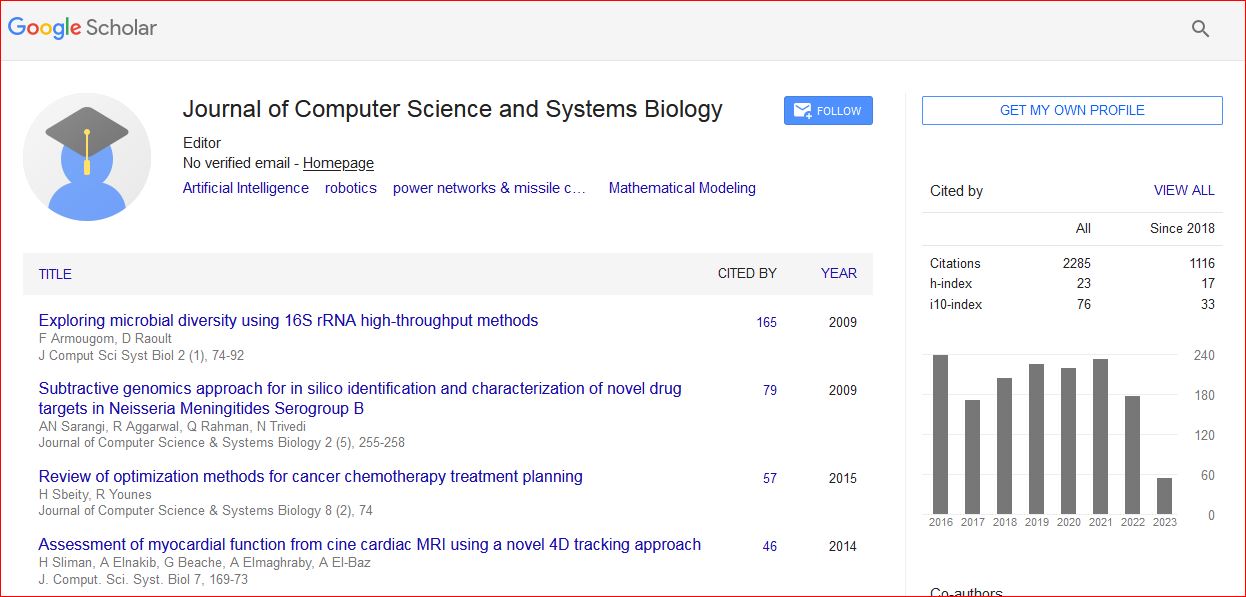
Journal of Computer Science & Systems Biology received 2279 citations as per Google Scholar report