Brief Report - (2025) Volume 18, Issue 5
Received: 31-Aug-2025, Manuscript No. jcsb-25-176444;
Editor assigned: 02-Sep-2025, Pre QC No. P-176444;
Reviewed: 16-Sep-2025, QC No. Q-176444;
Revised: 23-Sep-2025, Manuscript No. R-176444;
Published:
30-Sep-2025
, DOI: 10.37421/0974-7230.2025.18.601
Citation: Mbaye, Jean-Paul. ”AI-Driven Discovery Reshapes Biology and Medicine.” J Comput Sci Syst Biol 18 (2025):601.
Copyright: © 2025 Mbaye J. This is an open-access article distributed under the terms of the Creative Commons Attribution License, which permits unrestricted use, distribution and reproduction in any medium, provided the original author and source are credited.
The field of biological research is currently experiencing a profound transformation, moving rapidly toward data-driven paradigms that leverage advanced computational methods to unravel the complexities of living systems. This shift is enabling discoveries that were once limited by traditional hypothesis-driven approaches. For instance, the merging of machine learning techniques with systems biology is creating powerful data-driven models crucial for understanding intricate biological systems and driving new insights into areas like disease mechanisms and drug discovery [1].
While data-driven models offer significant predictive power, there is also a critical understanding that combining them with mechanistic models—which are grounded in underlying biological principles—can further enhance predictive accuracy and provide deeper biological insights. This hybrid modeling strategy helps overcome the inherent limitations of using either approach in isolation, leading to a more robust understanding of biological processes and accelerating discovery [2].
As Artificial Intelligence (AI) models become more pervasive in biological and medical research, the need for transparency in their decision-making processes has become paramount. Explainable AI (XAI) techniques are emerging to demystify these complex models, making their predictions understandable to biologists and clinicians alike. The emphasis on explaining AI's reasoning is vital for building trust, validating scientific findings, and identifying potential biases, all of which are essential for successful clinical translation and scientific advancement [3].
A comprehensive view of biological systems often necessitates the integration of diverse 'omics' datasets, such as genomics, transcriptomics, and proteomics. Various computational methods are being developed to combine these disparate data types, fostering a holistic understanding of disease mechanisms, drug responses, and fundamental biological processes. This multi-omics approach is proving indispensable for modern biological modeling, allowing for more complete and nuanced interpretations of complex biological data [4].
Beyond mere correlations, extracting meaningful cause-and-effect relationships from complex biological datasets is a critical challenge. Causal inference methods are playing a crucial role in addressing this, outlining principles and applications across diverse biological domains, including the identification of disease drivers and the elucidation of therapeutic mechanisms. These methods enhance data-driven biological modeling by providing insights into true causal relationships, which are indispensable for developing effective interventions [5].
Specialized architectures, like Graph Neural Networks (GNNs), are having a transformative impact on computational biology and bioinformatics. GNNs are uniquely suited to model complex biological data structured as graphs, such as protein-protein interaction networks or gene regulatory networks. Their application in drug discovery, disease prediction, and genomics highlights their potent capability in extracting insights from relational biological data [6].
The advent of single-cell technologies provides unprecedented resolution into cellular heterogeneity, but analyzing the resulting vast and complex datasets requires sophisticated computational methods. Techniques for data preprocessing, dimension reduction, clustering, and trajectory inference are vital for extracting biological insights from individual cell measurements. These methods enable detailed modeling of cellular states, differentiation pathways, and disease progression at a single-cell level, revolutionizing our understanding of biological systems [7].
Artificial Intelligence (AI) is also fundamentally reshaping the landscape of drug discovery and development, from initial target identification through to clinical trials. AI's capacity to analyze extensive biological and chemical datasets, predict drug-target interactions, and optimize compound properties is significantly accelerating the entire drug development pipeline. This efficiency makes the process more cost-effective and ultimately leads to the discovery of novel therapeutics for a wide array of diseases [8].
To build more robust and interpretable models, a new paradigm involves integrating domain knowledge—such as physical laws or biological principles—directly into neural network training. Physics-Informed Neural Networks (PINNs) exemplify this approach, addressing challenges in biological modeling by simultaneously learning from data and adhering to known biological principles. This method results in models that are more interpretable, robust, and data-efficient, especially valuable in scenarios where biological data is scarce [9].
Finally, the application of deep learning architectures, particularly Recurrent Neural Networks (RNNs) and Convolutional Neural Networks (CNNs), is proving invaluable for analyzing and modeling time series data in biological and medical contexts. These models are adept at capturing temporal dependencies and complex patterns, leading to more accurate predictions and insights into dynamic biological processes, such as disease progression or cellular dynamics [10].
The rapid advancement of computational power and data generation technologies is fundamentally reshaping biological and medical research, steering it toward a highly data-centric future. At the core of this transformation are sophisticated data-driven models, which increasingly integrate machine learning and Artificial Intelligence (AI) to decipher the complex interplay of biological systems [1]. These models are not just about prediction; they are about generating new hypotheses and understanding underlying mechanisms, crucial for addressing challenges in areas like disease biology and pharmaceutical development. The move from purely hypothesis-driven research to approaches that prioritize data-centric discoveries signifies a major paradigm shift in how scientific questions are formulated and answered.
An important evolutionary step in this journey involves combining these powerful data-driven models with established mechanistic models. Mechanistic models, built on known biological principles, offer a framework of understanding, while data-driven models provide the predictive accuracy gleaned from vast observational data. This synergistic integration leads to a more comprehensive and robust understanding of biological systems, mitigating the limitations inherent in using either approach in isolation [2]. As AI models become more ingrained in sensitive applications like clinical decision support or drug design, the demand for Explainable AI (XAI) grows. XAI techniques help demystify the internal workings of complex AI models, ensuring that biologists and clinicians can trust, validate, and interpret their predictions, thereby fostering broader acceptance and enabling responsible application in critical fields [3].
Modern biological research often generates diverse datasets, ranging from genomic sequences to protein expression profiles. Integrating these 'multi-omics' datasets is essential for constructing a holistic view of biological systems. Various computational methods are now dedicated to combining these disparate data types, allowing researchers to uncover intricate relationships between different molecular layers, understand disease mechanisms more completely, and predict responses to therapies with greater accuracy [4]. Complementing this, causal inference methods are critical for moving beyond mere correlations to identify true cause-and-effect relationships within complex biological data. Understanding these causal links is vital for developing effective interventions and therapeutic strategies, as it directly informs which factors are truly driving biological processes or disease states [5].
Furthermore, specialized deep learning architectures are proving exceptionally well-suited for particular types of biological data. Graph Neural Networks (GNNs), for instance, excel at modeling relational data, which is common in biology, such as protein-protein interaction networks or gene regulatory networks. GNNs are showing significant promise in applications like drug discovery, disease prediction, and genomics by effectively extracting insights from these complex network structures [6]. Similarly, the analysis of single-cell data, which provides unprecedented resolution into cellular heterogeneity, relies heavily on advanced computational methods for preprocessing, dimension reduction, clustering, and trajectory inference. These tools are revolutionizing our ability to model cellular states and disease progression at an individual cell level [7].
The impact of Artificial Intelligence (AI) is particularly profound in drug discovery and development. AI algorithms can sift through immense chemical and biological databases, predict drug-target interactions, and optimize compound properties, thereby significantly accelerating the entire drug development pipeline. This not only makes the process more efficient and cost-effective but also paves the way for novel therapeutics that address a wide range of diseases [8]. To ensure model accuracy and interpretability, particularly in data-scarce biological contexts, Physics-Informed Neural Networks (PINNs) are emerging. PINNs integrate known biological principles directly into the neural network training, resulting in models that are more robust, interpretable, and less reliant on massive datasets, by embedding domain knowledge into their learning process [9]. Finally, for understanding dynamic biological phenomena, deep learning models like Recurrent Neural Networks (RNNs) and Convolutional Neural Networks (CNNs) are indispensable for analyzing time series data. These models are adept at capturing temporal dependencies and complex patterns, offering accurate predictions and insights into biological processes over time, such as disease progression or cellular dynamics [10].
Biological and medical research is undergoing a significant transformation, driven by the integration of advanced computational methods and data-driven models. Machine learning and Artificial Intelligence (AI) are central to this shift, enabling deeper understanding of complex biological systems, from disease mechanisms to drug discovery. Researchers are increasingly combining data-driven models with mechanistic approaches to enhance predictive accuracy and gain robust biological insights. Key advancements include the development of Explainable AI (XAI) for transparent decision-making, multi-omics data integration for holistic views, and causal inference methods to identify true cause-and-effect relationships. Specialized techniques like Graph Neural Networks (GNNs) are revolutionizing the analysis of network-based biological data, while computational methods for single-cell analysis provide unprecedented resolution into cellular heterogeneity. AI's impact extends profoundly into drug discovery, accelerating the identification and optimization of therapeutics. Furthermore, Physics-Informed Neural Networks (PINNs) are emerging to embed domain knowledge into models, making them more robust, and deep learning architectures like Recurrent Neural Networks (RNNs) and Convolutional Neural Networks (CNNs) are proving essential for analyzing dynamic biological time series data. These diverse computational strategies collectively drive innovation, leading to more efficient discoveries and a comprehensive understanding of life sciences.
None
None
Manoj KKS, Alok KS, Avinash KS. "Data-driven models in biology: from machine learning to systems biology".Briefings in Bioinformatics 22 (2021):bbab097.
Indexed at, Google Scholar, Crossref
Samuel HKJ, Mads SLA, Adam DA. "Integrating mechanistic and data-driven models for prediction and discovery in biological systems".Current Opinion in Systems Biology 27 (2021):100378.
Indexed at, Google Scholar, Crossref
Han W, Jiangang M, Xi C. "Explainable AI in biological and medical research".Trends in Pharmacological Sciences 42 (2021):669-682.
Indexed at, Google Scholar, Crossref
Fang-Zhou L, An-Na F, Xiao-Yuan P. "Multi-omics data integration in biology and medicine".Genome Biology 22 (2021):301.
Indexed at, Google Scholar, Crossref
Carlos JGCLF, Philipp MS, Moritz GKSM. "Causal inference in biological data: Principles and applications".Annual Review of Biomedical Data Science 6 (2023):161-182.
Indexed at, Google Scholar, Crossref
Ravali KSA, Alok K, Nitish KS. "Graph neural networks in computational biology and bioinformatics".Nature Reviews Genetics 23 (2022):746-764.
Indexed at, Google Scholar, Crossref
Joseph AP, Luis PTP, Guillaume FPG. "Computational methods for single-cell data analysis".Nature Reviews Genetics 24 (2023):317-336.
Indexed at, Google Scholar, Crossref
Jianfeng Z, Yunxiang C, Daoyuan S. "Artificial intelligence in drug discovery and development".Nature Chemical Biology 19 (2023):161-170.
Indexed at, Google Scholar, Crossref
Harshita S, Bhasvanthi V, Ayush C. "Physics-informed neural networks for computational modeling of biological systems".PLOS Computational Biology 18 (2022):e1009841.
Indexed at, Google Scholar, Crossref
Tao S, Kai J, Mingchao L. "Deep learning models for time series data in biology and medicine".Briefings in Bioinformatics 21 (2020):2269-2280.
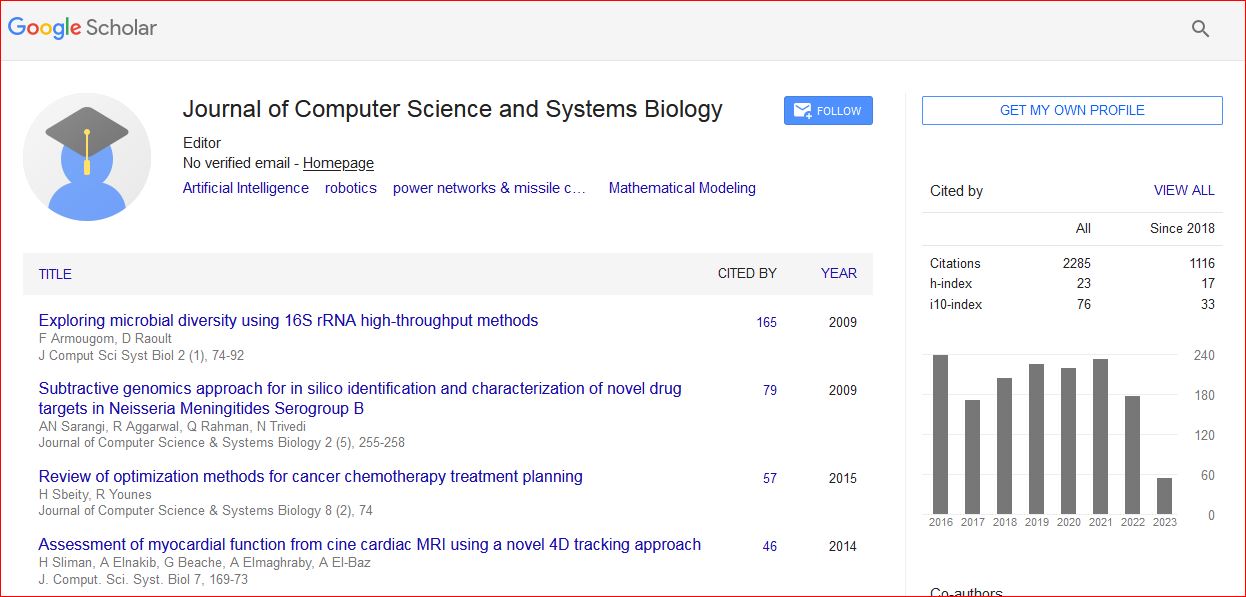
Journal of Computer Science & Systems Biology received 2279 citations as per Google Scholar report