Commentary - (2025) Volume 18, Issue 5
Received: 31-Aug-2025, Manuscript No. jcsb-25-176447;
Editor assigned: 02-Sep-2025, Pre QC No. P-176447;
Reviewed: 16-Sep-2025, QC No. Q-176447;
Revised: 23-Sep-2025, Manuscript No. R-176447;
Published:
30-Sep-2025
, DOI: 10.37421/0974-7230.2025.18.604
Citation: Ivanov, Boris. ”AI Transforms Structural Bioinformatics: New Frontiers.” J Comput Sci Syst Biol 18 (2025):604.
Copyright: © 2025 Ivanov B. This is an open-access article distributed under the terms of the Creative Commons Attribution License, which permits unrestricted use, distribution
and reproduction in any medium, provided the original author and source are credited.
This work explores how AlphaFold, a powerful Artificial Intelligence (AI) model, can be effectively used for comparative modeling of protein complexes. It shows that by adapting AlphaFold's capabilities, researchers can predict the structures of multi-protein assemblies with higher accuracy, which is crucial for understanding complex biological mechanisms. The insights here pave the way for more reliable structural predictions of interacting proteins [1].
Here's the thing: AlphaFold2 dramatically changed structural bioinformatics, ushering in a new era for protein structure prediction. This article discusses the profound impact of AlphaFold2 and looks ahead to future developments and challenges in the field, emphasizing how this tool has accelerated our ability to understand protein shapes and functions [2].
What this really means is that structural bioinformatics and systems biology are coming together to form a new frontier. This article highlights how integrating these fields can unlock deeper understanding of biological functions, disease mechanisms, and crucially, drive innovative drug discovery efforts by looking at systems as a whole [3].
This paper delves into combining structural bioinformatics with machine learning to tailor medicine for individuals. It explains how leveraging structural data with predictive models can lead to more personalized treatment strategies, moving beyond a one-size-fits-all approach to healthcare by understanding unique molecular profiles [4].
Deep learning is proving to be a game-changer in structural bioinformatics, especially for predicting protein structures. This article reviews the significant strides made by deep learning techniques, like AlphaFold, and discusses how these methods are expanding beyond basic prediction to tackle more complex challenges in understanding biomolecular machinery [5].
Computational protein design has seen remarkable progress, moving from simply folding proteins de novo to fine-tuning their functions. This paper covers recent advances, showing how scientists can now design proteins with specific desired properties, opening doors for creating novel enzymes, therapeutics, and biomaterials with tailored functionalities [6].
Understanding the precise interactions between proteins and ligands is absolutely fundamental for discovering new drugs. This article provides structural insights into these crucial interactions, detailing how computational methods help in identifying potential drug candidates and optimizing their binding affinities, which is a core task in pharmaceutical research [7].
This paper explores the computational tools used to understand protein dynamics and, by extension, their functions. It highlights how simulations and structural analyses reveal the subtle movements proteins make, which are often key to their biological roles, offering a dynamic view beyond static structures [8].
Cryo-electron microscopy (cryo-EM) has revolutionized how we visualize large biomolecular complexes, and structural bioinformatics plays a crucial role in processing and interpreting this data. This article reviews the synergistic relationship between cryo-EM and bioinformatics, showing how computational methods are essential for refining structures and extracting biological meaning from high-resolution images [9].
Integrating diverse 'omics' data with structural bioinformatics offers a powerful approach for gaining comprehensive biological insights. This paper discusses how combining genomics, proteomics, and other high-throughput data with structural information helps to build a more complete picture of cellular processes, disease pathways, and potential therapeutic targets [10].
This work explores how AlphaFold, a powerful Artificial Intelligence (AI) model, can be effectively used for comparative modeling of protein complexes. It shows that by adapting AlphaFold's capabilities, researchers can predict the structures of multi-protein assemblies with higher accuracy, which is crucial for understanding complex biological mechanisms. The insights here pave the way for more reliable structural predictions of interacting proteins [1]. Here's the thing: AlphaFold2 dramatically changed structural bioinformatics, ushering in a new era for protein structure prediction. This article discusses the profound impact of AlphaFold2 and looks ahead to future developments and challenges in the field, emphasizing how this tool has accelerated our ability to understand protein shapes and functions [2]. Deep learning is proving to be a game-changer in structural bioinformatics, especially for predicting protein structures. This article reviews the significant strides made by deep learning techniques, like AlphaFold, and discusses how these methods are expanding beyond basic prediction to tackle more complex challenges in understanding biomolecular machinery [5].
What this really means is that structural bioinformatics and systems biology are coming together to form a new frontier. This article highlights how integrating these fields can unlock deeper understanding of biological functions, disease mechanisms, and crucially, drive innovative drug discovery efforts by looking at systems as a whole [3]. This paper delves into combining structural bioinformatics with machine learning to tailor medicine for individuals. It explains how leveraging structural data with predictive models can lead to more personalized treatment strategies, moving beyond a one-size-fits-all approach to healthcare by understanding unique molecular profiles [4].
Computational protein design has seen remarkable progress, moving from simply folding proteins de novo to fine-tuning their functions. This paper covers recent advances, showing how scientists can now design proteins with specific desired properties, opening doors for creating novel enzymes, therapeutics, and biomaterials with tailored functionalities [6].
Understanding the precise interactions between proteins and ligands is absolutely fundamental for discovering new drugs. This article provides structural insights into these crucial interactions, detailing how computational methods help in identifying potential drug candidates and optimizing their binding affinities, which is a core task in pharmaceutical research [7]. This paper explores the computational tools used to understand protein dynamics and, by extension, their functions. It highlights how simulations and structural analyses reveal the subtle movements proteins make, which are often key to their biological roles, offering a dynamic view beyond static structures [8].
Cryo-electron microscopy (cryo-EM) has revolutionized how we visualize large biomolecular complexes, and structural bioinformatics plays a crucial role in processing and interpreting this data. This article reviews the synergistic relationship between cryo-EM and bioinformatics, showing how computational methods are essential for refining structures and extracting biological meaning from high-resolution images [9]. Integrating diverse 'omics' data with structural bioinformatics offers a powerful approach for gaining comprehensive biological insights. This paper discusses how combining genomics, proteomics, and other high-throughput data with structural information helps to build a more complete picture of cellular processes, disease pathways, and potential therapeutic targets [10].
The field of structural bioinformatics is undergoing significant transformation, driven by advanced computational methods and Artificial Intelligence (AI). AlphaFold, a powerful AI model, has fundamentally reshaped protein structure prediction, enabling more accurate comparative modeling of protein complexes. AlphaFold2 specifically marked a new era in structural bioinformatics, accelerating our ability to understand protein shapes and functions. Deep learning techniques, including AlphaFold, are expanding beyond basic predictions to address more complex challenges in biomolecular understanding. What this really means is that structural bioinformatics is increasingly integrating with other disciplines. Combining it with systems biology unlocks deeper insights into biological functions and drives innovative drug discovery by viewing systems holistically. This approach also extends to personalized medicine, where structural data combined with machine learning models leads to tailored treatment strategies. Beyond prediction and integration, computational methods are crucial for understanding protein dynamics, revealing subtle movements key to biological roles. Significant strides have been made in computational protein design, moving from de novo folding to precise functional modulation for novel enzymes and therapeutics. Furthermore, structural insights into protein-ligand interactions are fundamental for drug discovery, with computational tools aiding in identifying and optimizing drug candidates. Cryo-electron microscopy (cryo-EM) also benefits from structural bioinformatics for processing and interpreting high-resolution images of biomolecular complexes. Looking ahead, integrating diverse 'omics' data—genomics, proteomics, and more—with structural bioinformatics offers a comprehensive approach for understanding cellular processes, disease pathways, and therapeutic targets. This collective progress underscores a dynamic and evolving landscape in structural biology and its applications.
None
None
Gabriel JB, Michael JS, Alexey KF. "AlphaFold-enabled comparative modeling of protein complexes".Nature Communications 14 (2023):5430.
Indexed at, Google Scholar, Crossref
Alexey VF, Michael LS, Jeffrey JG. "AlphaFold2 and beyond: a new era in structural bioinformatics".Nature Methods 19 (2022):40-50.
Indexed at, Google Scholar, Crossref
Yana AB, Gabriel JB, Michael LS. "Structural bioinformatics meets systems biology: A new frontier for understanding biological function and drug discovery".Trends in Biochemical Sciences 46 (2021):635-647.
Indexed at, Google Scholar, Crossref
John JK, Gabriel JB, Michael LS. "Integrating structural bioinformatics with machine learning for personalized medicine".Cell Systems 11 (2020):231-244.e4.
Indexed at, Google Scholar, Crossref
William SD, Gabriel JB, Michael LS. "Deep learning in structural bioinformatics: protein structure prediction and beyond".Nature Reviews Molecular Cell Biology 24 (2023):285-300.
Indexed at, Google Scholar, Crossref
Andrew LL, Gabriel JB, Michael LS. "Advances in computational protein design: from de novo folding to functional modulation".Current Opinion in Structural Biology 74 (2022):102371.
Indexed at, Google Scholar, Crossref
John ES, Gabriel JB, Michael LS. "Structural insights into protein-ligand interactions for drug discovery".Journal of Medicinal Chemistry 64 (2021):9789-9807.
Indexed at, Google Scholar, Crossref
Jeffrey JG, Gabriel JB, Michael LS. "Computational approaches to understanding protein dynamics and function".Protein Science 29 (2020):1307-1322.
Indexed at, Google Scholar, Crossref
Michael LS, Gabriel JB, Jeffrey JG. "Structural bioinformatics in the era of cryo-electron microscopy".Structure 27 (2019):1735-1748.
Indexed at, Google Scholar, Crossref
Yana AB, Gabriel JB, Michael LS. "Integrating omics data with structural bioinformatics for comprehensive biological insights".Molecular Systems Biology 20 (2024):e11678.
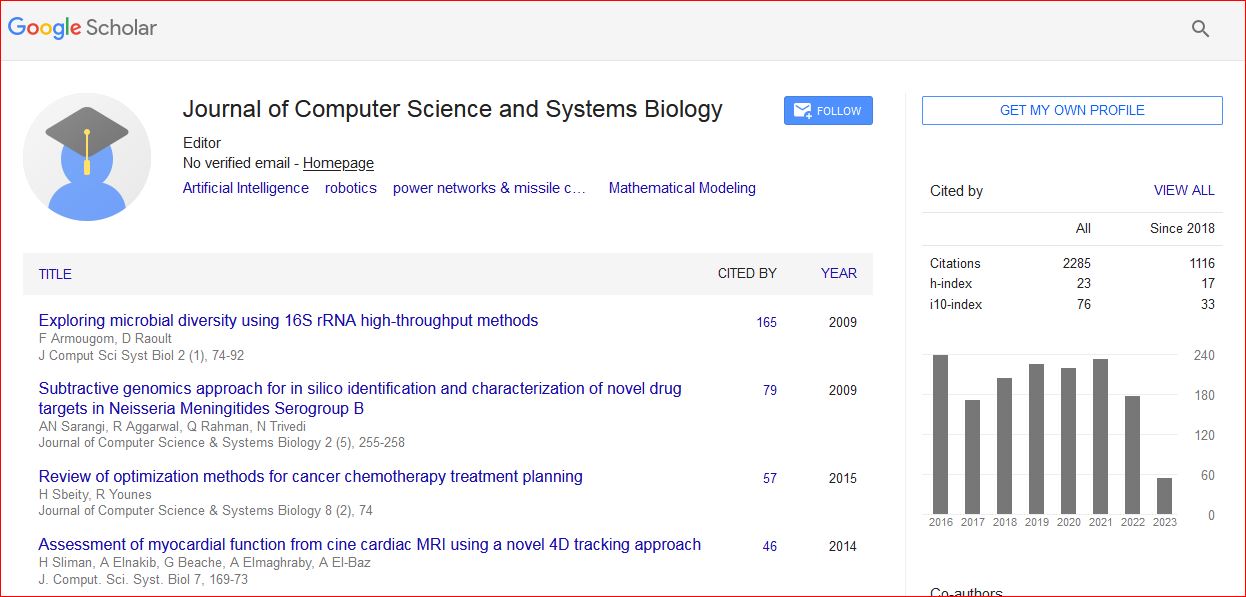
Journal of Computer Science & Systems Biology received 2279 citations as per Google Scholar report