Commentary - (2025) Volume 16, Issue 5
Received: 01-Sep-2025, Manuscript No. jhmi-26-178864;
Editor assigned: 03-Sep-2025, Pre QC No. P-178864;
Reviewed: 17-Sep-2025, QC No. Q-178864;
Revised: 22-Sep-2025, Manuscript No. R-178864;
Published:
29-Sep-2025
, DOI: 10.37421/2157-7420.2025.16.608
Citation: Pereira, Rafael D.. ”AI: Revolutionizing Pathology and Lab Informatics.” J Health Med Informat 16 (2025):608.
Copyright: © 2025 Pereira D. Rafael This is an open-access article distributed under the terms of the Creative Commons Attribution License, which permits unrestricted use, distribution and reproduction in any medium, provided the original author and source are credited.
Artificial intelligence (AI) is fundamentally reshaping the landscape of pathology and laboratory informatics, ushering in an era of enhanced diagnostic accuracy and operational efficiency [1].
The capacity of machine learning, particularly deep learning algorithms, to meticulously analyze histopathology slides is a cornerstone of this transformation, enabling precise cancer detection, grading, and prognostication [1].
In parallel, laboratory informatics is witnessing significant improvements through AI, which is optimizing critical processes such as sample tracking, quality control, and the predictive maintenance of laboratory instruments [1].
This integration promises to accelerate turnaround times and substantially reduce errors, paving the way for more personalized and precise patient care [1].
The application of deep learning models in digital pathology represents a profound advancement, facilitating the automated analysis of vast image datasets for intricate diagnostic tasks [2].
These sophisticated models can discern subtle patterns that might elude the human eye, thereby aiding in the early detection of diseases and the accurate stratification of patient risk [2].
While challenges concerning standardization, validation, and seamless integration into routine clinical workflows persist, the potential for AI to augment and elevate the expertise of pathologists is undeniably immense [2].
Laboratory informatics plays a pivotal role in managing the sheer volume of data generated by contemporary diagnostic laboratories [3].
AI is proving instrumental in optimizing these systems through the prediction of instrument failures, the automation of quality control checks, and the enhancement of sample logistics [3].
These advancements not only bolster operational efficiency but also contribute significantly to patient safety by minimizing the incidence of errors in sample handling and analysis [3].
The influence of AI on breast cancer pathology is particularly noteworthy, with machine learning algorithms demonstrating remarkable accuracy in detecting and classifying microcalcifications, assessing tumor grade, and predicting therapeutic response from histopathology slides [4].
This capability empowers pathologists to make more informed and data-driven decisions [4].
The integration of AI into laboratory workflows holds substantial promise for expediting turnaround times and curtailing operational costs [5].
AI-powered systems are adept at prioritizing urgent cases, efficiently managing reagent inventory, and optimizing instrument utilization, collectively fostering a more efficient and responsive laboratory environment [5].
Furthermore, AI algorithms are being instrumental in the interpretation of complex genomic data, a field of increasing importance in the pursuit of precision medicine [6].
Within pathology and laboratory informatics, AI assists in identifying clinically significant genetic alterations from sequencing data, thereby guiding treatment selection and improving prognostic accuracy [6].
The ethical dimensions and regulatory frameworks governing the deployment of AI in pathology are of paramount importance for ensuring its safe and effective implementation [7].
Prioritizing data privacy, fostering algorithm transparency, and diligently mitigating bias are essential steps in cultivating trust and promoting the widespread adoption of AI-driven diagnostic tools [7].
AI is actively enhancing the capabilities of digital pathology through the automation of tissue region segmentation and the precise quantification of biomarkers [8].
This automation leads to more objective and reproducible assessments, providing robust support for both research endeavors and clinical diagnostics [8].
The development of AI models for image-based diagnostics in pathology is heavily reliant on the availability of large, meticulously annotated datasets [9].
Consequently, concerted efforts toward data standardization and the facilitation of data sharing are critical for propelling the field forward and ensuring the generalizability of AI solutions across diverse institutions and equipment [9].
AI is poised to revolutionize the management and interpretation of laboratory data, with predictive analytics offering the capability to forecast patient risk, optimize resource allocation, and identify anomalies in test results [10].
These predictive capabilities significantly enhance clinical decision-making processes and ultimately lead to improved patient outcomes [10].
Artificial intelligence (AI) is fundamentally transforming pathology and laboratory informatics, leading to improved diagnostic precision and workflow efficiency [1].
Machine learning, especially deep learning, excels at analyzing histopathology slides for cancer detection and grading [1].
AI is also optimizing laboratory operations like sample tracking and instrument maintenance, resulting in faster results and fewer errors [1].
This integration is crucial for advancing personalized medicine [1].
Deep learning models in digital pathology enable automated analysis of large image datasets for complex diagnostic tasks, identifying subtle patterns for early disease detection and risk stratification [2].
Despite challenges in standardization and workflow integration, AI's potential to support pathologists is immense [2].
Laboratory informatics benefits greatly from AI in managing vast data volumes [3].
AI can predict instrument failures, automate quality control, and improve sample logistics, enhancing efficiency and patient safety by reducing errors [3].
AI's impact on breast cancer pathology is significant, with algorithms accurately detecting microcalcifications, assessing tumor grade, and predicting treatment response from histopathology slides, aiding pathologists in decision-making [4].
Integrating AI into laboratory workflows promises faster turnaround times and reduced costs [5].
AI systems can prioritize urgent cases, manage inventory, and optimize instrument use, creating a more efficient laboratory environment [5].
AI algorithms are also vital for interpreting complex genomic data in precision medicine [6].
In pathology and laboratory informatics, AI helps identify relevant genetic alterations from sequencing data, guiding treatment and prognosis [6].
Ethical considerations and regulatory frameworks are critical for AI deployment in pathology, emphasizing data privacy, algorithm transparency, and bias mitigation to build trust and encourage adoption [7].
AI enhances digital pathology by automating tissue segmentation and biomarker quantification, allowing for more objective and reproducible assessments in research and diagnostics [8].
Developing AI for pathology diagnostics necessitates large, well-annotated datasets [9].
Standardization and data sharing are crucial for advancing the field and ensuring AI solutions work across different settings [9].
AI is set to revolutionize laboratory data management and interpretation through predictive analytics, forecasting patient risk, optimizing resources, and identifying anomalies for better clinical decisions and outcomes [10].
Artificial intelligence (AI) is revolutionizing pathology and laboratory informatics by enhancing diagnostic accuracy, automating tasks, and improving workflow efficiency. Machine learning and deep learning algorithms are crucial for analyzing histopathology slides for cancer detection and prognostication. In laboratory informatics, AI optimizes sample tracking, quality control, and instrument maintenance, leading to faster turnaround times and reduced errors. Deep learning models in digital pathology can identify subtle disease patterns. AI aids in managing laboratory data, predicting instrument failures, and automating quality control. In breast cancer pathology, AI assists in detecting abnormalities and predicting treatment response. AI integration into lab workflows improves efficiency and reduces costs. Furthermore, AI is vital for interpreting genomic data in precision medicine and identifying clinically relevant genetic alterations. Ethical considerations like data privacy and bias mitigation are essential for AI adoption. AI enhances digital pathology through automated segmentation and quantification of biomarkers, leading to more objective assessments. The development of AI requires standardized, large datasets for generalizability. Predictive analytics in laboratory medicine offer insights into patient risk and resource optimization, ultimately improving patient outcomes.
None
None
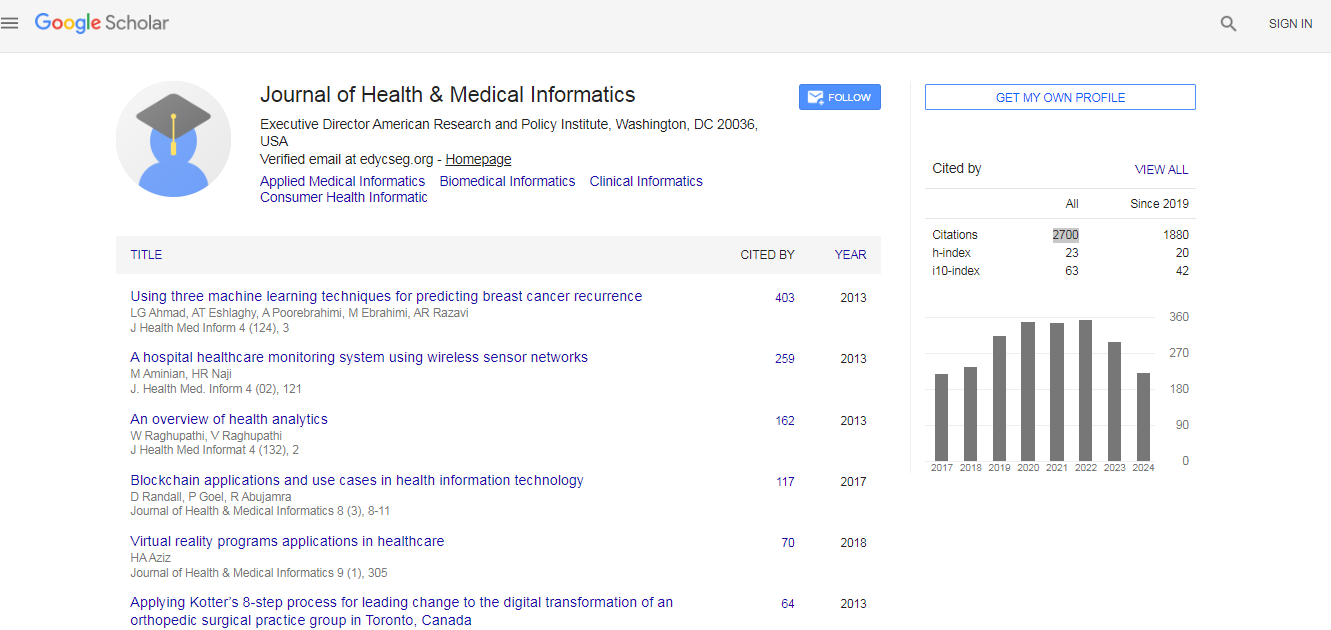
Journal of Health & Medical Informatics received 2700 citations as per Google Scholar report