Brief Report - (2025) Volume 16, Issue 2
Received: 03-Mar-2025, Manuscript No. jch-26-178746;
Editor assigned: 05-Mar-2025, Pre QC No. P-178746;
Reviewed: 19-Mar-2025, QC No. Q-178746;
Revised: 24-Mar-2025, Manuscript No. R-178746;
Published:
31-Mar-2025
, DOI: 10.37421/2157-7099.2025.16.784
Citation: Sato, Yuki. ”AI Revolutionizing Cytopathology: Efficiency, Accuracy, Access.” J Cytol Histol 16 (2025):784.
Copyright: © 2025 Sato Y. This is an open-access article distributed under the terms of the Creative Commons Attribution License, which permits unrestricted use, distribution and reproduction in any medium, provided the original author and source are credited.
The integration of digital cytology and artificial intelligence (AI) is ushering in a new era of diagnostic pathology, marked by enhanced efficiency, accuracy, and consistency in the meticulous analysis of cytological slides. AI algorithms possess the remarkable capability to automate numerous tasks, including precise cell counting, sophisticated feature extraction, and the adept detection of anomalies, thereby empowering pathologists to dedicate their expertise to more complex cases and significantly improving diagnostic turnaround times. This transformative technology holds immense promise for bolstering the effectiveness of screening programs, facilitating the critical advancement of remote diagnostic capabilities, and establishing a standardized framework for quality control within the specialized field of cytopathology [1].
Deep learning models are demonstrating profound potential in the accurate classification of cervical cytology specimens, achieving performance levels that rival those of experienced human experts in the field. These advanced AI systems are instrumental in assisting with the precise identification of high-grade squamous intraepithelial lesions and other significant abnormalities, which in turn serves to reduce the inherent variability among observers and substantially enhance diagnostic precision. The ongoing development and rigorous validation of robust AI tools are absolutely crucial for their widespread and successful adoption within routine clinical practice [2].
The advent of whole-slide imaging (WSI) technology, when coupled with the analytical power of AI, has greatly facilitated the objective and quantitative assessment of cytological features. This innovative approach permits more precise measurements of critical parameters such as nuclear size, nuclear shape, and chromatin texture, all of which are profoundly important for accurate prognostication and the informed selection of appropriate treatment strategies across a spectrum of cancers. AI-powered quantitative cytology is uniquely positioned to uncover subtle morphological patterns that might have previously remained undetected during traditional manual review [3].
Artificial intelligence applications within the realm of diagnostic pathology are continuously expanding, now encompassing the crucial tasks of detecting and accurately grading fine-needle aspiration (FNA) specimens, with a particular focus on the evaluation of thyroid nodules. Machine learning algorithms are adept at analyzing complex cytological features to effectively differentiate between benign and potentially malignant lesions, offering the prospect of reducing the need for repeat biopsies and providing invaluable support for surgical decision-making. It is important to note that the quality and diversity of the training data used for these algorithms are key determinants of their reliable performance [4].
The practical implementation of AI within existing digital cytology workflows necessitates a careful and thorough consideration of a multitude of ethical implications, stringent data privacy requirements, and the obtaining of necessary regulatory approvals. Ensuring that AI decisions are both explainable and transparent is of paramount importance for fostering clinician trust and safeguarding patient safety throughout the diagnostic process. Therefore, collaborative efforts involving AI developers, practicing pathologists, and relevant regulatory bodies are absolutely essential for the responsible and effective integration of this technology [5].
AI algorithms are actively being developed to provide crucial assistance in the detection of neoplastic cells within liquid-based cytology samples, with a specific emphasis on identifying these abnormal cells in various body fluids. These powerful AI tools can help prioritize cases that exhibit a higher likelihood of malignancy, thereby optimizing the workload of pathologists and potentially improving the rates of early cancer detection. It is acknowledged that the accuracy of AI in this specific context can be significantly influenced by factors such as the quality of sample preparation and the overall quality of the resulting smear [6].
The role of artificial intelligence in ensuring the quality control of cytopathology specimens is becoming increasingly significant, given its ability to objectively assess the completeness of sample preparation and the presence of essential diagnostic elements. AI-driven systems are capable of flagging suboptimal smears for further expert review, thereby ensuring that all diagnostically relevant material is present and has been adequately prepared. This meticulous attention to detail fundamentally contributes to the maintenance of the highest standards in cytological diagnosis [7].
Artificial intelligence is rapidly emerging as an exceptionally valuable tool for the precise identification and accurate classification of precancerous lesions across diverse anatomical sites, including the esophagus and stomach, through the analysis of endoscopic biopsy cytology. By meticulously analyzing digital images, AI can effectively detect subtle yet critical cellular and architectural changes that are indicative of dysplasia, thereby significantly aiding in early diagnosis and potentially preventing the progression of these lesions to invasive cancer. It is imperative that the standardization of image acquisition protocols and annotation methods is achieved to ensure robust and reliable AI performance [8].
The development of advanced AI-powered diagnostic platforms specifically designed for cytology is actively enabling remote consultation and the widespread adoption of telepathology, effectively bridging geographical divides and substantially improving access to expert diagnostic services. Digital slides can be seamlessly shared and analyzed by both AI systems and pathologists located anywhere in the world, facilitating timely and highly accurate diagnoses, particularly in underserved or remote regions. This innovative approach significantly enhances collaboration and the sharing of knowledge within the broader pathology community [9].
Artificial intelligence is profoundly transforming the entire landscape of diagnostic pathology by offering a sophisticated suite of tools specifically designed for advanced image analysis and pattern recognition within cytological specimens. The seamless integration of AI into existing workflows promises to significantly augment the capabilities of human pathologists, ultimately leading to the achievement of more efficient, more accurate, and demonstrably more reproducible diagnoses. Continued rigorous research and extensive validation studies are absolutely essential to fully harness the immense potential of AI in the vital field of cytopathology [10].
The integration of digital cytology with artificial intelligence (AI) is revolutionizing diagnostic pathology by substantially enhancing efficiency, improving accuracy, and ensuring consistency in the analysis of cytological slides. AI algorithms are capable of automating fundamental tasks such as cell counting, feature extraction, and anomaly detection, allowing pathologists to concentrate on more complex cases and reduce turnaround times. This technology is poised to improve screening programs, facilitate remote diagnostics, and standardize quality control in cytopathology [1].
Deep learning models have shown significant promise in classifying cervical cytology specimens, achieving performance levels comparable to human experts. These systems can assist in identifying high-grade squamous intraepithelial lesions and other abnormalities, thereby reducing inter-observer variability and improving diagnostic precision. The development of robust, validated AI tools is crucial for widespread clinical adoption [2].
The advent of whole-slide imaging (WSI), in conjunction with AI, enables the objective quantification of cytological features. This approach allows for precise measurement of nuclear size, shape, and chromatin texture, which are vital for prognostication and treatment selection in various cancers. AI-powered quantitative cytology can reveal subtle morphological patterns previously undetectable through manual review [3].
AI applications in diagnostic pathology are extending to the detection and grading of fine-needle aspiration (FNA) specimens, particularly for thyroid nodules. Machine learning algorithms can analyze cytological features to differentiate between benign and malignant lesions, potentially reducing the need for repeat biopsies and aiding surgical decision-making. The quality and diversity of training data are critical for reliable performance [4].
The implementation of AI in digital cytology workflows requires careful consideration of ethical implications, data privacy, and regulatory approvals. Ensuring the explainability and transparency of AI decisions is paramount for clinician trust and patient safety. Collaborative efforts between AI developers, pathologists, and regulatory bodies are essential for responsible integration [5].
AI algorithms are being developed to aid in the detection of neoplastic cells in liquid-based cytology samples, particularly in body fluids. These tools can help prioritize cases with a higher likelihood of malignancy, optimizing pathologist workload and potentially improving early cancer detection rates. The accuracy of AI in this context is influenced by sample preparation and smear quality [6].
The role of AI in quality control for cytopathology is significant, as it can objectively assess sample preparation completeness and the presence of critical diagnostic elements. AI-driven systems can flag suboptimal smears for review, ensuring all diagnostically relevant material is present and adequately prepared. This contributes to maintaining high standards in cytological diagnosis [7].
AI is emerging as a valuable tool for identifying and classifying precancerous lesions in various anatomical sites, such as the esophagus and stomach, using endoscopic biopsy cytology. By analyzing digital images, AI can detect subtle cellular and architectural changes indicative of dysplasia, aiding early diagnosis and potentially preventing progression to invasive cancer. Standardization of image acquisition and annotation is critical for robust performance [8].
The development of AI-powered diagnostic platforms for cytology enables remote consultation and telepathology, bridging geographical gaps and improving access to expert diagnostics. Digital slides can be shared and analyzed globally, facilitating timely and accurate diagnoses, especially in underserved regions. This enhances collaboration and knowledge sharing within the pathology community [9].
AI is transforming diagnostic pathology by offering sophisticated tools for image analysis and pattern recognition in cytological specimens. Its integration promises to augment pathologist capabilities, leading to more efficient, accurate, and reproducible diagnoses. Continued research and validation are essential to harness the full potential of AI in cytopathology [10].
Artificial intelligence (AI) is revolutionizing diagnostic pathology by enhancing efficiency, accuracy, and consistency in slide analysis through automated tasks like cell counting and anomaly detection. AI excels in classifying cytology specimens, identifying precancerous lesions, and grading FNA samples, rivaling human expert performance and reducing inter-observer variability. Whole-slide imaging combined with AI enables objective quantification of cellular features for improved prognostication. AI also plays a crucial role in quality control and the detection of neoplastic cells in liquid-based cytology. Furthermore, AI-powered platforms facilitate remote consultation and telepathology, expanding access to expert diagnostics globally. However, the integration of AI necessitates careful consideration of ethical implications, data privacy, and regulatory requirements, emphasizing the need for explainable and transparent AI decisions. Continuous research and validation are essential to fully realize AI's potential in cytopathology.
None
None
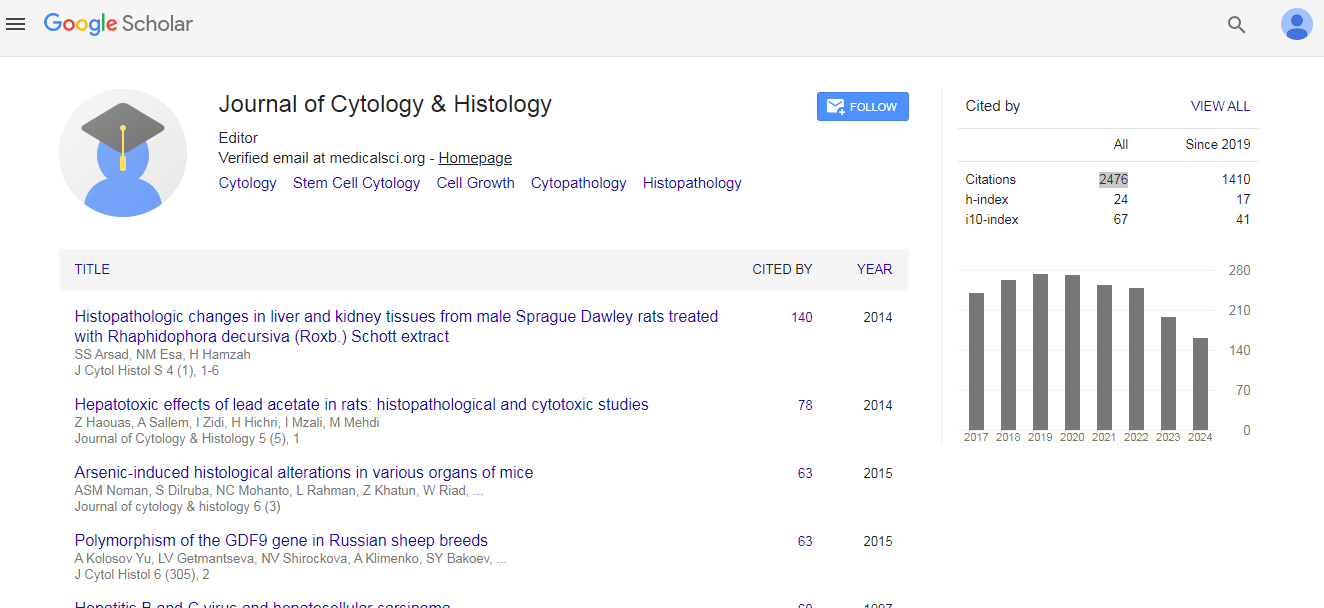
Journal of Cytology & Histology received 2476 citations as per Google Scholar report