Perspective - (2025) Volume 16, Issue 3
Received: 02-May-2025, Manuscript No. jhmi-26-178841;
Editor assigned: 05-May-2025, Pre QC No. P-178841;
Reviewed: 19-May-2025, QC No. Q-178841;
Revised: 23-May-2025, Manuscript No. R-178841;
Published:
30-May-2025
, DOI: 10.37421/2157-7420.2025.16.593
Citation: Chen, Mei-Ling. ”AI Revolutionizes Precision Medicine For Personalized Care.” J Health Med Informat 16 (2025):593.
Copyright: © 2025 Chen M. This is an open-access article distributed under the terms of the Creative Commons Attribution License, which permits unrestricted use, distribution and reproduction in any medium, provided the original author and source are credited.
Artificial intelligence (AI) is profoundly reshaping the landscape of precision medicine, offering unprecedented capabilities to analyze extensive and intricate datasets. This includes vast amounts of genomic information, electronic health records, and medical imaging, enabling a more nuanced understanding of patient health and disease [1].
The integration of AI into these data streams is crucial for identifying distinct disease subtypes, predicting how individuals will respond to various treatments, and ultimately developing highly personalized therapeutic strategies tailored to each patient's unique biological profile [1].
This transformative potential extends to accelerating the discovery of new drugs, optimizing the design of clinical trials to be more efficient and targeted, and significantly enhancing the accuracy of diagnostic processes, collectively leading to more precise and effective patient care [1].
Machine learning models, a subset of AI, are proving to be invaluable tools in the analysis of patient data, empowering the prediction of disease risk and the monitoring of disease progression. By learning from intricate patterns within large and diverse datasets, these models can accurately identify individuals who are at a high risk for developing specific health conditions, thereby facilitating the implementation of early and effective interventions [2].
Furthermore, AI has the capacity to stratify patient populations into distinct subgroups, each characterized by unique biological and clinical features, which paves the way for the development and delivery of more targeted and effective treatment regimens [2].
The application of AI in the realm of medical imaging analysis is leading to a substantial enhancement in diagnostic capabilities across a wide spectrum of diseases. Sophisticated deep learning algorithms are now capable of detecting subtle abnormalities in radiological scans, such as those found in CT and MRI images, often with a level of accuracy and speed that surpasses that of human experts [3].
This heightened precision in the interpretation of medical images contributes significantly to the earlier detection of diseases and the more informed planning of personalized treatment strategies [3].
AI is also making significant strides in accelerating the processes of drug discovery and development. It achieves this by accurately predicting drug efficacy, identifying novel molecular targets for therapeutic intervention, and optimizing preclinical testing methodologies. By meticulously analyzing complex molecular structures and intricate biological pathways, AI algorithms can pinpoint promising drug candidates with remarkable efficiency [4].
This capability critically reduces the extensive time and considerable costs typically associated with bringing new, personalized therapies from the laboratory to the patient [4].
The seamless integration of AI with electronic health records (EHRs) is facilitating the creation of comprehensive patient profiles and enabling advanced predictive analytics. AI algorithms possess the ability to extract meaningful and actionable insights from both unstructured clinical notes and structured data residing within EHRs. This extraction aids in identifying established treatment patterns, predicting potential adverse events, and generating personalized treatment recommendations that are specifically suited to individual patient needs [5].
AI-driven genomics analysis stands as a cornerstone of the precision medicine revolution. By expertly interpreting highly complex genomic data, AI can pinpoint specific genetic variants that are strongly associated with disease susceptibility or an individual's likely response to certain drugs. This detailed understanding empowers the design of individualized therapies and proactive preventative strategies that are grounded in a patient's unique genetic makeup [6].
Personalized treatment recommendations, a central tenet of precision medicine, can be significantly refined and improved through the application of AI. By intelligently integrating a wide array of patient-specific data, which includes their comprehensive clinical history, detailed genetic makeup, and relevant lifestyle factors, AI algorithms are capable of predicting the most effective treatment options and precise dosages. This precision aims to minimize the occurrence of side effects while simultaneously maximizing the overall therapeutic outcomes for the patient [7].
The development and rigorous validation of AI models specifically designed for precision medicine applications necessitate stringent evaluation processes. These essential processes encompass ensuring the robust privacy of patient data, upholding algorithmic fairness across diverse populations, and demonstrating clear clinical utility. Successfully addressing these aspects is crucial for building widespread trust and facilitating the broad adoption of AI technologies within healthcare settings [8].
AI plays an absolutely critical role in the optimization of clinical trial design. This optimization is achieved through its ability to identify suitable patient cohorts for participation and to predict potential treatment outcomes for these cohorts. Such capabilities lead to the execution of clinical trials that are not only more efficient and targeted but also significantly accelerate the delivery of crucial personalized therapies to the patients who stand to benefit from them [9].
Looking ahead, the future trajectory of precision medicine is inextricably linked to the continuous advancement and deeper integration of artificial intelligence. As AI capabilities continue to expand and evolve, so too will the profound potential for delivering truly personalized healthcare experiences. This evolution promises to result in vastly improved patient outcomes, a reduction in overall healthcare costs, and the fostering of a more proactive and preventative approach to health management for individuals worldwide [10].
Artificial intelligence (AI) is fundamentally transforming precision medicine through its capacity to analyze vast and complex datasets. This includes diverse sources such as genomic data, electronic health records, and medical imaging, which are essential for identifying disease subtypes, predicting treatment responses, and developing personalized therapeutic strategies. AI algorithms are instrumental in accelerating drug discovery, optimizing clinical trial designs, and enhancing diagnostic accuracy, ultimately leading to more tailored and effective patient care [1].
Machine learning models are proving indispensable for analyzing patient data to forecast disease risk and progression. By discerning patterns within large datasets, these models can identify individuals at high risk for specific conditions, enabling early interventions. Moreover, AI facilitates patient stratification into subgroups with distinct biological characteristics, paving the way for more targeted and effective treatments [2].
The application of AI in medical imaging analysis significantly boosts diagnostic capabilities for various diseases. Deep learning algorithms can detect subtle abnormalities in radiological scans like CT and MRI, often with greater accuracy and speed than human experts, contributing to early disease detection and personalized treatment planning [3].
AI is accelerating drug discovery and development by predicting drug efficacy, identifying novel drug targets, and optimizing preclinical testing. By analyzing molecular structures and biological pathways, AI efficiently identifies promising drug candidates, substantially reducing the time and cost of bringing new personalized therapies to market [4].
The integration of AI with electronic health records (EHRs) enables comprehensive patient profiling and predictive analytics. AI extracts meaningful insights from both unstructured clinical notes and structured data within EHRs to identify treatment patterns, predict adverse events, and personalize treatment recommendations [5].
AI-driven genomics analysis is a foundational element of precision medicine. By interpreting complex genomic data, AI identifies genetic variants linked to disease susceptibility or drug response, enabling the design of individualized therapies and preventative strategies [6].
Personalized treatment recommendations are significantly improved by AI. By integrating patient-specific data, including clinical history, genetic makeup, and lifestyle factors, AI algorithms predict the most effective treatment options and dosages, minimizing side effects and maximizing therapeutic outcomes [7].
The development and validation of AI models for precision medicine require rigorous evaluation, focusing on data privacy, algorithmic fairness, and clinical utility to build trust and facilitate widespread adoption in healthcare settings [8].
AI plays a vital role in optimizing clinical trial design by identifying suitable patient cohorts and predicting treatment outcomes, leading to more efficient and targeted trials that accelerate the delivery of personalized therapies [9].
The future of precision medicine is contingent upon the continued advancement and integration of AI. As AI capabilities grow, the potential for truly personalized healthcare will expand, leading to improved patient outcomes, reduced healthcare costs, and a more proactive approach to health management [10].
Artificial intelligence (AI) is revolutionizing precision medicine by enabling advanced analysis of genomics, electronic health records, and medical imaging. This integration facilitates disease subtype identification, treatment response prediction, and the development of personalized therapeutic strategies. AI accelerates drug discovery, optimizes clinical trials, and enhances diagnostic accuracy, leading to more tailored patient care. Machine learning models are crucial for predicting disease risk and progression by identifying patterns in large datasets, allowing for early interventions and patient stratification. Deep learning algorithms improve medical imaging analysis for early disease detection. AI streamlines drug discovery by predicting efficacy and identifying targets. Integration with EHRs provides comprehensive patient profiling and predictive analytics. AI-driven genomics analysis identifies genetic predispositions and drug responses for individualized therapies. Personalized treatment recommendations are enhanced by AI's ability to integrate diverse patient data. Rigorous evaluation of AI models is essential for data privacy, fairness, and clinical utility. AI optimizes clinical trials for efficient delivery of personalized therapies. Continued AI advancement promises truly personalized healthcare, improved outcomes, and reduced costs.
None
None
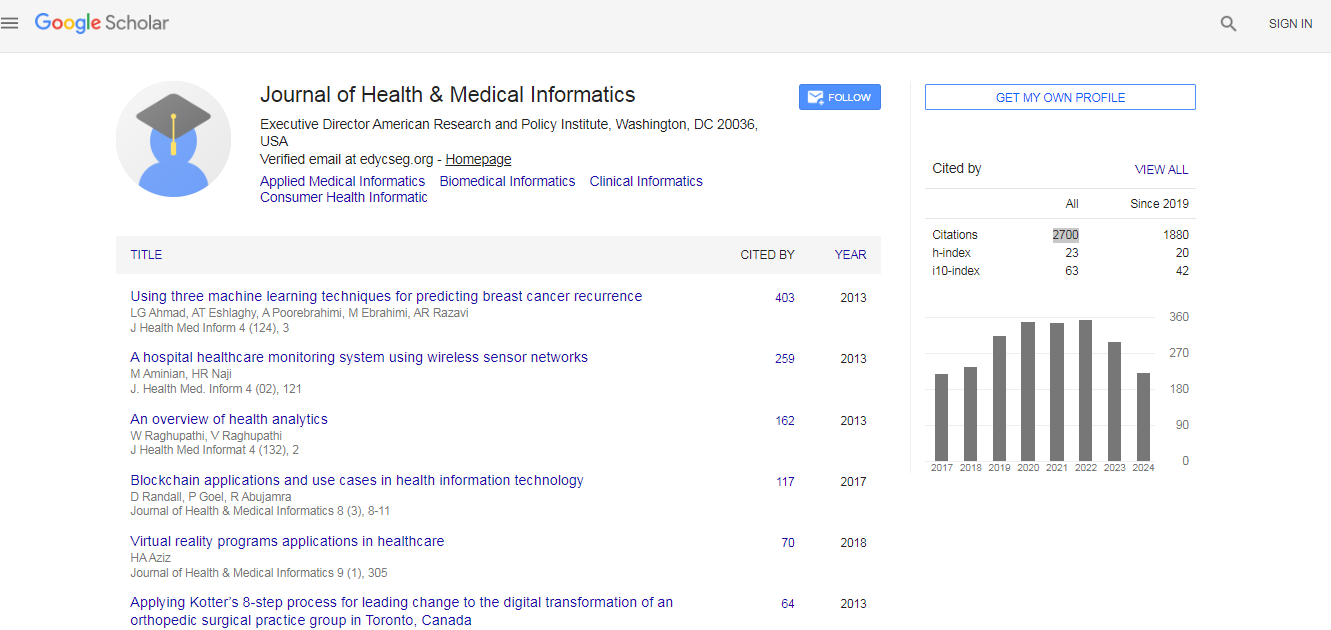
Journal of Health & Medical Informatics received 2700 citations as per Google Scholar report