Opinion - (2025) Volume 14, Issue 4
Received: 01-Jul-2025, Manuscript No. mcce-26-190184;
Editor assigned: 03-Jul-2025, Pre QC No. P-190184;
Reviewed: 17-Jul-2025, QC No. Q-190184;
Revised: 22-Jul-2025, Manuscript No. R-190184;
Published:
29-Jul-2025
, DOI: 10.37421/2470-6965.2025.14.418
Citation: AlKhalifa, Ahmed. ”AI Revolutionizes Malaria Transmission Prediction.” Malar Contr Elimination 14 (2025):418.
Copyright: © 2025 AlKhalifa A. This is an open-access article distributed under the terms of the Creative Commons Attribution License, which permits unrestricted use, distribution and reproduction in any medium, provided the original author and source are credited.
Artificial intelligence, particularly machine learning models, offers significant potential for predicting malaria transmission patterns by analyzing complex environmental, entomological, and socio-economic data. These AI-driven approaches can enhance early warning systems, optimize intervention strategies, and improve resource allocation for malaria control programs [1].
Deep learning techniques, such as Convolutional Neural Networks (CNNs) and Recurrent Neural Networks (RNNs), are proving effective in processing high-resolution satellite imagery and time-series meteorological data to forecast malaria risk hotspots. This allows for more targeted and efficient vector control efforts [2].
The integration of AI with traditional epidemiological data, including case incidence, population movement, and vector surveillance data, can create dynamic models that predict the spatial and temporal spread of malaria. This predictive capability is crucial for proactive public health responses [3].
Machine learning algorithms, such as Support Vector Machines (SVM) and Random Forests, can identify key environmental drivers of malaria transmission, including temperature, rainfall, and humidity, and their non-linear interactions. This aids in understanding the complex ecological factors influencing disease outbreaks [4].
AI models can be trained on historical malaria data to predict future outbreaks with greater accuracy than traditional statistical methods. This improved forecasting allows for timely implementation of preventative measures and resource mobilization [5].
The application of AI in analyzing vector surveillance data, including mosquito density and species distribution, can provide insights into localized malaria transmission dynamics. This helps in understanding vector behavior and optimizing insecticide resistance management [6].
AI-powered systems can integrate diverse data streams, such as climate forecasts, mobile phone data, and social media trends, to provide a comprehensive picture of potential malaria outbreaks. This multi-source data integration enhances the predictive power of these models [7].
The development of interpretable AI models is crucial for building trust and facilitating the adoption of these technologies in public health decision-making for malaria control. Understanding the 'why' behind predictions is as important as the predictions themselves [8].
AI can help identify geographical areas with a high risk of malaria resurgence, allowing for targeted interventions and resource allocation to prevent outbreaks. This proactive approach is essential for sustaining malaria elimination efforts [9].
The application of artificial intelligence in malaria transmission prediction has the potential to revolutionize malaria control by providing more accurate, timely, and actionable insights for public health officials. This can lead to more effective strategies and ultimately contribute to malaria elimination [10].
Artificial intelligence, particularly machine learning, is transforming the prediction of malaria transmission by analyzing vast datasets encompassing environmental, entomological, and socio-economic factors. This analytical prowess enhances early warning systems, refines intervention strategies, and optimizes resource allocation for robust malaria control programs [1].
Advanced deep learning techniques, including Convolutional Neural Networks (CNNs) and Recurrent Neural Networks (RNNs), demonstrate considerable efficacy in processing high-resolution satellite imagery and historical meteorological data. This capability is instrumental in forecasting malaria risk hotspots, thereby enabling more precise and efficient vector control interventions [2].
Integrating artificial intelligence with established epidemiological data, such as case incidence rates, population mobility patterns, and vector surveillance information, allows for the construction of dynamic models. These models are adept at predicting the spatial and temporal progression of malaria, a vital attribute for enabling proactive public health responses [3].
Machine learning algorithms, specifically Support Vector Machines (SVM) and Random Forests, excel at identifying critical environmental determinants of malaria transmission. These include variables like temperature, rainfall, and humidity, along with their complex, non-linear interrelationships, thus illuminating the ecological factors that drive disease outbreaks [4].
By training AI models on historical malaria data, it becomes possible to forecast future outbreaks with a significantly higher degree of accuracy compared to conventional statistical methodologies. This enhanced predictive capability facilitates the timely deployment of preventative measures and the strategic mobilization of resources [5].
The deployment of AI for analyzing vector surveillance data, such as mosquito density and species distribution, yields crucial insights into localized malaria transmission dynamics. This analysis is key to understanding vector behavior patterns and developing effective strategies for insecticide resistance management [6].
AI-driven systems possess the capacity to consolidate disparate data streams, including climate forecasts, mobile phone usage data, and social media trends, to construct a holistic view of potential malaria outbreaks. This multi-source data integration substantially amplifies the predictive power and comprehensiveness of these forecasting models [7].
Crucially, the development of interpretable AI models is paramount for fostering trust and encouraging the widespread adoption of these advanced technologies within public health decision-making frameworks for malaria control. Understanding the underlying rationale for predictions is as critical as the predictions themselves [8].
Artificial intelligence can effectively pinpoint geographical zones at elevated risk of malaria resurgence. This allows for the implementation of highly targeted interventions and the strategic allocation of resources specifically designed to preemptively avert outbreaks, a proactive stance essential for sustaining malaria elimination initiatives [9].
The integration of artificial intelligence into malaria transmission prediction holds the promise of fundamentally revolutionizing malaria control efforts. It offers public health officials more precise, timely, and actionable intelligence, paving the way for superior strategies and ultimately contributing significantly to the global goal of malaria elimination [10].
Artificial intelligence, particularly machine learning and deep learning, is revolutionizing malaria transmission prediction. By analyzing diverse data sources including environmental, entomological, socio-economic, epidemiological, and vector surveillance data, AI models offer enhanced accuracy and timeliness in forecasting outbreaks. Techniques like CNNs and RNNs process satellite imagery and meteorological data, while algorithms like SVM and Random Forests identify key environmental drivers. AI enables proactive public health responses, targeted interventions, and optimized resource allocation, surpassing traditional statistical methods. The development of interpretable AI models is crucial for adoption. Overall, AI's application promises to significantly advance malaria control and contribute to elimination efforts.
None
None
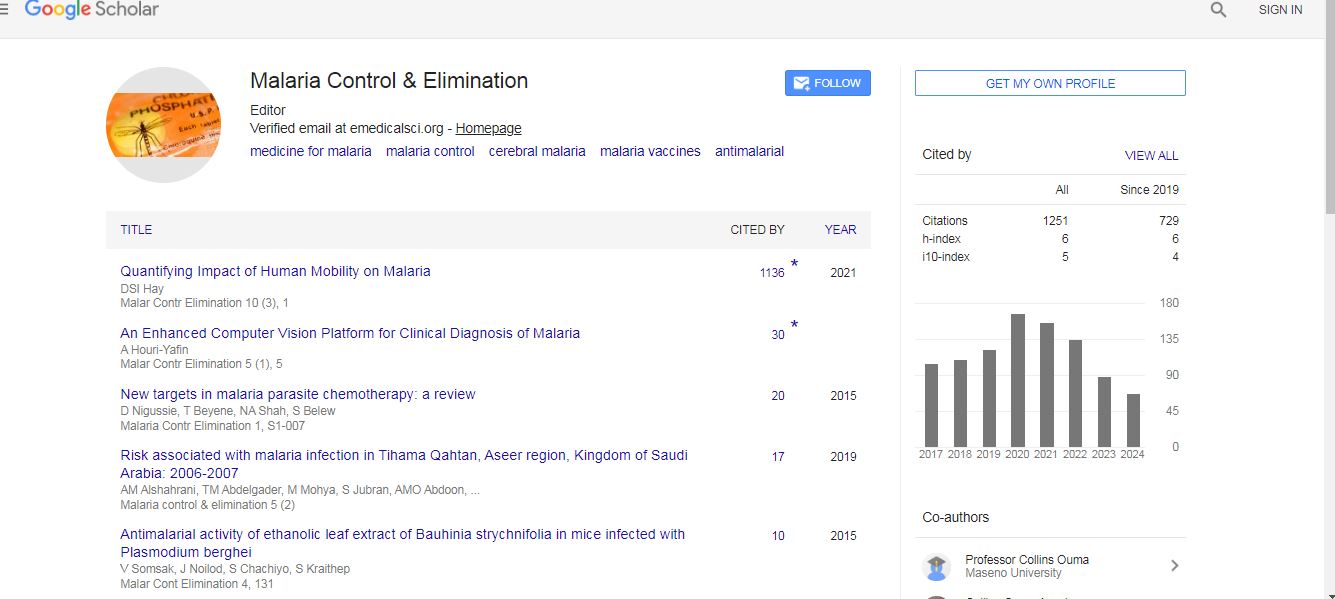
Malaria Control & Elimination received 1187 citations as per Google Scholar report