Opinion - (2025) Volume 16, Issue 4
Received: 01-Jul-2025, Manuscript No. jhmi-26-178857;
Editor assigned: 03-Jul-2025, Pre QC No. P-178857;
Reviewed: 17-Jul-2025, QC No. Q-178857;
Revised: 22-Jul-2025, Manuscript No. R-178857;
Published:
30-Jul-2025
, DOI: 10.37421/2157-7420.2025.16.604
Citation: Park, Hyun-Woo. ”AI Predicts ICU Events: Better Patient Outcomes.” J Health Med Informat 16 (2025):604.
Copyright: © 2025 Park H. This is an open-access article distributed under the terms of the Creative Commons Attribution License, which permits unrestricted use, distribution and reproduction in any medium, provided the original author and source are credited.
The integration of artificial intelligence (AI) into intensive care units (ICUs) is revolutionizing patient care, offering unprecedented opportunities for early detection, precise prediction, and personalized treatment of critical conditions. AI-driven predictive modeling stands at the forefront of this transformation, enabling healthcare professionals to anticipate and mitigate patient deterioration with remarkable efficacy. AI-driven predictive modeling in ICUs offers substantial improvements in patient outcomes by enabling early detection of critical events such as sepsis, cardiac arrest, and acute kidney injury. These models can analyze vast amounts of real-time patient data from electronic health records and monitoring devices to identify subtle patterns indicative of impending deterioration. This allows for timely interventions, reduced length of stay, and improved resource allocation [1].
The application of machine learning algorithms for predicting sepsis onset in ICUs has shown promising results. These models can integrate physiological data, laboratory results, and clinical notes to identify patients at high risk days before clinical manifestation, allowing for prompt administration of antibiotics and fluids [2].
Deep learning models are increasingly being utilized to predict acute kidney injury (AKI) in critically ill patients. By analyzing complex patterns in time-series data, these models can identify early indicators of AKI, enabling earlier intervention and potentially reducing the severity and progression of the condition [3].
Predicting the risk of cardiac arrest in the ICU is another critical area where AI models are making significant contributions. These models can integrate a wide range of patient data to identify individuals at elevated risk, prompting closer monitoring and proactive management strategies [4].
The interpretability of AI models in healthcare remains a significant challenge, especially in high-stakes environments like the ICU. Developing explainable AI (XAI) techniques is crucial for clinicians to understand the rationale behind predictions, fostering trust and facilitating clinical adoption [5].
Real-time data integration from various sources, including bedside monitors, ventilators, and electronic health records, is fundamental for the success of AI-driven predictive models in the ICU. Standardized data formats and robust data pipelines are essential for accurate and timely predictions [6].
The ethical implications of using AI in critical care, including issues of bias, accountability, and patient autonomy, require careful consideration. Developing ethical guidelines and robust validation processes is crucial to ensure responsible deployment of these technologies [7].
AI-powered early warning scores (EWS) are emerging as a more dynamic and accurate alternative to traditional EWS. These models can continuously re-evaluate patient risk based on real-time data, providing a more nuanced assessment of patient stability [8].
The integration of AI into clinical workflows in the ICU requires significant investment in infrastructure, training, and change management. Successful implementation hinges on close collaboration between AI developers, clinicians, and IT professionals [9].
Natural Language Processing (NLP) is a key component for extracting valuable information from unstructured clinical notes, which can significantly enhance the predictive power of AI models in the ICU. This includes identifying subtle symptoms or patient concerns not captured by structured data [10].
Artificial intelligence is profoundly impacting intensive care units (ICUs) by enhancing diagnostic capabilities and improving patient outcomes through predictive modeling. These advanced systems can process massive datasets to identify subtle patterns that may elude human observation, leading to earlier interventions and better prognoses. The application of AI in ICUs is not merely an enhancement but a paradigm shift in critical care delivery. AI-driven predictive modeling in ICUs offers substantial improvements in patient outcomes by enabling early detection of critical events such as sepsis, cardiac arrest, and acute kidney injury. These models can analyze vast amounts of real-time patient data from electronic health records and monitoring devices to identify subtle patterns indicative of impending deterioration. This allows for timely interventions, reduced length of stay, and improved resource allocation [1].
The application of machine learning algorithms for predicting sepsis onset in ICUs has shown promising results. These models can integrate physiological data, laboratory results, and clinical notes to identify patients at high risk days before clinical manifestation, allowing for prompt administration of antibiotics and fluids [2].
Deep learning models are increasingly being utilized to predict acute kidney injury (AKI) in critically ill patients. By analyzing complex patterns in time-series data, these models can identify early indicators of AKI, enabling earlier intervention and potentially reducing the severity and progression of the condition [3].
Predicting the risk of cardiac arrest in the ICU is another critical area where AI models are making significant contributions. These models can integrate a wide range of patient data to identify individuals at elevated risk, prompting closer monitoring and proactive management strategies [4].
The interpretability of AI models in healthcare remains a significant challenge, especially in high-stakes environments like the ICU. Developing explainable AI (XAI) techniques is crucial for clinicians to understand the rationale behind predictions, fostering trust and facilitating clinical adoption [5].
Real-time data integration from various sources, including bedside monitors, ventilators, and electronic health records, is fundamental for the success of AI-driven predictive models in the ICU. Standardized data formats and robust data pipelines are essential for accurate and timely predictions [6].
The ethical implications of using AI in critical care, including issues of bias, accountability, and patient autonomy, require careful consideration. Developing ethical guidelines and robust validation processes is crucial to ensure responsible deployment of these technologies [7].
AI-powered early warning scores (EWS) are emerging as a more dynamic and accurate alternative to traditional EWS. These models can continuously re-evaluate patient risk based on real-time data, providing a more nuanced assessment of patient stability [8].
The integration of AI into clinical workflows in the ICU requires significant investment in infrastructure, training, and change management. Successful implementation hinges on close collaboration between AI developers, clinicians, and IT professionals [9].
Natural Language Processing (NLP) is a key component for extracting valuable information from unstructured clinical notes, which can significantly enhance the predictive power of AI models in the ICU. This includes identifying subtle symptoms or patient concerns not captured by structured data [10].
AI-driven predictive modeling in ICUs significantly enhances patient outcomes by enabling early detection of critical events like sepsis, cardiac arrest, and acute kidney injury. These models analyze vast real-time patient data to identify subtle signs of deterioration, allowing for timely interventions, reduced hospital stays, and optimized resource allocation. Machine learning algorithms are proving effective in predicting sepsis onset, integrating diverse data sources to identify high-risk patients. Deep learning models are advancing the prediction of acute kidney injury by recognizing complex temporal patterns. AI is also crucial in forecasting cardiac arrest risk, prompting proactive management. While the potential is vast, challenges remain, including the interpretability of AI models, the need for robust real-time data integration from various sources, and careful consideration of ethical implications such as bias and accountability. AI-powered early warning scores offer a more dynamic approach than traditional methods. Successful implementation necessitates investment in infrastructure, training, and collaborative efforts between developers and clinicians. Natural Language Processing plays a vital role in extracting insights from unstructured clinical notes, further improving predictive accuracy.
None
None
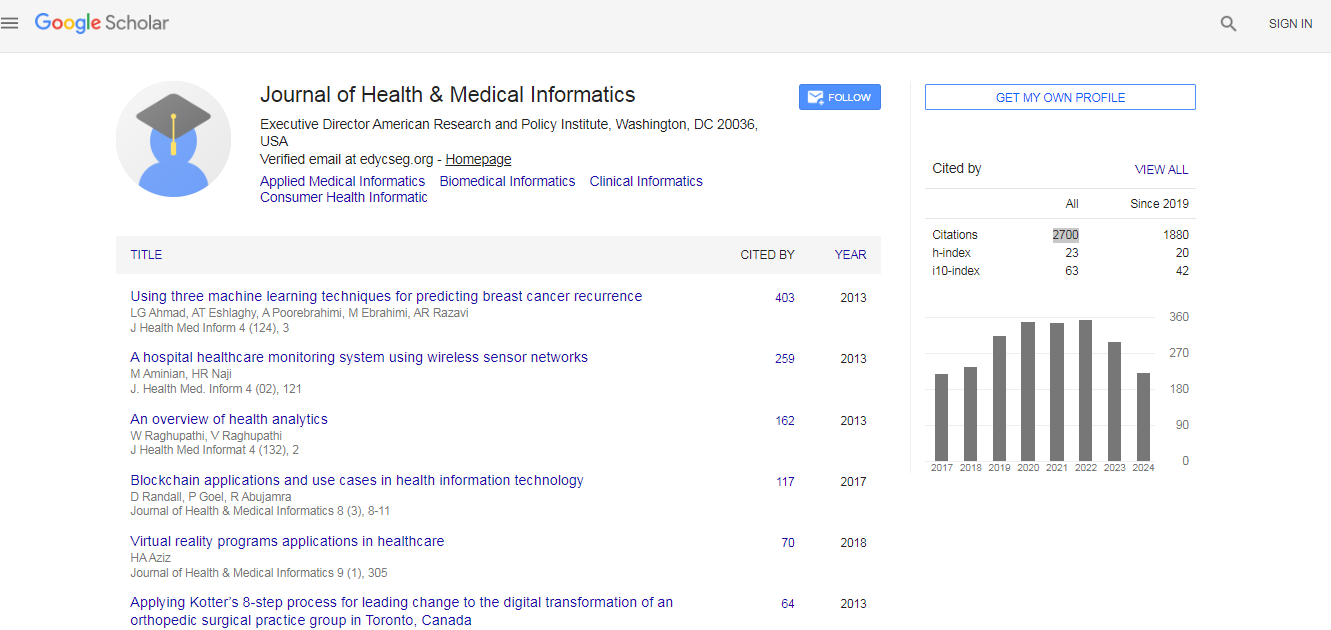
Journal of Health & Medical Informatics received 2700 citations as per Google Scholar report