Short Communication - (2025) Volume 15, Issue 6
Received: 31-Oct-2025, Manuscript No. jtese-26-184265;
Editor assigned: 03-Nov-2025, Pre QC No. P-184265;
Reviewed: 17-Nov-2025, QC No. Q-184265;
Revised: 21-Nov-2025, Manuscript No. R-184265;
Published:
28-Nov-2025
, DOI: 10.37421/2165-8064.2025.15.686
Citation: Musa, Ibrahim. ”AI Predicts Fabric Performance: Optimizing Material Development.” J Textile Sci Eng 15 (2025):686.
Copyright: © 2025 Musa I. This is an open-access article distributed under the terms of the Creative Commons Attribution License, which permits unrestricted use, distribution and reproduction in any medium, provided the original author and source are credited.
Artificial intelligence, especially machine learning, provides powerful capabilities for predicting fabric performance. By analyzing extensive datasets that include material properties, manufacturing specifics, and end-use performance data, AI models can discern complex relationships that are often missed by traditional methods. This facilitates more precise predictions of characteristics such as tensile strength, tear resistance, colorfastness, and durability, ultimately leading to optimized material selection, streamlined product development, and improved quality control in the textile industry [1].
Deep learning algorithms, a sophisticated subset of AI, demonstrate a particular aptitude for processing intricate patterns within textile data. Convolutional Neural Networks (CNNs) are capable of analyzing images of fabric structures to forecast mechanical properties, while Recurrent Neural Networks (RNNs) can model sequential data generated during testing procedures. This advanced capability enables real-time monitoring and prediction of fabric performance throughout the production process, allowing for the early detection of potential issues before they affect the final product [2].
Machine learning models, including Support Vector Machines (SVMs) and Random Forests, can be effectively trained on datasets that correlate fiber attributes (e.g., denier, length, tenacity) and yarn characteristics (e.g., twist, strength) with fabric performance outcomes. This predictive power is instrumental in selecting optimal fiber blends and yarn structures to achieve desired fabric functionalities for a wide array of applications, from everyday apparel to high-performance technical textiles [3].
The integration of AI into textile research significantly accelerates the discovery of novel materials possessing enhanced performance characteristics. Through the simulation and prediction of the behavior of various material combinations under diverse conditions, AI can effectively guide experimental endeavors, thereby reducing the time and financial investment typically associated with traditional trial-and-error approaches in materials science [4].
AI-driven predictive models are capable of forecasting the lifespan and performance degradation of textiles under specific usage scenarios. This capability is of immense value to industries that require highly durable materials, such as the automotive, aerospace, and protective clothing sectors, as it allows for more robust product warranties and informed material selections based on anticipated long-term performance [5].
The successful development of AI models for fabric performance prediction is intrinsically dependent on the quality and comprehensiveness of the training data. Datasets that encompass a wide variety of fiber types, yarn constructions, weaving or knitting parameters, finishing processes, and thorough performance testing results are absolutely critical for building models that are both accurate and broadly applicable [6].
AI can substantially enhance the efficiency and precision of quality control processes within textile manufacturing. By analyzing sensor data from production lines or visual data from finished fabrics, AI systems can identify any deviations from expected performance characteristics, thereby enabling prompt corrective actions and minimizing material waste [7].
The application of AI extends to predicting the functional performance of smart textiles, including their conductivity, flexibility, and responsiveness to various stimuli. This predictive capacity is vital for the advancement of next-generation wearable electronics, sophisticated sensors, and integrated systems that rely on intelligent fabric functionalities [8].
AI-driven simulations are capable of predicting how fabrics will perform when subjected to environmental stresses such as UV exposure, humidity, and significant temperature fluctuations. This predictive capability is indispensable for the development of textiles intended for outdoor applications, apparel designed for specific climatic conditions, and protective gear that must withstand harsh environments [9].
The adoption of AI in fabric performance prediction serves as a catalyst for innovation by facilitating rapid prototyping and virtual testing of new material designs. This allows designers and engineers to explore a broader spectrum of possibilities and iterate on designs with greater efficiency, ultimately leading to the creation of advanced textiles with finely tuned performance attributes tailored to specific market demands [10].
Artificial intelligence, particularly in its machine learning forms, offers a potent toolkit for the accurate prediction of fabric performance characteristics. Through the analysis of vast datasets that meticulously record material properties, manufacturing variables, and real-world performance metrics, AI models excel at identifying intricate relationships that often elude conventional analytical methods. This advanced analytical power leads to more reliable predictions of critical properties like tensile strength, tear resistance, colorfastness, and overall durability, thereby enabling optimized material selection, accelerating product development cycles, and enhancing the rigorousness of quality control within textile manufacturing operations [1].
Deep learning algorithms, a specialized branch of artificial intelligence, exhibit a remarkable proficiency in discerning complex patterns inherent in textile data. Convolutional Neural Networks (CNNs), for instance, are adept at analyzing visual representations of fabric structures to forecast mechanical properties, while Recurrent Neural Networks (RNNs) are well-suited for modeling sequential data derived from various testing procedures. This sophisticated capability empowers real-time monitoring and predictive analysis of fabric performance during the production phase, flagging potential anomalies before they can compromise the integrity of the final product [2].
Established machine learning models, such as Support Vector Machines (SVMs) and Random Forests, can be trained on comprehensive datasets that establish correlations between fundamental fiber characteristics, including denier, length, and tenacity, and yarn properties like twist and strength, with subsequent fabric performance outcomes. This predictive capacity is invaluable for guiding the selection of optimal fiber blends and yarn structures, ensuring the achievement of desired fabric functionalities for a diverse range of applications, spanning from fashion apparel to advanced technical textiles [3].
The integration of artificial intelligence into the realm of textile research acts as a significant accelerant for the discovery of novel materials characterized by superior performance attributes. By employing AI to simulate and predict the behavior of different material combinations under a wide spectrum of conditions, experimental efforts can be more strategically directed, substantially reducing the time and cost traditionally associated with empirical trial-and-error methodologies in materials science [4].
AI-driven predictive models possess the capability to forecast the expected lifespan and the rate of performance degradation of textiles when subjected to specific usage conditions. This predictive accuracy is particularly crucial for industries that depend on highly durable materials, such as the automotive, aerospace, and protective clothing sectors, facilitating the establishment of more credible product warranties and enabling more informed material procurement decisions based on projected long-term performance [5].
The efficacy and generalizability of AI models developed for predicting fabric performance are profoundly influenced by the quality and sheer volume of the training data utilized. Datasets that comprehensively document diverse fiber types, intricate yarn constructions, detailed weaving and knitting parameters, various finishing processes, and the results of rigorous performance testing are fundamentally essential for building accurate and broadly applicable predictive models [6].
Artificial intelligence presents a significant opportunity to enhance both the efficiency and the precision of quality control measures employed in textile manufacturing. By leveraging the analysis of sensor data generated on production lines or image data captured from finished fabrics, AI systems can reliably identify any deviations from anticipated performance characteristics, thereby facilitating immediate implementation of corrective actions and substantially reducing material wastage [7].
The transformative applications of artificial intelligence extend to the accurate prediction of the functional performance characteristics of smart textiles, including their electrical conductivity, inherent flexibility, and dynamic responsiveness to external stimuli. This predictive foresight is critically important for the ongoing development and innovation of next-generation wearable electronic devices, advanced sensor technologies, and integrated smart textile systems [8].
AI-driven simulation techniques offer the capacity to accurately predict how fabrics will perform when exposed to a range of environmental stresses, such as prolonged ultraviolet radiation, fluctuating humidity levels, and significant temperature variations. This predictive power is absolutely essential for the design and development of textiles intended for demanding outdoor applications, apparel tailored for specific climatic conditions, and specialized protective gear designed to function reliably in harsh environmental settings [9].
The increasing adoption of artificial intelligence in the domain of fabric performance prediction actively fosters a culture of innovation by enabling rapid prototyping and the efficient virtual testing of newly conceived material designs. This technological advancement empowers designers and engineers to explore a far wider array of creative possibilities and to refine their designs with greater speed and efficiency, ultimately leading to the creation of advanced textiles possessing precisely tailored performance attributes to meet specific and evolving market demands [10].
Artificial intelligence, particularly machine learning and deep learning, offers advanced capabilities for predicting fabric performance. By analyzing vast datasets of material properties, manufacturing parameters, and end-use metrics, AI models can accurately forecast characteristics like tensile strength, tear resistance, and durability, optimizing material selection and product development. Algorithms like CNNs and RNNs analyze fabric structures and test data for real-time monitoring, while models like SVMs and Random Forests correlate fiber and yarn properties with fabric outcomes. AI accelerates the discovery of novel materials and helps predict lifespan and degradation, crucial for durable textiles. It also enhances quality control by identifying deviations and aids in predicting functional performance of smart textiles and behavior under environmental stresses. This integration fosters innovation through rapid prototyping and virtual testing, leading to advanced textiles with tailored attributes.
None
None
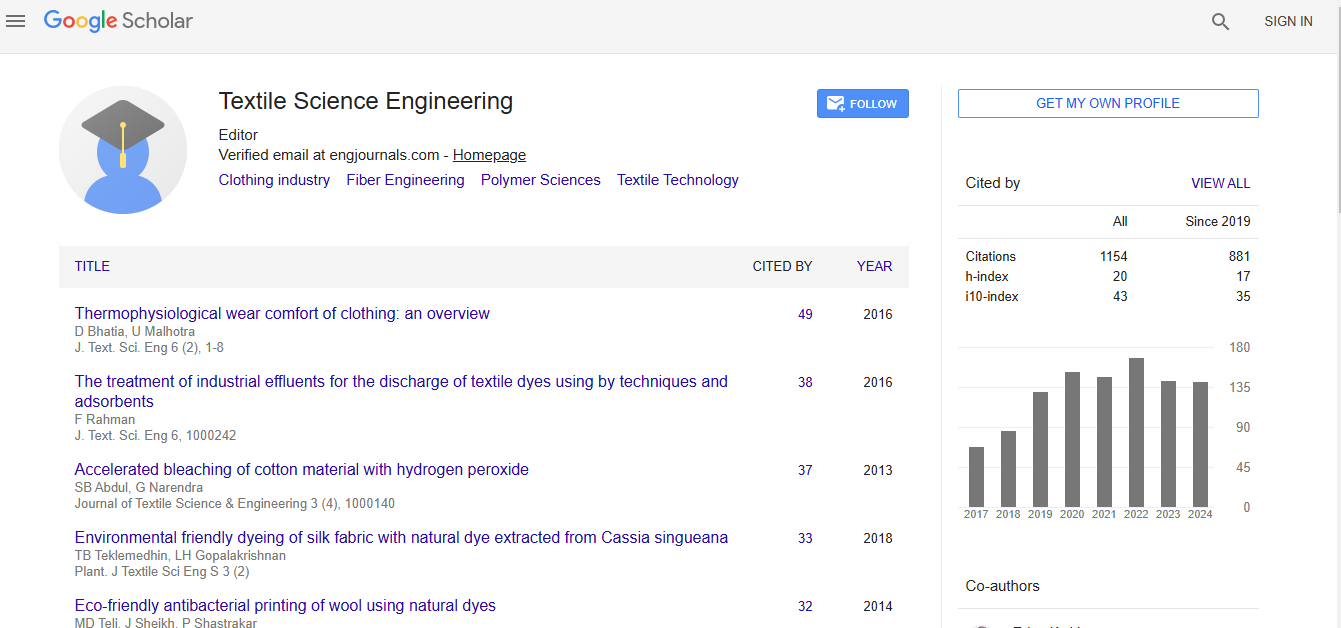
Journal of Textile Science & Engineering received 1008 citations as per Google Scholar report