Short Communication - (2025) Volume 16, Issue 6
Received: 01-Nov-2025, Manuscript No. jhmi-26-178905;
Editor assigned: 03-Nov-2025, Pre QC No. P-178905;
Reviewed: 17-Nov-2025, QC No. Q-178905;
Revised: 24-Nov-2025, Manuscript No. R-178905;
Published:
29-Nov-2025
, DOI: 10.37421/2157-7420.2025.16.626
Citation: Wangchuk, Tenzin D.. ”AI, Data and the Future of Health Informatics.” J Health Med Informat 16 (2025):626.
Copyright: © 2025 Wangchuk D. Tenzin This is an open-access article distributed under the terms of the Creative Commons Attribution License, which permits unrestricted use, distribution and reproduction in any medium, provided the original author and source are credited.
The landscape of health and medical informatics is being profoundly reshaped by the advent of advanced technologies, particularly artificial intelligence (AI) and machine learning (ML) [1].
These innovations are not merely incremental improvements; they represent a paradigm shift with the potential to revolutionize core areas of healthcare, including diagnostic accuracy, the tailoring of treatments to individual patients, and the complex process of drug discovery. The ability of AI and ML to process vast datasets and identify intricate patterns far surpasses human capabilities, promising unprecedented advancements in these fields. Furthermore, the imperative for seamless data exchange across disparate healthcare systems has never been more pronounced [1].
As healthcare becomes increasingly interconnected, interoperability standards are emerging as a critical enabler for better patient care coordination, public health surveillance, and the efficient management of health information. The integration of diverse data sources, from electronic health records to the burgeoning ecosystem of wearable devices and the Internet of Medical Things (IoMT), is generating an unprecedented volume of real-time health data [1].
This continuous flow of information offers significant opportunities for proactive health management and the expansion of remote patient monitoring capabilities, allowing for timely interventions and personalized health strategies. However, alongside these transformative opportunities come significant ethical considerations that demand careful attention and robust governance [1].
Concerns surrounding data privacy, the security of sensitive health information, and the potential for algorithmic bias within AI systems necessitate the development of transparent frameworks to build trust and ensure equitable access to these advancements for all individuals. The increasing adoption of electronic health records (EHRs) and the broader shift towards value-based care models are driving the need for sophisticated informatics solutions [2].
These solutions are essential for analyzing complex patient data, optimizing resource allocation, and ultimately improving the quality and efficiency of healthcare delivery. The role of natural language processing (NLP) is becoming increasingly paramount in this data-rich environment [2].
NLP techniques are vital for extracting meaningful insights from unstructured clinical notes, which often contain critical patient information that would otherwise remain inaccessible to systematic analysis. This enhanced ability to process unstructured data contributes to the creation of more comprehensive patient profiles and facilitates more robust medical research. Future research endeavors should also prioritize the development of patient-centric informatics tools [2].
Empowering individuals with greater control over their health information and fostering active engagement in their own care are crucial steps towards a more collaborative and effective healthcare system. The expansion of telemedicine and remote monitoring technologies is poised to significantly enhance healthcare accessibility, particularly in geographically underserved or remote regions [3].
These technologies, when supported by a strong health informatics infrastructure, facilitate continuous patient engagement and enable timely interventions, bridging the gap between patients and healthcare providers. Research efforts are increasingly focusing on evaluating the efficacy and cost-effectiveness of these virtual care models, aiming to optimize their integration into mainstream healthcare delivery. The development of predictive models for patient deterioration, drawing on data from wearables and EHRs, holds immense promise for enabling preemptive care [3].
Such models can alert clinicians to potential adverse events before they become critical, thereby reducing hospital readmissions and significantly improving patient outcomes. As the volume and complexity of health information continue to grow exponentially, the security and privacy of this sensitive data remain paramount concerns [4].
The increasing digitization of health records and the interconnectedness of healthcare systems make them vulnerable to a growing array of cyber threats. Future research in health informatics must therefore prioritize the development and implementation of advanced security protocols, leveraging technologies such as blockchain for secure data sharing and employing privacy-preserving techniques like differential privacy. Ensuring explicit patient consent and maintaining patient control over their data are fundamental pillars for fostering trust and enabling the ethical and responsible use of health information for both clinical applications and vital research purposes [4].
Robust regulatory frameworks are indispensable for governing the responsible handling of sensitive patient data in this evolving digital landscape. The integration of genomic data into health informatics systems is a critical driver for the realization of personalized medicine [5].
Understanding the intricate interplay between an individual's unique genetic makeup, their lifestyle choices, and their environmental exposures is key to achieving more precise diagnoses and developing highly targeted therapies. This endeavor necessitates the development and deployment of sophisticated bioinformatics tools and platforms capable of analyzing massive-scale genomic datasets with accuracy and efficiency. Concurrent with these technical advancements, ethical considerations surrounding genetic privacy and the potential for genetic discrimination are of paramount importance and require ongoing investigation [5].
Future research directions must focus on creating robust models that effectively translate complex genomic insights into actionable clinical recommendations, ultimately optimizing treatment efficacy and minimizing the occurrence of adverse drug reactions. The development of interoperable health information systems stands as a fundamental prerequisite for efficient and effective healthcare delivery [6].
Standards such as Fast Healthcare Interoperability Resources (FHIR) are actively paving the way for seamless and standardized data exchange between previously disparate systems, thereby significantly improving care coordination and reducing the incidence of medical errors. Future research will undoubtedly concentrate on the wider adoption and practical implementation of these interoperability standards across the healthcare spectrum [6].
Moreover, there is an ongoing need for the development of more advanced interoperability solutions that can accommodate the ever-increasing complexity and diversity of health data, including data streams originating from the burgeoning Internet of Medical Things (IoMT) ecosystem. This enhanced interoperability will facilitate a more comprehensive and holistic understanding of patient health, enabling real-time, data-driven decision-making at the point of care. Wearable devices and an array of sophisticated sensors are fundamentally transforming the way health is monitored by enabling continuous, real-time data collection from individuals [7].
This continuous influx of physiological and behavioral data holds immense potential to revolutionize preventive care strategies, facilitate early disease detection, and empower personalized health management on an unprecedented scale. Addressing the inherent challenges associated with data validation, seamless integration into existing clinical workflows, and navigating the complex ethical considerations surrounding data privacy and ownership is a critical area for future research [7].
The development of advanced algorithms specifically designed to interpret these continuous streams of health data will be paramount to unlocking their full potential for improving patient outcomes and advancing public health initiatives. The ethical implications surrounding the deployment and utilization of artificial intelligence (AI) within the healthcare domain represent a significant and ongoing area for critical future research [8].
A primary concern is the potential for bias embedded within AI algorithms, which could inadvertently lead to inequities in diagnosis, treatment recommendations, and overall healthcare access for different patient populations. Issues related to accountability for AI-driven decisions and the need for transparent AI models are also crucial aspects that require systematic attention and resolution. The development of clear ethical guidelines and robust regulatory frameworks specifically tailored for the application of AI in healthcare settings is essential to ensure responsible innovation and deployment [8].
Future research efforts should be directed towards the creation of explainable AI (XAI) models that can provide clear and understandable justifications for their recommendations, thereby fostering trust among both clinicians and patients and ensuring that AI applications genuinely promote equitable and high-quality healthcare for all. Natural Language Processing (NLP) plays an indispensable role in unlocking the vast repository of unstructured data contained within clinical notes, which often represent a rich source of critical patient information [9].
Future advancements in NLP technologies are expected to enable even more accurate and nuanced extraction of patient-specific data, thereby significantly enhancing clinical decision support systems and accelerating the pace of medical research. This includes the development of advanced capabilities such as sentiment analysis to gauge patient feedback and more sophisticated entity recognition for complex and specialized medical concepts. The continuous development and refinement of sophisticated NLP models are therefore crucial for the creation of comprehensive, machine-readable patient records that serve as a foundation for ongoing innovation within the field of healthcare informatics. The role of health informatics in enhancing public health surveillance and improving the accuracy of outbreak prediction is becoming increasingly vital in a globalized world [10].
By effectively analyzing real-time data streams originating from diverse sources, including social media platforms and electronic health records, informatics systems can facilitate the early identification of potential health threats and emerging disease outbreaks. Future research in this domain will concentrate on the development of more sophisticated predictive modeling techniques, enhancing the capabilities for seamless data integration from disparate sources, and ensuring the stringent protection of data privacy and security. The ability to rapidly detect and mount an effective response to public health emergencies is a critical future imperative, underscoring the need for strong and sustained collaborations between health informatics professionals and public health agencies worldwide [10].
Emerging technologies such as artificial intelligence (AI) and machine learning (ML) are fundamentally shaping the future of health and medical informatics [1].
These powerful tools are poised to bring about revolutionary changes in critical areas like diagnostics, the development of personalized medicine tailored to individual patient needs, and the intricate process of drug discovery. The capacity of AI and ML to analyze complex datasets and discern subtle patterns offers unprecedented potential for advancement. Simultaneously, the demand for interoperability standards is growing significantly to ensure that health data can be exchanged seamlessly across diverse and often fragmented healthcare systems [1].
This interoperability is crucial for improving patient care coordination and for enhancing public health surveillance capabilities, allowing for a more unified approach to population health management. The integration of wearable devices and the expanding network of the Internet of Medical Things (IoMT) are generating vast quantities of real-time health data [1].
This continuous stream of information is enabling proactive health management strategies and facilitating the expansion of remote patient monitoring, allowing healthcare providers to keep a closer watch on patients outside of traditional clinical settings. However, these technological advancements are accompanied by significant ethical considerations that require careful navigation [1].
Issues concerning data privacy, the security of highly sensitive health information, and the potential for bias in AI algorithms necessitate the establishment of robust governance frameworks and transparent practices to foster trust and ensure that these innovations benefit all segments of society equitably. The widespread adoption of electronic health records (EHRs) and the growing emphasis on value-based care models necessitate advanced informatics solutions to effectively manage and interpret complex patient data [2].
These informatics tools are essential for optimizing resource allocation and improving the overall efficiency of healthcare delivery. Natural language processing (NLP) plays a pivotal role in extracting valuable information from unstructured clinical notes, which often contain rich qualitative data that can enhance patient profiles and support medical research [2].
The development of NLP capabilities allows for a more comprehensive understanding of patient histories and clinical nuances. Future research should focus on creating patient-centric informatics tools designed to empower individuals, giving them greater control over their health information and encouraging more active participation in their own healthcare journey [2].
The integration of telemedicine and remote monitoring technologies is expanding healthcare access, particularly for populations in underserved or remote geographical areas [3].
These technologies, when supported by a strong health informatics infrastructure, enable continuous patient engagement and facilitate timely interventions, reducing geographical barriers to care. Research is increasingly being directed towards understanding the efficacy and cost-effectiveness of virtual care models, aiming to optimize their integration into the broader healthcare system. The development of predictive models for patient deterioration, utilizing data from wearables and EHRs, holds significant promise for enabling preemptive care strategies [3].
Such models can alert healthcare providers to potential risks, allowing for early intervention, which can reduce hospital readmissions and lead to improved patient outcomes. The security and privacy of health data are paramount concerns, especially as the volume and complexity of health information continue to escalate [4].
As healthcare systems become more interconnected, the vulnerability to cyber threats increases, making robust security measures essential. Future research in health informatics must prioritize the development of advanced security protocols, including the exploration of blockchain technologies for secure data sharing, and the implementation of privacy-preserving techniques such as differential privacy [4].
Ensuring explicit patient consent and empowering patients with control over their data are fundamental to building trust and facilitating the ethical use of health information for both research and clinical applications. Robust regulatory frameworks are indispensable for governing the responsible handling of sensitive patient data in this evolving digital environment. The integration of genomic data into health informatics systems is a cornerstone for advancing personalized medicine [5].
Understanding the complex interactions between an individual's genetic makeup, their lifestyle, and their environment is crucial for enabling more precise diagnoses and developing highly targeted therapeutic interventions. This requires sophisticated bioinformatics tools capable of analyzing large-scale genomic datasets effectively. Ethical considerations related to genetic privacy and the potential for discrimination based on genetic information are critical areas that require ongoing attention and robust policy development [5].
Future research should concentrate on developing sophisticated models to translate genomic insights into actionable clinical recommendations, thereby optimizing treatment efficacy and minimizing the occurrence of adverse drug reactions. The establishment of interoperable health information systems is essential for achieving efficient and coordinated healthcare delivery [6].
Standards such as Fast Healthcare Interoperability Resources (FHIR) are instrumental in facilitating seamless data exchange between various healthcare systems, thereby improving care coordination and reducing medical errors. Future research will focus on promoting the wider adoption and implementation of these standards, alongside the development of more advanced interoperability solutions to manage the increasing complexity of health data, including data from the Internet of Medical Things (IoMT) [6].
This will ultimately lead to a more holistic understanding of patient health and enable real-time decision-making. Wearable devices and sensors are fundamentally changing health monitoring by enabling continuous, real-time data collection [7].
This influx of data has the potential to revolutionize preventive care, enhance early disease detection, and personalize health management strategies. Future research must address critical challenges related to data validation, integration into clinical workflows, and the ethical implications of data privacy and ownership. The development of sophisticated algorithms to interpret these continuous data streams will be key to unlocking their full potential for improving patient outcomes and public health [7].
The ethical implications of artificial intelligence (AI) in healthcare are a significant area of ongoing research [8].
Potential biases within AI algorithms can lead to disparities in diagnoses and treatments, while issues of accountability and transparency require careful consideration. Developing clear ethical guidelines and regulatory frameworks for AI deployment in healthcare is crucial for responsible innovation [8].
Future work should focus on creating explainable AI (XAI) models that provide transparent justifications for their recommendations, fostering trust among clinicians and patients and ensuring AI applications promote equitable and high-quality healthcare. Natural Language Processing (NLP) is a critical technology for extracting meaningful information from the vast amount of unstructured data found in clinical notes [9].
Advancements in NLP will lead to more accurate patient information extraction, thereby improving clinical decision support and accelerating medical research. This includes enhanced capabilities for analyzing patient sentiment and recognizing complex medical concepts. The ongoing development of sophisticated NLP models is vital for creating comprehensive, machine-readable patient records that drive innovation in healthcare informatics [9].
The role of health informatics in public health surveillance and outbreak prediction is becoming increasingly important [10].
By analyzing real-time data from various sources, informatics systems can identify potential health threats early. Future research will focus on developing more sophisticated predictive models, improving data integration, and ensuring data privacy and security. The ability to rapidly detect and respond to public health emergencies is a critical future perspective, requiring strong collaborations between informatics professionals and public health agencies [10].
The future of health informatics is being significantly shaped by AI and ML, promising advancements in diagnostics, personalized medicine, and drug discovery. Interoperability standards are crucial for seamless data exchange, improving care coordination and public health surveillance. Wearable devices and IoMT are generating real-time health data for proactive management and remote monitoring. Ethical considerations surrounding data privacy, security, and algorithmic bias require robust governance. EHRs and value-based care necessitate advanced informatics for data analysis and resource optimization. NLP is vital for extracting insights from clinical notes, enhancing patient profiles and research. Telemedicine and remote monitoring are expanding healthcare access, especially in underserved areas, with research focusing on virtual care models. Predictive models using wearable and EHR data can enable preemptive care. Data security and privacy are paramount, with ongoing research in advanced security protocols and privacy-preserving techniques. Genomic data integration is driving personalized medicine, requiring sophisticated bioinformatics tools and addressing ethical concerns. Interoperable health information systems, facilitated by standards like FHIR, are essential for efficient healthcare delivery. Wearable sensors are transforming health monitoring with continuous data collection for preventive care and early disease detection. Ethical implications of AI in healthcare, including bias and accountability, are critical areas for future research, emphasizing explainable AI. NLP is key to unlocking unstructured clinical data, improving decision support and research. Health informatics plays a vital role in public health surveillance and outbreak prediction through real-time data analysis and predictive modeling.
None
None
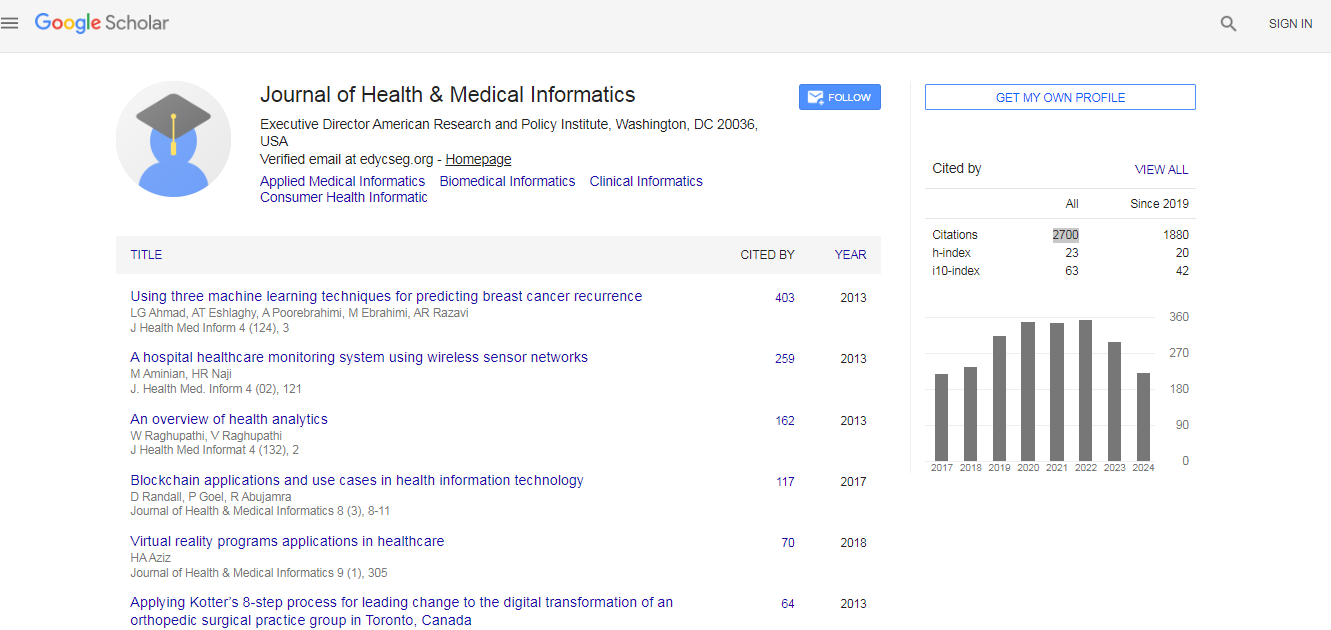
Journal of Health & Medical Informatics received 2700 citations as per Google Scholar report