Short Communication - (2025) Volume 16, Issue 5
Received: 01-Sep-2025, Manuscript No. jhmi-26-178882;
Editor assigned: 03-Sep-2025, Pre QC No. P-178882;
Reviewed: 17-Sep-2025, QC No. Q-178882;
Revised: 22-Sep-2025, Manuscript No. R-178882;
Published:
29-Sep-2025
, DOI: 10.37421/2157-7420.2025.16.615
Citation: Al-Khalifa, Farah M.. ”AI Chatbots: Revolutionizing Patient Care and Efficiency.” J Health Med Informat 16 (2025):615.
Copyright: © 2025 Al-Khalifa M. Farah This is an open-access article distributed under the terms of the Creative Commons Attribution License, which permits unrestricted use, distribution and reproduction in any medium, provided the original author and source are credited.
AI-powered chatbots are rapidly transforming patient communication and the initial stages of healthcare, offering immediate, accessible, and consistent support to individuals seeking medical assistance. This technological advancement plays a crucial role in enhancing patient engagement by streamlining processes such as appointment scheduling and providing essential health information. Furthermore, these chatbots facilitate preliminary symptom assessment, ultimately improving the overall efficiency of healthcare systems and boosting patient satisfaction levels [1].
The application of AI chatbots extends to optimizing the efficiency of patient triage, particularly in demanding environments like emergency departments. By systematically gathering initial patient information and detailed symptom descriptions, these intelligent systems aid in prioritizing cases, guiding patients towards the most appropriate care pathways, and significantly reducing patient waiting times. This enhanced prioritization leads to more effective resource allocation and, consequently, can contribute to improved patient outcomes [2].
In the realm of primary care, the integration of AI chatbots presents a scalable and effective solution for managing a high volume of routine patient inquiries and administrative tasks. They are instrumental in appointment management and pre-visit information gathering, thereby freeing up valuable time for healthcare professionals. This allows clinicians to dedicate more attention to complex cases and direct patient care, while ensuring that patients receive prompt and accurate responses to their common questions [3].
Research into the impact of AI-powered chatbots on patient satisfaction with healthcare communication reveals promising results. When designed with user needs in mind, these chatbots can deliver clear, concise, and personalized information. This capability fosters increased patient trust and leads to higher satisfaction rates, especially in the context of handling routine inquiries and tasks [4].
However, the increasing integration of AI chatbots in patient communication and triage necessitates a thorough examination of the associated ethical considerations and potential challenges. Key issues include ensuring robust data privacy measures, mitigating algorithmic bias, and recognizing the indispensable need for human oversight in critical decision-making processes. These considerations are paramount to safeguarding patient safety and ensuring equitable care for all [5].
A systematic review of the current literature has synthesized findings on the effectiveness of AI chatbots for symptom checking and preliminary diagnosis. These studies highlight the potential of chatbots to improve early detection of health issues and provide readily accessible health guidance. Nevertheless, it is crucial to clearly communicate the inherent limitations of these technologies to users to manage expectations and ensure appropriate use [6].
The implementation of conversational AI within healthcare settings offers a significant avenue for improving patient engagement. By providing continuous 24/7 access to health information and support, chatbots can address frequently asked questions, deliver timely medication reminders, and offer personalized health tips. This promotes a more proactive and informed approach to health management among patients [7].
Furthermore, AI chatbots possess the considerable potential to reduce overall healthcare costs. This is achieved through the automation of various administrative tasks and the enhancement of the efficiency of patient interactions. By effectively managing initial inquiries and offering self-service options, chatbots can lead to substantial savings in personnel and operational expenses for healthcare providers [8].
The development and deployment of secure and privacy-preserving AI chatbots for patient communication are of paramount importance. This involves addressing the technical challenges inherent in ensuring patient data confidentiality and maintaining strict compliance with critical healthcare regulations, such as the Health Insurance Portability and Accountability Act (HIPAA) [9].
Finally, a comprehensive evaluation of the usability and user experience of AI chatbots designed for patient triage is essential. This includes examining factors such as the ease with which patients can interact with the system, the clarity of the information provided, and the overall perceived helpfulness of the chatbot. Such insights are vital for designing user-friendly and effective chatbots that cater to diverse patient populations [10].
AI-powered chatbots are revolutionizing patient communication and the initial steps of healthcare by providing immediate, accessible, and consistent support. Their ability to enhance patient engagement, streamline appointment scheduling, offer health information, and perform preliminary symptom assessments significantly improves healthcare efficiency and patient satisfaction [1].
These AI-driven tools are particularly effective in improving patient triage within emergency departments. By collecting essential initial patient information and symptoms, chatbots assist in prioritizing cases, directing individuals to the correct level of care, and reducing overall waiting times, leading to better resource allocation and potentially improved patient outcomes [2].
In primary care settings, AI chatbots offer a scalable solution for handling routine patient inquiries, managing appointments, and gathering pre-visit information. This functionality allows healthcare professionals to concentrate on more complex patient cases and direct care, ensuring patients receive timely responses to common concerns [3].
Studies investigating the influence of AI-powered chatbots on patient satisfaction in healthcare communication have found positive correlations. Effectively designed chatbots provide clear, concise, and personalized information, thereby increasing patient trust and satisfaction, especially for straightforward tasks [4].
However, the integration of AI chatbots into healthcare workflows brings forth ethical considerations and challenges that require careful attention. These include safeguarding data privacy, addressing potential algorithmic bias, and ensuring that human oversight remains integral to critical decision-making processes to maintain patient safety and equitable care [5].
A systematic review of existing literature highlights the effectiveness of AI chatbots for symptom checking and preliminary diagnosis. These chatbots show potential in facilitating early detection of health issues and providing accessible health guidance, but it is crucial to clearly communicate their limitations to users [6].
Conversational AI in healthcare settings is improving patient engagement by offering 24/7 access to health information and support. Chatbots can answer frequently asked questions, send medication reminders, and provide personalized health tips, encouraging a more proactive approach to health management [7].
The potential for AI chatbots to reduce healthcare costs is substantial. By automating administrative tasks and enhancing the efficiency of patient interactions, chatbots can handle initial inquiries and provide self-service options, leading to savings in personnel and operational expenses [8].
Ensuring the development and deployment of secure and privacy-preserving AI chatbots is a critical requirement. This involves tackling technical challenges related to patient data confidentiality and adhering to healthcare regulations like HIPAA [9].
Evaluating the usability and user experience of AI chatbots for patient triage is vital for their successful adoption. Factors such as ease of use, information clarity, and perceived helpfulness are important for designing effective and user-friendly chatbots for diverse patient populations [10].
AI-powered chatbots are revolutionizing patient communication and triage by offering immediate, accessible, and consistent support. They enhance patient engagement, streamline appointment scheduling, provide health information, and facilitate preliminary symptom assessment, leading to improved healthcare efficiency and patient satisfaction. In emergency departments, chatbots help prioritize cases and reduce waiting times, while in primary care, they manage routine inquiries and appointments, freeing up clinicians. Studies show that well-designed chatbots increase patient trust and satisfaction. However, ethical considerations like data privacy and algorithmic bias, along with the need for human oversight, are crucial. Chatbots show promise in symptom checking and preliminary diagnosis, but their limitations must be communicated. They improve patient engagement through 24/7 access to information and support. Furthermore, chatbots can reduce healthcare costs by automating tasks and improving interaction efficiency. Ensuring data privacy and security is paramount. Finally, usability and user experience are key factors for the successful design and adoption of these tools.
None
None
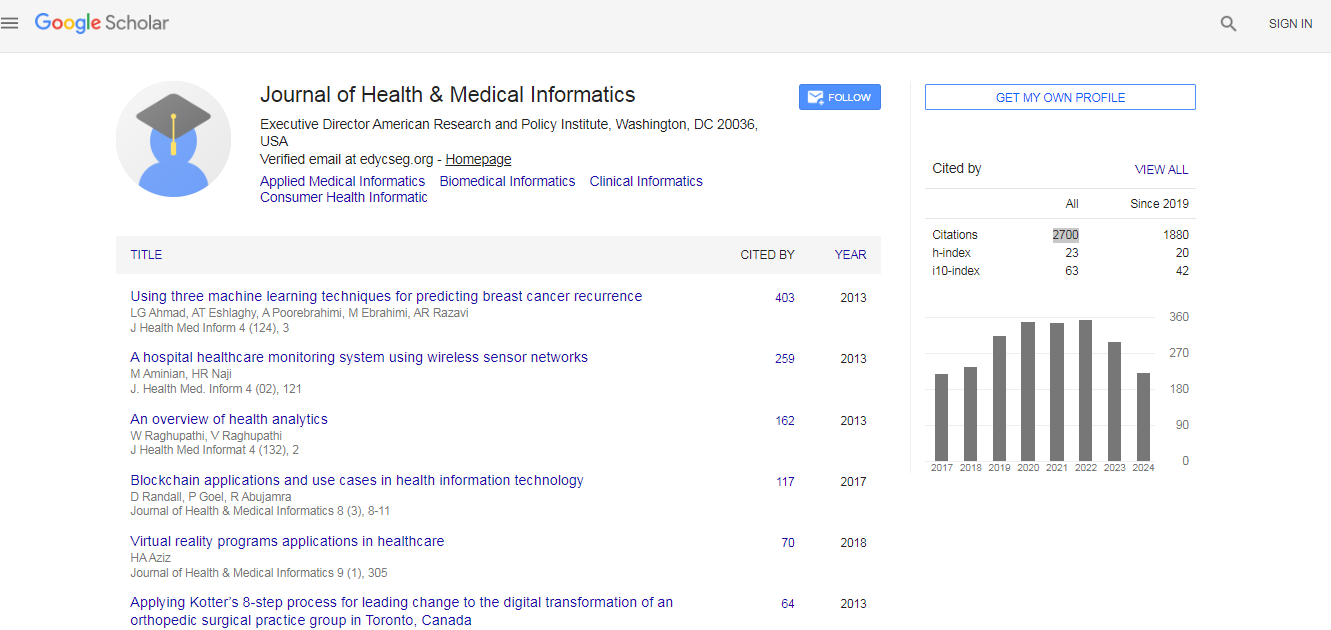
Journal of Health & Medical Informatics received 2700 citations as per Google Scholar report