Brief Report - (2025) Volume 15, Issue 4
Received: 03-Aug-2025, Manuscript No. mccr-25-173789;
Editor assigned: 05-Aug-2025, Pre QC No. P-173789;
Reviewed: 19-Aug-2025, QC No. Q-173789;
Revised: 25-Aug-2025, Manuscript No. R-173789;
Published:
30-Aug-2025
, DOI: : 10.37421/2161-0444.2025.15.789
Citation: Mehta, Arun. ”AI and Biotech Transform Drug Discovery.” Med Chem 15 (2025):789.
Copyright: © 2025 Mehta A. This is an open-access article distributed under the terms of the Creative Commons Attribution License, which permits unrestricted use, distribution and reproduction in any medium, provided the original author and source are credited.
The landscape of drug discovery is undergoing a profound transformation, driven by innovative technologies. One significant area seeing rapid evolution is the application of Artificial Intelligence (AI). Artificial intelligence is truly changing drug discovery, especially in areas like target identification, drug design, and predicting drug efficacy and toxicity. What this really means is that AI tools are speeding up the process, making it more efficient to find promising drug candidates and filter out less viable ones much earlier [1].
A foundational yet increasingly refined aspect of this journey involves identifying and validating suitable drug targets. Identifying and validating drug targets is a foundational step, and recent advances are making this more precise. Researchers are using things like genomics, proteomics, and advanced bioinformatics to pinpoint targets with higher confidence, which then leads to more effective drug development pathways [2].
Beyond target identification, new modalities for drug creation are proving highly successful. Fragment-based drug discovery, or FBDD, has been incredibly successful, with several drugs now in clinical use or approved. This approach starts with small molecular fragments, growing them into potent drugs, which helps find new chemical matter and tackle difficult drug targets effectively [3].
Genetic manipulation technologies also offer powerful new avenues. CRISPR-Cas genome editing has truly revolutionized genetic research and is now showing significant promise in drug discovery. It allows precise manipulation of genes, which means scientists can create better disease models, validate drug targets more rigorously, and even develop gene therapies [4].
Another exciting therapeutic strategy emerging focuses on protein degradation. Proteolysis-Targeting Chimeras (PROTACs) represent an exciting new therapeutic strategy. Instead of inhibiting protein function, they degrade disease-causing proteins entirely. This approach is opening up new avenues for drugging previously 'undruggable' targets, which is a big deal in drug development [5].
Improving the predictive power of preclinical models is crucial for efficiency. Organ-on-a-chip platforms are becoming a crucial tool for drug discovery, offering more physiologically relevant models than traditional cell cultures or animal studies. These microfluidic devices can mimic human organ function and disease, giving more accurate predictions of drug efficacy and toxicity [6].
The approach to initial compound screening is also evolving. Phenotypic screening is experiencing a resurgence in drug discovery, moving away from purely target-centric approaches. This involves testing compounds directly on disease models to observe their effects, leading to the discovery of drugs with novel mechanisms of action, especially for complex diseases [7].
Underpinning many of these advancements are sophisticated computational tools. Computational methods are now central to modern drug discovery and development. These tools, ranging from molecular docking to machine learning, significantly accelerate the identification of new chemical entities, optimize lead compounds, and predict molecular properties, making the entire process faster and more cost-effective [8].
Beyond small molecules, peptide and protein therapeutics are gaining prominence. Peptide and protein drugs are gaining increasing attention due to their high specificity and low toxicity. Recent advances in rational design, chemical synthesis, and delivery systems are overcoming previous limitations, making these biologics a powerful class of therapeutics for a range of diseases [9].
Finally, comprehensive biological data analysis is key to unraveling complex disease mechanisms. Omics-based approaches, like genomics, proteomics, and metabolomics, are providing an incredible amount of biological data. Here's the thing: leveraging these vast datasets is crucial for identifying novel drug targets, understanding disease mechanisms, and stratifying patients for personalized medicine, pushing drug discovery forward [10].
Modern drug discovery is experiencing a significant acceleration, largely due to the integration of advanced technologies. Artificial Intelligence (AI) is at the forefront of this shift, fundamentally changing how drug candidates are identified, designed, and evaluated [1]. What this really means is that AI tools are speeding up the entire process, making it far more efficient to pinpoint promising compounds and discard less viable ones early on [1]. Complementing AI, a broad spectrum of computational methods, from molecular docking to machine learning, have become central to development efforts [8]. These tools optimize lead compounds, predict molecular properties, and generally make the journey faster and more cost-effective [8].
Pinpointing and validating drug targets remains a crucial, foundational step in developing effective therapies. Recent advances are making this process much more precise [2]. Researchers are now leveraging sophisticated techniques like genomics, proteomics, and advanced bioinformatics to identify targets with higher confidence, which then guides more effective drug development pathways [2]. Here's the thing: Omics-based approachesâ??genomics, proteomics, and metabolomicsâ??are generating an incredible volume of biological data [10]. Successfully leveraging these vast datasets is essential for uncovering novel drug targets, gaining a deeper understanding of disease mechanisms, and enabling patient stratification for truly personalized medicine [10].
Beyond traditional small molecule inhibitors, novel therapeutic strategies are expanding the druggable landscape. Fragment-based drug discovery (FBDD) has achieved remarkable success, with several FBDD-derived drugs now in clinical use or approved [3]. This innovative approach starts with small molecular fragments, then systematically grows them into potent drugs, which helps in discovering new chemical matter and effectively tackling difficult targets [3]. Another exciting development involves Proteolysis-Targeting Chimeras (PROTACs). Instead of just inhibiting protein function, PROTACs are designed to entirely degrade disease-causing proteins [5]. This unique mechanism is opening up new avenues for targeting proteins previously considered 'undruggable,' representing a big deal in drug development [5]. Moreover, peptide and protein drugs are garnering increasing attention due to their inherent high specificity and low toxicity profiles [9]. Advances in rational design, chemical synthesis, and sophisticated delivery systems are now overcoming historical limitations, establishing these biologics as a powerful class of therapeutics for a wide range of diseases [9].
Improving the fidelity of preclinical models and screening methods is vital for better drug candidates. CRISPR-Cas genome editing has truly revolutionized genetic research, and its promise in drug discovery is now becoming evident [4]. It allows for precise manipulation of genes, enabling scientists to create superior disease models, validate drug targets more rigorously, and even develop gene therapies [4]. In parallel, Organ-on-a-chip platforms are emerging as crucial tools [6]. These microfluidic devices offer physiologically relevant models that surpass traditional cell cultures or animal studies by mimicking human organ function and disease. This leads to more accurate predictions of drug efficacy and toxicity [6]. Furthermore, phenotypic screening is experiencing a resurgence, moving away from purely target-centric approaches [7]. This method involves directly testing compounds on disease models to observe their overall effects, which has been particularly effective in discovering drugs with novel mechanisms of action, especially for complex diseases [7].
Artificial Intelligence (AI) is fundamentally reshaping drug discovery, making processes significantly faster and more efficient across areas like target identification, rational drug design, and the critical prediction of drug efficacy and toxicity. This means AI tools help find promising drug candidates and filter out less viable ones much earlier in the pipeline. At the same time, pinpointing and validating drug targets has become more precise. Researchers are using advanced methods such as genomics, proteomics, and bioinformatics to identify targets with greater confidence, paving the way for more effective drug development. Fragment-based drug discovery (FBDD) has proven remarkably successful, with a number of drugs now either approved or in clinical trials. This strategy begins with small molecular fragments, progressively building them into potent therapeutic agents, which is excellent for exploring new chemical space and tackling challenging targets. CRISPR-Cas genome editing technology is another game-changer, revolutionizing genetic research and showing immense potential in drug discovery. It allows for highly precise gene manipulation, enabling scientists to develop superior disease models, validate drug targets with greater rigor, and even pave the way for gene therapies. A new therapeutic strategy involves Proteolysis-Targeting Chimeras (PROTACs). Instead of merely inhibiting protein function, PROTACs actively degrade disease-causing proteins. This approach is opening up entirely new avenues, making previously 'undruggable' targets accessible for therapeutic intervention. To improve early-stage testing, Organ-on-a-chip platforms are becoming essential. These microfluidic devices offer more physiologically relevant models than traditional cell cultures or animal studies, accurately mimicking human organ function and disease states, which leads to better predictions of drug efficacy and potential toxicity. Interestingly, phenotypic screening is experiencing a notable resurgence. This method shifts focus from purely target-centric approaches by testing compounds directly on disease models to observe their overall effects. It's especially useful for discovering drugs with novel mechanisms of action, particularly for complex diseases. Computational methods stand at the core of modern drug discovery. Tools like molecular docking and machine learning significantly accelerate the identification of novel chemical entities, optimize lead compounds, and predict crucial molecular properties. This makes the entire drug development process faster and more cost-effective. Furthermore, peptide and protein drugs are drawing increased attention because of their high specificity and often lower toxicity. Recent advancements in rational design, chemical synthesis, and sophisticated delivery systems are overcoming past limitations, establishing these biologics as a potent class of therapeutics. Finally, omics-based approachesâ??genomics, proteomics, metabolomicsâ??are generating vast amounts of biological data. Leveraging these extensive datasets is vital for uncovering novel drug targets, understanding intricate disease mechanisms, and enabling patient stratification for truly personalized medicine, propelling drug discovery forward.
None
None
1. Yu-Hao L, Wen-Bin L, Ke-Feng W. "Artificial intelligence in drug discovery: current trends and future perspectives".Briefings in Bioinformatics 23 (2022):bbab428.
Indexed at, Google Scholar, Crossref
2. Chun-Qing S, Ling-Yi F, Liang-Wen Z. "Advances in target identification and validation for drug discovery".Signal Transduction and Targeted Therapy 7 (2022):115.
Indexed at, Google Scholar, Crossref
3. William MS, Matthew PH, Robert HES. "Fragment-based drug discovery: a decade of clinical success".Nature Reviews Drug Discovery 21 (2022):832-845.
Indexed at, Google Scholar, Crossref
4. Shuo Y, Min-Jian Y, Jing W. "CRISPR-Cas genome editing for drug discovery".Briefings in Bioinformatics 22 (2021):bbaa278.
Indexed at, Google Scholar, Crossref
5. Yan-Bo C, Ming-Hui J, Yu-Hua C. "PROTACs: an emerging therapeutic strategy for drug discovery".Cell Death & Disease 14 (2023):669.
Indexed at, Google Scholar, Crossref
6. Jae MJ, Seon HP, Hyung JK. "Organ-on-a-chip platforms as an emerging tool for drug discovery".Advanced Drug Delivery Reviews 186 (2022):114324.
Indexed at, Google Scholar, Crossref
7. Matthew PH, William MS, Philip EH. "The resurgence of phenotypic screening for drug discovery".Nature Reviews Drug Discovery 19 (2020):618-636.
Indexed at, Google Scholar, Crossref
8. Jie S, Xiaodong L, Jianbo L. "Computational Methods for Drug Discovery and Development".International Journal of Molecular Sciences 24 (2023):12217.
Indexed at, Google Scholar, Crossref
9. Liang-Qiang W, Qian L, Yu-Yan W. "Recent advances in peptide and protein drug discovery".Peptides 152 (2022):170798.
Indexed at, Google Scholar, Crossref
10. Yu-Hua C, Jian-Yu J, Yu-Fei F. "Omics-based approaches in drug discovery and development: Recent advances and future perspectives".Signal Transduction and Targeted Therapy 6 (2021):228.
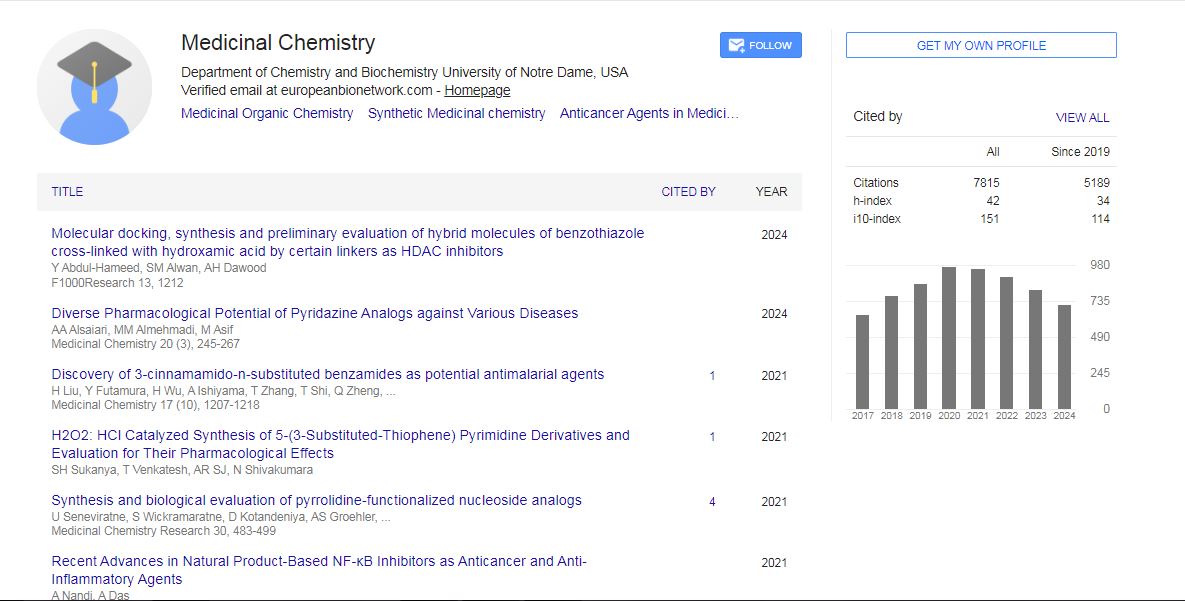
Medicinal Chemistry received 6627 citations as per Google Scholar report