Perspective - (2025) Volume 15, Issue 5
Received: 01-Sep-2025, Manuscript No. jcde-25-177515;
Editor assigned: 03-Sep-2025, Pre QC No. P-177515;
Reviewed: 17-Sep-2025, QC No. Q-177515;
Revised: 22-Sep-2025, Manuscript No. R-177515;
Published:
29-Sep-2025
, DOI: 10.37421/2165-784X.2025.15.628
Citation: Saeed, Ahmed. ”Aerospace Materials, Structures, and
Performance Optimization.” J Civil Environ Eng 15 (2025):628.
Copyright: © 2025 Saeed A. This is an open-access article distributed under the terms of the Creative Commons Attribution License, which permits unrestricted use, distribution
and reproduction in any medium, provided the original author and source are credited.
This work explores the design and manufacturing of lightweight composite structures, critical for aerospace applications where weight reduction directly impacts fuel efficiency and performance. It delves into various advanced composite materials, fabrication techniques like automated fiber placement and additive manufacturing, and discusses the challenges and opportunities in integrating these structures into next-generation aircraft [1].
This article reviews the development and potential of advanced materials and structures, such as smart materials, meta-materials, and self-healing composites, for future aerospace systems. It highlights how these innovations can lead to more resilient, lighter, and multi-functional aircraft components, addressing the increasing demands for performance and safety in the aerospace industry [2].
This comprehensive review examines various structural health monitoring (SHM) techniques applied to aerospace composite structures. It covers fiber optic sensors, piezoelectric sensors, acoustic emission, and guided waves, discussing their principles, applications, and challenges in detecting damage and assessing structural integrity in complex aerospace environments [3].
This review provides an overview of additive manufacturing technologies and their significant role in producing complex aerospace structures. It highlights the materials compatible with additive processes, the specific manufacturing techniques, and the current challenges regarding part certification, material properties, and process control for critical aerospace applications [4].
This paper reviews the latest advancements in fatigue life prediction methodologies for metallic aerospace structures. It discusses various analytical, numerical, and experimental approaches, including multiaxial fatigue models, damage mechanics, and probabilistic methods, crucial for ensuring the long-term reliability and safety of aircraft components [5].
This article discusses optimization strategies applied to aerospace structures to improve performance while simultaneously reducing weight. It covers topology optimization, material selection, and structural configuration adjustments, demonstrating how these methods contribute to more efficient designs, lower fuel consumption, and increased payload capacity [6].
This review focuses on the effects of impact damage on composite aerospace structures, presenting both experimental and numerical methodologies for understanding and predicting damage behavior. It discusses the mechanisms of impact, damage assessment techniques, and the influence of various parameters on the residual strength and integrity of composite components [7].
This paper examines the thermomechanical behavior of aerospace structures when subjected to extreme operating conditions, such as high temperatures and rapid thermal cycling. It outlines analytical and computational models used to predict stress, deformation, and potential failure modes, which are essential for designing resilient structures for hypersonic flight or re-entry vehicles [8].
This review delves into the durability and damage tolerance of metallic structures commonly used in aerospace. It covers the latest research on fracture mechanics, crack propagation, and various methodologies to assess and extend the lifespan of components, emphasizing the importance of these concepts for maintaining aircraft safety and operational efficiency over time [9].
This paper highlights recent advancements in non-destructive testing (NDT) and evaluation techniques tailored for aerospace applications. It covers a range of methods like ultrasonic testing, eddy current testing, thermography, and radiographic inspection, discussing how these technologies are evolving to improve the detection of defects and ensure the structural integrity of complex aerospace components [10].
Aerospace engineering consistently pushes for innovations in material science and structural design to boost performance, fuel efficiency, and safety. A lot of research looks at lightweight composite structures, exploring advanced materials and manufacturing techniques like automated fiber placement and additive manufacturing to integrate these into future aircraft [1]. Advanced materials, including smart materials, meta-materials, and self-healing composites, are also being developed for resilient and multi-functional aircraft components [2]. Additive manufacturing is playing a big role in creating complex aerospace structures, though challenges remain in part certification and material properties [4].
Ensuring the integrity of these intricate structures is absolutely essential. Structural health monitoring (SHM) techniques, such as fiber optic and piezoelectric sensors, acoustic emission, and guided waves, are vital for detecting damage and assessing structural integrity in demanding aerospace environments [3]. In addition, recent advancements in non-destructive testing (NDT) and evaluation techniques, covering methods like ultrasonic, eddy current, thermography, and radiographic inspection, are improving defect detection and guaranteeing the structural soundness of complex aerospace components [10].
For metallic structures, considerable effort goes into fatigue life prediction methodologies, employing analytical, numerical, and experimental approaches, including multiaxial fatigue models and probabilistic methods, all crucial for long-term reliability and safety [5]. Similarly, research into the durability and damage tolerance of metallic structures focuses on fracture mechanics, crack propagation, and various methods to extend component lifespan, which is key for aircraft safety and operational efficiency [9].
Beyond just materials, optimization strategies are applied to aerospace structures to enhance performance while cutting down on weight. These methods, including topology optimization and material selection, lead to more efficient designs, reduced fuel consumption, and increased payload capacity [6]. Moreover, understanding the effects of impact damage on composite aerospace structures is critical, with experimental and numerical approaches helping to predict damage behavior and assess residual strength [7].
Finally, the thermomechanical behavior of aerospace structures under extreme operating conditions, such as high temperatures and rapid thermal cycling, is thoroughly examined. Analytical and computational models are developed to predict stress, deformation, and potential failure modes, which are fundamental for designing resilient structures suitable for hypersonic flight or re-entry vehicles [8].
Aerospace engineering constantly seeks improvements in material science and structural design to enhance performance, fuel efficiency, and safety. Research heavily focuses on lightweight composite structures, exploring advanced materials and manufacturing techniques like automated fiber placement and additive manufacturing for integration into next-generation aircraft. Advanced materials, including smart and self-healing composites, are being developed to create more resilient, lighter, and multi-functional aircraft components. Structural health monitoring (SHM) techniques, such as fiber optic sensors and acoustic emission, are crucial for detecting damage and assessing structural integrity. Additive manufacturing is transforming the production of complex components, though certification challenges persist. For metallic structures, advancements in fatigue life prediction and durability analysis are vital for long-term reliability. Optimization strategies, including topology optimization and material selection, contribute to efficient, lightweight designs and lower fuel consumption. The effects of impact damage on composite structures are thoroughly investigated through experimental and numerical methods. Furthermore, understanding thermomechanical behavior under extreme conditions is essential for designing resilient structures for high-speed or re-entry vehicles. Non-destructive testing (NDT) and evaluation methods, like ultrasonic and thermographic inspections, are continuously improving to detect defects and guarantee the structural soundness of aerospace components.
1. Mohammad KA, Mohammad FH, Md. RI. "Design and manufacturing of lightweight composite structures for aerospace applications".J. Manuf. Process. 90 (2023):111-124.
Indexed at, Google Scholar, Crossref
2. S. CSHK, S. RV, B. RKK. "Advanced materials and structures for future aerospace applications".Mater. Today Proc. 62 (2022):749-756.
Indexed at, Google Scholar, Crossref
3. Xiaoqing L, Hailong D, Dongsheng W. "Structural health monitoring of aerospace composite structures: A review".Compos. Struct. 271 (2021):114138.
Indexed at, Google Scholar, Crossref
4. Abdulsalam ATA, Sadiq JA, Bushra FA. "Additive manufacturing for aerospace structures: A review on materials, processes, and challenges".J. Mater. Res. Technol. 9 (2020):10141-10156.
Indexed at, Google Scholar, Crossref
5. Hongyi W, Jianfeng L, Yaping Z. "Fatigue life prediction of aerospace metallic structures: A review of recent advances".Eng. Fract. Mech. 282 (2023):109156.
Indexed at, Google Scholar, Crossref
6. P. ABSJJ, R. MFCA, P. VSUR. "Optimisation of aerospace structures for enhanced performance and weight reduction".Mater. Today Proc. 46 (2021):10450-10455.
Indexed at, Google Scholar, Crossref
7. A. KS, V. KS, S. KS. "Impact damage on composite aerospace structures: A review of experimental and numerical approaches".Compos. Struct. 247 (2020):112521.
Indexed at, Google Scholar, Crossref
8. G. HRK, M. FI, H. UK. "Thermomechanical analysis of aerospace structures under extreme conditions".Aerosp. Sci. Technol. 125 (2022):107572.
Indexed at, Google Scholar, Crossref
9. Ling C, Yonggang Z, Jianfeng L. "Durability and damage tolerance of aerospace metallic structures: A review".Int. J. Fatigue 181 (2024):108669.
Indexed at, Google Scholar, Crossref
10. Vijay KO, Ajay KS, Vinod KS. "Recent advancements in non-destructive testing and evaluation for aerospace applications".J. Nondestruct. Eval. 41 (2022):106.
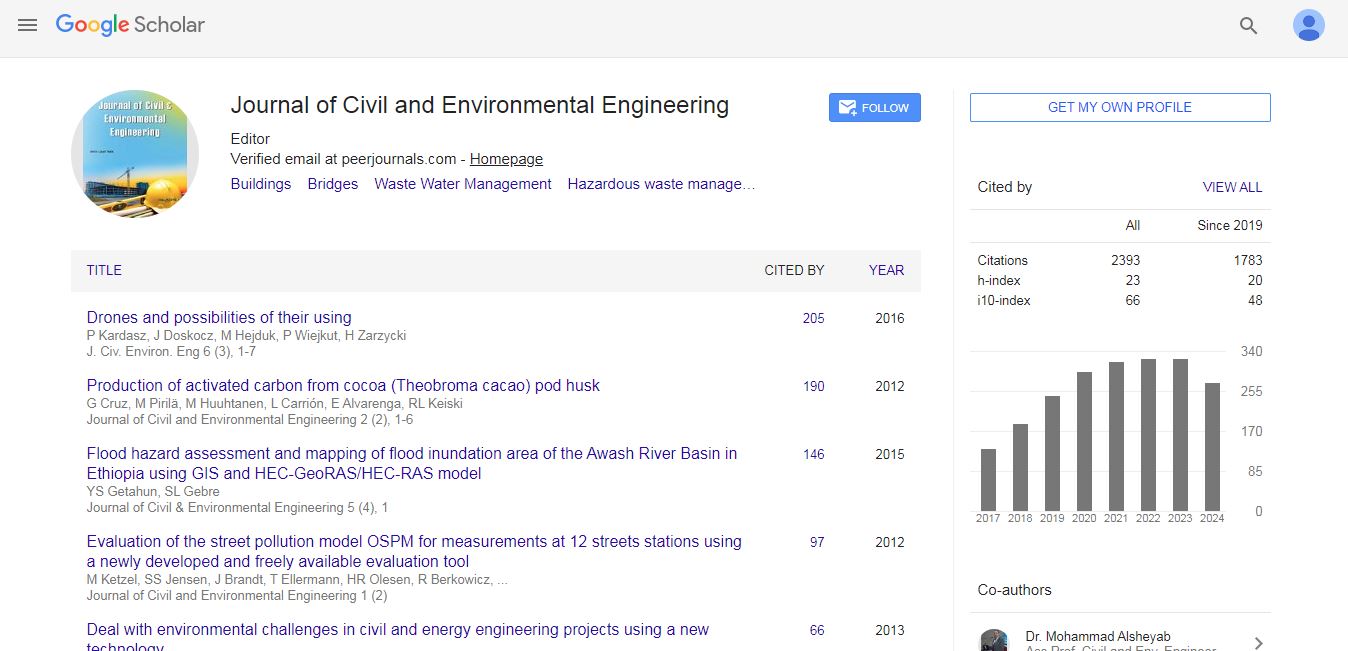
Journal of Civil and Environmental Engineering received 1798 citations as per Google Scholar report