Perspective - (2025) Volume 11, Issue 2
Received: 01-Apr-2025, Manuscript No. jssc-26-188263;
Editor assigned: 03-Apr-2025, Pre QC No. P-188263;
Reviewed: 17-Apr-2025, QC No. Q-188263;
Revised: 22-Apr-2025, Manuscript No. R-188263;
Published:
29-Apr-2025
, DOI: 10.37421/2472-0437.2025.11.293
Citation: Müller, Laura. ”Advancing Tall Steel Buildings: Safety,
Sustainability, Performance.” J Steel Struct Constr 11 (2025):293.
Copyright: © 2025 Müller L. This is an open-access article distributed under the terms of the Creative Commons Attribution License, which permits unrestricted use, distribution
and reproduction in any medium, provided the original author and source are credited.
Recent advancements in steel structural design for high-rise buildings are significantly reshaping the landscape of modern architecture and engineering. These innovations are primarily driven by the need to optimize seismic performance, a critical factor in earthquake-prone regions. The integration of advanced analytical methods and refined modeling of material nonlinearity are central to achieving desired performance objectives under significant seismic events, ensuring greater resilience [1].
Furthermore, a growing emphasis on sustainability is leading to the development of steel structures with reduced embodied carbon and enhanced end-of-life recyclability. This includes the investigation of recycled steel and novel alloys with a lower environmental impact, utilizing lifecycle assessment methodologies to minimize the ecological footprint of tall steel structures throughout their lifespan [2].
Another key area of focus is the enhancement of fire resistance, a paramount concern for high-rise buildings. Innovative passive fire protection techniques, such as advanced intumescent coatings and composite structural elements, are being developed to improve fire endurance. Concurrently, the application of performance-based seismic design principles in tall steel buildings is being explored through a comprehensive review of existing methodologies and the integration of advanced analytical tools. The goal is to achieve a more accurate assessment of seismic resilience, enabling engineers to meet stringent performance requirements during significant earthquake events [3].
Advanced connection details for high-rise steel structures are also under scrutiny, with a particular emphasis on their seismic behavior and constructability. Experimental testing and numerical simulations of innovative moment-resisting connections are yielding valuable insights into their capacity for ductile response and their ability to maintain structural integrity under severe loading conditions. Practical considerations for fabrication and erection are also being addressed in the development of these advanced connections [4].
The integration of Building Information Modeling (BIM) with structural analysis and design software is revolutionizing the design process for high-rise steel structures. BIM facilitates superior coordination, clash detection, and visualization, thereby enhancing design accuracy and reducing construction errors. The benefits extend to streamlined workflows for material procurement and construction sequencing, marking a significant leap in efficiency [5].
Advancements in fire-resistant design for steel high-rise buildings continue to be a critical area of research. This includes the exploration of innovative passive fire protection techniques and the review of current fire design codes and standards, with proposals for future research aimed at enhancing the fire safety of these structures. The use of high-performance steel (HPS) in the construction of tall buildings presents considerable advantages due to its superior strength-to-weight ratio and enhanced durability. A comparative analysis of HPS versus conventional steel in structural member design for high-rise applications highlights the potential for material savings, reduced foundation loads, and improved structural performance [6].
Seismic vulnerability assessment and retrofitting strategies for existing steel high-rise buildings are also gaining traction. Advanced assessment techniques, such as nonlinear response history analysis, are being employed to evaluate the performance of older structures under seismic loads. Case studies on effective retrofitting methods, including the addition of bracing or base isolation systems, are presented to bolster the safety and resilience of these existing buildings [7].
The development of smart damping systems for high-rise steel buildings is crucial for mitigating vibrations induced by wind and seismic events. A review of various damping technologies, including viscous dampers, tuned mass dampers, and active control systems, discusses their effectiveness in enhancing occupant comfort and structural stability, with a focus on practical implementation challenges and future trends [8].
Innovative façade systems for steel high-rise buildings are being explored, aiming to integrate structural efficiency with architectural aesthetics and energy performance. This involves examining advanced curtain wall systems, composite cladding, and self-healing materials, analyzing their impact on structural loads, wind resistance, and thermal comfort. The ease of installation and maintenance of these advanced façade solutions is also a key consideration [9].
In summary, the field of steel structural design for high-rise buildings is characterized by a dynamic interplay of innovation across seismic performance, fire resistance, sustainability, advanced materials, digital integration, and structural systems. These multifaceted advancements collectively contribute to the creation of safer, more efficient, and environmentally conscious tall structures for the future [10].
Recent advancements in the structural design of high-rise steel buildings are significantly enhancing their seismic performance and safety. The use of high-strength steel alloys, advanced composite materials, and smart structural systems that can adapt to environmental loads are key innovations. Computational modeling and simulation techniques are also crucial for predicting and mitigating structural behavior under extreme conditions, leading to more efficient and safer designs [1].
The application of performance-based seismic design principles in tall steel buildings, integrating advanced analytical methods, is a significant area of exploration. Refined modeling of material nonlinearity and connection behavior contributes to a more accurate assessment of seismic resilience, enabling engineers to achieve desired performance objectives under substantial earthquake events. Robust numerical simulations are vital for verifying these design strategies [2].
Sustainability is increasingly influencing steel structural design, with a focus on embodied carbon reduction and end-of-life recyclability. This involves investigating the use of recycled steel and novel steel alloys with lower environmental impact. Lifecycle assessment methodologies are applied to high-rise steel structures to minimize their ecological footprint throughout their lifespan [3].
Advanced connection details for high-rise steel structures are being developed and tested to improve seismic behavior and constructability. Experimental testing and numerical simulations of innovative moment-resisting connections highlight their capacity for ductile response and structural integrity under severe loading. Practical aspects of fabrication and erection are also considered [4].
The integration of Building Information Modeling (BIM) with structural analysis and design software is revolutionizing the design process for high-rise steel structures. BIM improves coordination, clash detection, and visualization, leading to enhanced design accuracy and fewer construction errors. This streamlines workflows for material procurement and construction sequencing [5].
Advancements in fire-resistant design for steel high-rise buildings include innovative passive fire protection techniques, such as advanced intumescent coatings and composite structural elements that improve fire endurance. Current fire design codes and standards are being reviewed, with proposals for future research to enhance fire safety [6].
The use of high-performance steel (HPS) in tall building construction offers significant advantages in terms of strength-to-weight ratio and durability. A comparative analysis of HPS versus conventional steel reveals potential for material savings, reduced foundation loads, and improved structural performance in high-rise applications [7].
Seismic vulnerability assessment and retrofitting strategies for existing steel high-rise buildings are being developed using advanced techniques. Nonlinear response history analysis is employed to evaluate older structures' performance under seismic loads. Case studies on retrofitting methods, such as adding bracing or base isolation, are presented to enhance safety and resilience [8].
Smart damping systems are crucial for high-rise steel buildings to mitigate vibrations from wind and seismic events. A review of various damping technologies, including viscous dampers, tuned mass dampers, and active control systems, discusses their effectiveness in improving occupant comfort and structural stability, addressing practical implementation challenges and future trends [9].
Innovative façade systems for steel high-rise buildings are being explored to integrate structural efficiency with architectural aesthetics and energy performance. These include advanced curtain wall systems, composite cladding, and self-healing materials, analyzing their impact on structural loads, wind resistance, and thermal comfort, while also considering ease of installation and maintenance [10].
Modern high-rise steel building design is advancing through innovations in seismic performance, fire resistance, and sustainability. Key developments include high-strength steel alloys, composite materials, smart structural systems, and advanced computational modeling for improved safety and efficiency. Performance-based seismic design principles are being integrated with refined analytical methods for better resilience. Sustainable practices are focusing on reducing embodied carbon and enhancing recyclability, with the use of recycled steel and lifecycle assessments. Advanced connection details and robust fire-resistant designs are also crucial. The integration of BIM is streamlining design processes. High-performance steel offers advantages in strength and durability, while seismic vulnerability assessments and retrofitting strategies are improving existing structures. Smart damping systems are mitigating vibrations, and innovative façade systems are balancing structural, aesthetic, and energy performance. These collective advancements are leading to safer, more efficient, and environmentally conscious tall buildings.
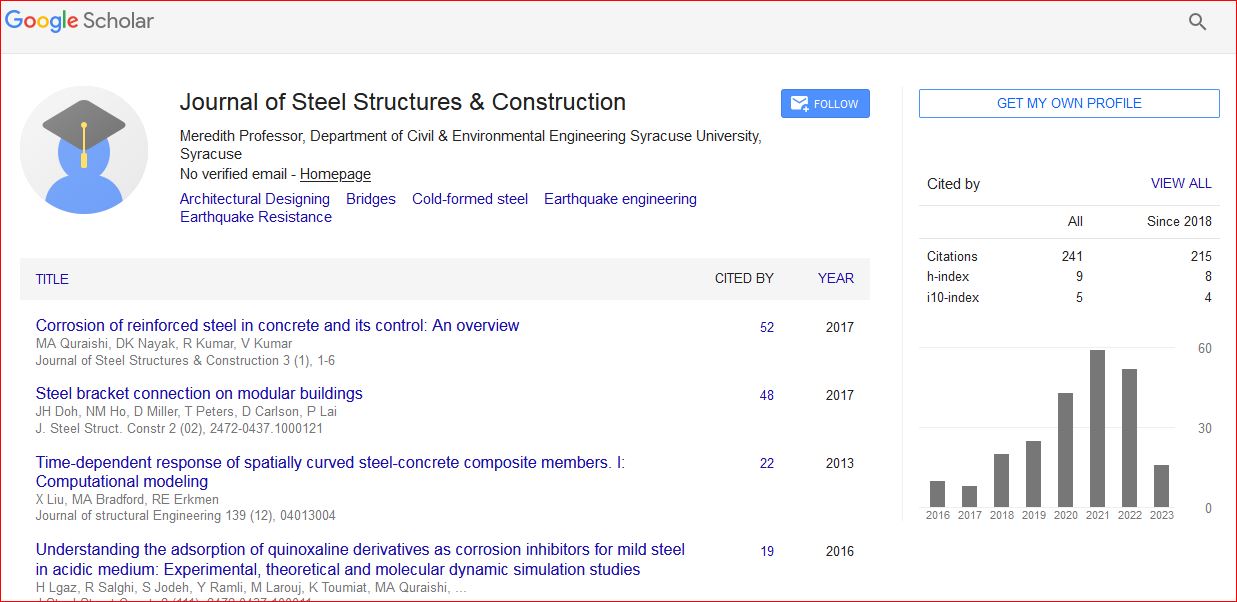
Journal of Steel Structures & Construction received 583 citations as per Google Scholar report