Short Communication - (2025) Volume 11, Issue 4
Received: 02-Nov-2025, Manuscript No. jotr-25-175619;
Editor assigned: 04-Nov-2025, Pre QC No. P-175619;
Reviewed: 18-Nov-2025, QC No. Q-175619;
Revised: 24-Nov-2025, Manuscript No. R-175619;
Published:
29-Nov-2025
, DOI: 10.37421/2476-2261. 2025.11.329
Citation: Fournier, Isabelle. ”Advancing Radiation Oncology: AI, Precision, Personalized Care.” J Oncol Transl Res 11 (2025):329.
Copyright: © 2025 Fournier I. This is an open-access article distributed under the terms of the Creative Commons Attribution License, which permits unrestricted use, distribution and reproduction in any medium, provided the original author and source are credited.
Artificial Intelligence (AI) is rapidly transforming radiation oncology, offering advances in areas such as treatment planning, image segmentation, dose prediction, and outcome prediction. AI promises enhanced efficiency and precision, though challenges remain concerning data quality, model interpretability, and effective clinical integration. It will undoubtedly play a pivotal role, necessitating thorough validation and ethical considerations for broad adoption [1].
FLASH radiotherapy, a novel ultra-high dose rate treatment, shows significant promise in preclinical models by demonstrating tissue-sparing effects. This technique could potentially reduce side effects while maintaining tumor control. However, its clinical translation faces considerable challenges, demanding comprehensive preclinical validation, the development of specialized delivery systems, and early-phase clinical trials to establish its safety and efficacy in humans [2].
Proton therapy is becoming increasingly important in treating prostate cancer, mainly due to its superior dose distribution which leads to reduced toxicity compared to conventional photon therapy. Ongoing trials and technological innovations like Intensity-Modulated Proton Therapy (IMPT) are refining its precision. Debates about cost-effectiveness and the need for more long-term outcome data persist, but its role continues to evolve [3].
The synergistic combination of immunotherapy and radiation therapy holds great potential to amplify anti-tumor responses. Radiation can sensitize tumors to immune checkpoint inhibitors by boosting antigen presentation and altering the tumor microenvironment. Current clinical trials are exploring optimal sequencing, dosing, and patient selection to maximize therapeutic benefits across various cancer types while minimizing adverse effects [4].
Stereotactic Body Radiation Therapy (SBRT) provides an evidence-based approach for managing oligometastatic cancer, a condition with a limited number of metastases. Randomized controlled trials and prospective studies confirm SBRT's ability to improve local control and positively influence progression-free and overall survival in carefully chosen patients. Defining optimal patient selection and dosing remains crucial for further establishing its role [5].
Radiomics represents a new frontier for personalized radiation oncology, enabling the extraction of quantitative features from medical images. These 'radiomic signatures' can characterize tumor heterogeneity, predict treatment response, and identify patients at risk for toxicity. Standardizing image acquisition, feature extraction, and model validation is essential to translate this promising field into widespread clinical utility [6].
Hypofractionated radiation therapy for early-stage breast cancer has been rigorously evaluated, with systematic reviews and meta-analyses confirming its non-inferiority to conventional schedules. This approach offers benefits like shorter treatment durations, improved patient convenience, and better resource utilization without compromising efficacy or increasing toxicity. This reinforces its position as a standard of care, encouraging shared decision-making [7].
Precision radiation therapy in pediatric oncology is advancing significantly, with techniques such as proton therapy and Image-Guided Radiation Therapy (IGRT) designed to minimize radiation dose to healthy tissues. Strategies aim to reduce long-term toxicities, including secondary malignancies and cognitive impairments, which are critical for child cancer survivors. Individualized planning and novel radiobiological research are vital for improving outcomes while preserving quality of life [8].
Predictive and prognostic biomarkers are vital for personalizing radiation oncology treatments. These biomarkers, spanning genomic, proteomic, and imaging-based indicators, can predict tumor response, identify toxicity risks, and guide dose adjustments. Integrating these into clinical practice requires overcoming challenges in validation and necessitates comprehensive, multi-institutional studies to confirm their utility [9].
Adaptive Radiation Therapy (ART) allows for real-time or periodic modification of treatment plans to account for anatomical changes and tumor response throughout a radiotherapy course. Both online and offline adaptation approaches enhance dose conformity and reduce toxicity. Despite technological complexities and workflow challenges, ART holds substantial potential for optimizing treatment outcomes across various cancer sites [10].
Modern radiation oncology is witnessing a surge in technological innovation aimed at enhancing precision and minimizing side effects. Artificial Intelligence (AI) is at the forefront, revolutionizing treatment planning, image segmentation, and dose and outcome prediction, leading to more efficient and accurate care [1]. Another breakthrough, FLASH radiotherapy, an ultra-high dose rate method, is showing exciting preclinical results by sparing healthy tissues while controlling tumors. This suggests a potential for significantly reduced side effects, though it requires comprehensive preclinical validation and specialized delivery systems for human application [2]. Similarly, proton therapy continues to improve, especially for prostate cancer, offering superior dose distribution that effectively reduces toxicity compared to conventional photon approaches. Advances like Intensity-Modulated Proton Therapy (IMPT) further refine its accuracy, although its cost-effectiveness and long-term data are still under evaluation [3].
Beyond single modalities, combination therapies are proving impactful. The synergy between immunotherapy and radiation therapy is a prime example, where radiation can sensitize tumors to immune checkpoint inhibitors by enhancing antigen presentation and favorably altering the tumor microenvironment. Ongoing trials are diligently working to optimize the sequencing, dosing, and patient selection to maximize therapeutic gains while keeping toxicity at bay across various cancer types [4]. This move towards personalized treatment extends to radiomics, a field extracting quantitative features from medical images. These 'radiomic signatures' can reveal tumor heterogeneity, predict response to radiotherapy, and even pinpoint patients susceptible to toxicity. However, standardizing image acquisition and validation is paramount for widespread clinical adoption [6].
Specific treatment advancements are reshaping standards of care in various disease sites. Stereotactic Body Radiation Therapy (SBRT), for instance, has emerged as an effective strategy for oligometastatic cancer, a condition characterized by a limited number of metastases. Evidence from rigorous studies confirms SBRT's capability to improve local control and potentially enhance progression-free and overall survival in carefully selected patients. The emphasis here remains on precise patient selection and optimal dosing to fully define its utility in this challenging setting [5]. For early-stage breast cancer, hypofractionated radiation therapy has been established as non-inferior to conventional schedules, offering patients shorter treatment durations, greater convenience, and efficient resource use without compromising efficacy or increasing toxicity. This reinforces its position as a standard of care, encouraging shared decision-making [7].
Treating vulnerable populations, like pediatric cancer patients, requires specialized attention. Precision radiation therapy techniques, including proton therapy and Image-Guided Radiation Therapy (IGRT), are critically important in pediatric oncology. These methods focus on minimizing radiation exposure to healthy, developing tissues to reduce severe long-term toxicities such as secondary malignancies and cognitive impairments. Individualized treatment planning and continuous research into novel radiobiological approaches are essential for improving outcomes while diligently preserving the quality of life for childhood cancer survivors [8]. Supplementing these efforts, the identification and validation of predictive and prognostic biomarkers are crucial for truly personalizing radiation oncology. These biomarkers, derived from genomics, proteomics, or imaging, can predict tumor response, flag patients at risk for toxicity, and inform precise dose adjustments. Integrating these into clinical practice requires overcoming challenges in validation and necessitates comprehensive, multi-institutional studies to confirm their utility [9].
Finally, Adaptive Radiation Therapy (ART) represents a dynamic approach to treatment delivery. This technique involves modifying treatment plans in real-time or periodically throughout a course of radiotherapy to account for anatomical changes or tumor response. By employing online and offline adaptation strategies, ART improves dose conformity to the target while simultaneously reducing exposure to healthy tissues, thus minimizing toxicity. While the implementation of ART involves technological complexities and presents clinical workflow challenges, its potential to optimize outcomes across various cancer sites is undeniable, marking a significant step forward in advanced radiation therapy [10].
The field of radiation oncology is rapidly evolving, driven by advancements across various fronts. Artificial Intelligence (AI) is emerging as a transformative tool, enhancing treatment planning, image segmentation, dose prediction, and outcome prediction, while demanding careful consideration for data quality and ethical integration. New treatment modalities like FLASH radiotherapy show promise in preclinical models for reducing side effects while maintaining tumor control, though clinical translation presents significant hurdles. Proton therapy continues to advance, particularly in prostate cancer treatment, offering reduced toxicity and improved dose distribution. Combining immunotherapy with radiation therapy offers synergistic potential to boost anti-tumor responses, influencing antigen presentation and the tumor microenvironment. Stereotactic Body Radiation Therapy (SBRT) has proven effective for oligometastatic cancer, improving local control and potentially extending survival for carefully selected patients. Personalized radiation oncology is gaining traction through fields like radiomics, which extracts quantitative features from medical images to predict patient outcomes and guide tailored treatment decisions. Hypofractionated radiation therapy is becoming a standard of care for early-stage breast cancer, providing equivalent efficacy with shorter treatment durations. Significant strides are also being made in pediatric oncology, with precision techniques like proton therapy and Image-Guided Radiation Therapy (IGRT) aiming to minimize long-term toxicities in vulnerable populations. The integration of predictive and prognostic biomarkers, including genomic and imaging-based indicators, is crucial for personalizing treatment strategies and optimizing patient outcomes. Finally, Adaptive Radiation Therapy (ART) offers a dynamic approach to modify treatment plans in real-time, improving dose conformity and reducing toxicity by accounting for anatomical changes during therapy. Each of these areas represents a vital step towards more effective, precise, and patient-centric cancer care.
None
None
Jihong W, Zhaoyang L, Min Y. "Artificial intelligence in radiation oncology: A review of current applications and future directions".Cancer Res Treat 54 (2022):350-366.
Indexed at, Google Scholar, Crossref
Marie-Catherine V, Edward LN, Jean-Pierre P. "Clinical translation of FLASH radiotherapy: a paradigm shift or a passing fad?".Lancet Oncol 22 (2021):e487-e497.
Indexed at, Google Scholar, Crossref
Anthony LZ, Jason AE, Bradford SH. "Advances in proton therapy for prostate cancer".Nat Rev Urol 17 (2020):293-305.
Indexed at, Google Scholar, Crossref
Silvia CF, Sandra D, David DH. "Combining immunotherapy with radiation therapy for cancer".Cancer Cell 38 (2020):440-454.
Indexed at, Google Scholar, Crossref
David P, Max D, Steven JF. "Stereotactic body radiation therapy for oligometastatic cancer: An evidence-based review".Radiother Oncol 147 (2020):224-233.
Indexed at, Google Scholar, Crossref
Junjie L, Jiazhou W, Xiaodong Y. "Radiomics: a new paradigm for personalized radiation oncology".Radiat Oncol 16 (2021):118.
Indexed at, Google Scholar, Crossref
David AP, Laura D, John JK. "Hypofractionated radiation therapy for early-stage breast cancer: A systematic review and meta-analysis of randomized controlled trials".Radiother Oncol 147 (2020):250-257.
Indexed at, Google Scholar, Crossref
David RG, Thomas EM, Louis SC. "Precision radiation therapy in pediatric oncology: Current concepts and future directions".Semin Radiat Oncol 31 (2021):361-370.
Indexed at, Google Scholar, Crossref
Adam JC, Matthew P, Helen GM. "Predictive and prognostic biomarkers in radiation oncology: A review of current status and future perspectives".Crit Rev Oncol Hematol 151 (2020):102996.
Indexed at, Google Scholar, Crossref
Xiaorong S, Jingyan X, Chunxue Z. "Adaptive radiation therapy: A systematic review and future directions".Phys Imaging Radiat Oncol 18 (2021):22-31.
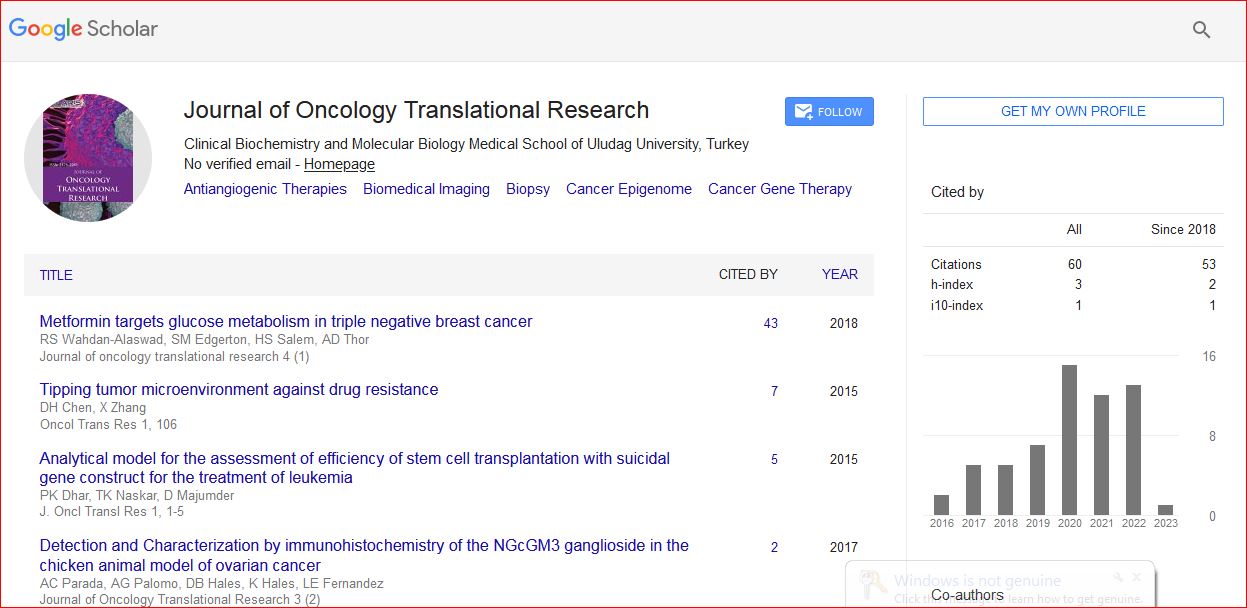
Journal of Oncology Translational Research received 93 citations as per Google Scholar report