Perspective - (2025) Volume 15, Issue 4
Received: 03-Aug-2025, Manuscript No. jprm-25-174461;
Editor assigned: 06-Aug-2025, Pre QC No. P-174461;
Reviewed: 19-Aug-2025, QC No. Q-174461;
Revised: 25-Aug-2025, Manuscript No. R-174461;
Published:
30-Aug-2025
, DOI: 10.37421/2161-105X.2025.15.754
Citation: Johnson, Grace. ”Advancing Pediatric Respiratory Health: Diagnosis to Prevention.” J Pulm Respir Med 15 (2025):754.
Copyright: © 2025 Johnson G. This is an open-access article distributed under the terms of the Creative Commons Attribution License, which permits unrestricted use, distribution and reproduction in any medium, provided the original author and source are credited.
This review emphasizes the importance of early and accurate diagnosis of pediatric asthma, distinguishing it from other respiratory conditions. It highlights updated guidelines for step-wise management, focusing on personalized treatment plans involving inhaled corticosteroids and bronchodilators, alongside environmental control and patient education for optimal outcomes and reduced exacerbations [1].
This guideline updates recommendations for managing bronchiolitis in infants, emphasizing supportive care like nasal suctioning and hydration. It advises against routine use of bronchodilators, corticosteroids, and nebulized hypertonic saline, highlighting their limited efficacy and potential side effects, thus promoting judicious use of resources and minimizing unnecessary interventions [2].
The article reviews significant progress in diagnosing and treating cystic fibrosis, particularly focusing on the impact of cystic fibrosis transmembrane conductance regulator (CFTR) modulators. It discusses how these therapies target the underlying genetic defect, leading to improved lung function, reduced exacerbations, and enhanced quality of life for pediatric patients, representing a paradigm shift in management [3].
This review provides an overview of community-acquired pneumonia in children, emphasizing the importance of clinical assessment for diagnosis. It details updated recommendations for antimicrobial therapy, considering local epidemiology and resistance patterns, while also discussing the role of vaccinations in prevention and supportive care strategies for varying severity levels [4].
The article addresses the complexities of diagnosing and managing rare lung diseases in children, which often present with nonspecific symptoms and require specialized expertise. It highlights the utility of advanced imaging, genetic testing, and multidisciplinary team approaches to achieve accurate diagnoses and implement tailored therapies, improving outcomes for these challenging conditions [5].
This review discusses the significant burden of RSV infection in infants, detailing its clinical manifestations and risk factors. It emphasizes the importance of passive immunoprophylaxis with palivizumab for high-risk infants and explores emerging prevention strategies like maternal vaccination and new monoclonal antibodies, aiming to reduce hospitalizations and severe outcomes [6].
This article examines the clinical characteristics and respiratory outcomes of COVID-19 in pediatric populations. It highlights that while most children experience mild disease, a subset can develop severe respiratory symptoms, multisystem inflammatory syndrome (MIS-C), or prolonged respiratory issues, underscoring the need for continued surveillance and understanding of long-term effects [7].
This paper explores how genetic predispositions and early environmental exposures, such as maternal smoking, air pollution, and viral infections, collectively shape the trajectory of respiratory health from infancy. It discusses how these factors can lead to increased susceptibility to chronic conditions like asthma and COPD later in life, emphasizing the critical window of early development for prevention [8].
This review highlights the evolving role of advanced imaging modalities like low-dose CT, MRI, and lung ultrasound in diagnosing pediatric respiratory disorders. It emphasizes their advantages in reducing radiation exposure while providing detailed anatomical and functional information, aiding in the assessment of congenital anomalies, interstitial lung diseases, and airway pathologies in children [9].
This article synthesizes evidence on how various air pollutants, including particulate matter and nitrogen dioxide, negatively affect children's developing respiratory systems globally. It discusses increased risks of asthma exacerbations, impaired lung function development, and respiratory infections, advocating for urgent public health interventions to mitigate exposure and protect vulnerable pediatric populations [10].
The landscape of pediatric respiratory health is continually evolving, with significant advancements and persistent challenges in diagnosis and management. Effective strategies for conditions like pediatric asthma involve early and accurate diagnosis, distinguishing it from other respiratory illnesses, followed by personalized, step-wise management plans. These plans frequently incorporate inhaled corticosteroids and bronchodilators, alongside crucial environmental control measures and comprehensive patient education to optimize outcomes and minimize exacerbations [1]. Similarly, managing community-acquired pneumonia in children hinges on robust clinical assessment for diagnosis, coupled with updated recommendations for antimicrobial therapy that consider local epidemiological patterns and resistance. Preventative measures, such as vaccinations, and supportive care are also vital across varying severity levels [4].
In contrast, recent guidelines for bronchiolitis in infants emphasize supportive care, including nasal suctioning and hydration, actively advising against the routine use of bronchodilators, corticosteroids, and nebulized hypertonic saline due to their limited efficacy and potential side effects. This approach promotes the judicious use of resources and aims to reduce unnecessary interventions [2]. Respiratory Syncytial Virus (RSV) infection in infants also represents a significant burden. Current prevention strategies highlight passive immunoprophylaxis with palivizumab for high-risk infants, while new monoclonal antibodies and maternal vaccinations are emerging as promising avenues to reduce hospitalizations and severe outcomes [6]. Furthermore, the impact of COVID-19 on pediatric populations has shown that while many children experience mild disease, some can develop severe respiratory symptoms, Multisystem Inflammatory Syndrome in Children (MIS-C), or long-term respiratory issues, necessitating ongoing surveillance and research into prolonged effects [7].
Complex respiratory conditions, such as cystic fibrosis, have seen a paradigm shift in treatment, primarily driven by the advent of cystic fibrosis transmembrane conductance regulator (CFTR) modulators. These therapies specifically target the underlying genetic defect, leading to substantial improvements in lung function, reduced exacerbations, and an enhanced quality of life for pediatric patients [3]. Diagnosing and managing rare lung diseases in children presents its own set of complexities, often due to nonspecific symptoms. Addressing these challenging conditions requires specialized expertise, leveraging advanced imaging, genetic testing, and multidisciplinary team approaches to ensure accurate diagnoses and the implementation of tailored therapies that improve patient outcomes [5].
Beyond specific diseases, a broader understanding of pediatric respiratory health encompasses early life determinants. Genetic predispositions and environmental exposures, such as maternal smoking, air pollution, and viral infections, play a crucial role in shaping respiratory health trajectories from infancy. These factors can significantly increase susceptibility to chronic conditions like asthma and Chronic Obstructive Pulmonary Disease (COPD) later in life, underscoring the importance of early developmental windows for preventative interventions [8]. Indeed, various air pollutants, including particulate matter and nitrogen dioxide, are known to adversely affect children's developing respiratory systems globally, increasing the risks of asthma exacerbations, impaired lung function, and respiratory infections. This critical public health issue demands urgent interventions to mitigate exposure and protect vulnerable pediatric populations [10]. To further aid in diagnosis, advanced imaging modalities like low-dose CT, MRI, and lung ultrasound are becoming increasingly vital in pediatric respiratory disorders. These techniques offer reduced radiation exposure while providing detailed anatomical and functional information crucial for assessing congenital anomalies, interstitial lung diseases, and airway pathologies in children [9].
The diagnosis and management of pediatric respiratory conditions require nuanced approaches, from distinguishing pediatric asthma early and accurately with personalized treatment plans, including environmental control and education to updated guidelines for bronchiolitis emphasizing supportive care over routine interventions like bronchodilators. Significant advances in treating cystic fibrosis, particularly with CFTR modulators, are improving lung function and quality of life for children by targeting underlying genetic defects. Effective management of community-acquired pneumonia in children relies on clinical assessment, updated antimicrobial therapy recommendations, and vaccination for prevention. Rare lung diseases pose diagnostic challenges, often necessitating advanced imaging, genetic testing, and multidisciplinary teams. Respiratory Syncytial Virus (RSV) infection in infants is a major concern, with prevention strategies focusing on immunoprophylaxis and emerging maternal vaccinations. COVID-19 outcomes in children range from mild to severe, including Multisystem Inflammatory Syndrome in Children (MIS-C), highlighting the need for ongoing surveillance. Early life factors, encompassing genetic predispositions and environmental exposures like air pollution, profoundly influence the trajectory of respiratory health, increasing susceptibility to chronic conditions. Advanced imaging techniques offer reduced radiation exposure and detailed insights into various pediatric respiratory disorders. Ultimately, air pollution significantly impairs children's developing respiratory systems, underscoring the urgency for public health interventions. This body of research collectively highlights the critical need for precise diagnosis, tailored management, and robust prevention strategies to improve respiratory health outcomes in children globally.
None
None
1. Shuen-Huei K, Sheng-Hui W, Yu-Shih H. "Current perspectives on diagnosis and management of asthma in children".J Formos Med Assoc 122 (2023):1113-1120.
Indexed at, Google Scholar, Crossref
2. Todd MR, Kevin CT, Joshua MW. "Management of Bronchiolitis in Infants: A Clinical Practice Guideline".Pediatrics 148 (2021):e2021055106.
Indexed at, Google Scholar, Crossref
3. Jessica LGS, Rachel LM, Scott DS. "Cystic Fibrosis in Infants, Children, and Adolescents: Recent Advances in Diagnosis and Treatment".Curr Pediatr Rev 18 (2022):169-178.
Indexed at, Google Scholar, Crossref
4. Eric FK, Jeffrey RS, Seema UM. "Diagnosis and Management of Community-Acquired Pneumonia in Children: A Review".JAMA Pediatr 174 (2020):290-297.
Indexed at, Google Scholar, Crossref
5. Matthias G, Ronald EL, Dirk S. "Rare lung diseases in children: Challenges in diagnosis and management".Respiration 100 (2021):846-857.
Indexed at, Google Scholar, Crossref
6. Laura GD, Marta C, Juan AT. "Respiratory syncytial virus infection in infants: Current understanding and prevention strategies".An Pediatr (Engl Ed) 97 (2022):147.e1-147.e9.
Indexed at, Google Scholar, Crossref
7. Fatma A, AyÅ?e Å?A, Elif GY. "COVID-19 in Children: Clinical Features, Outcomes, and Impact on Respiratory Health".Pediatr Int 64 (2022):e15220.
Indexed at, Google Scholar, Crossref
8. Anne TTL, Deborah AH, Graeme JH. "Early life determinants of chronic respiratory disease: From genetics to environment".Eur Respir J 61 (2023):220318.
Indexed at, Google Scholar, Crossref
9. Kai-Sing W, Po-Chin L, Yu-Chi L. "Advanced Imaging Techniques in Pediatric Respiratory Diseases".Front Pediatr 9 (2021):642938.
Indexed at, Google Scholar, Crossref
10. Isabella A, Florence G, Emmanuelle K. "Impact of Air Pollution on Children's Respiratory Health: A Global Perspective".Int J Environ Res Public Health 17 (2020):1416.
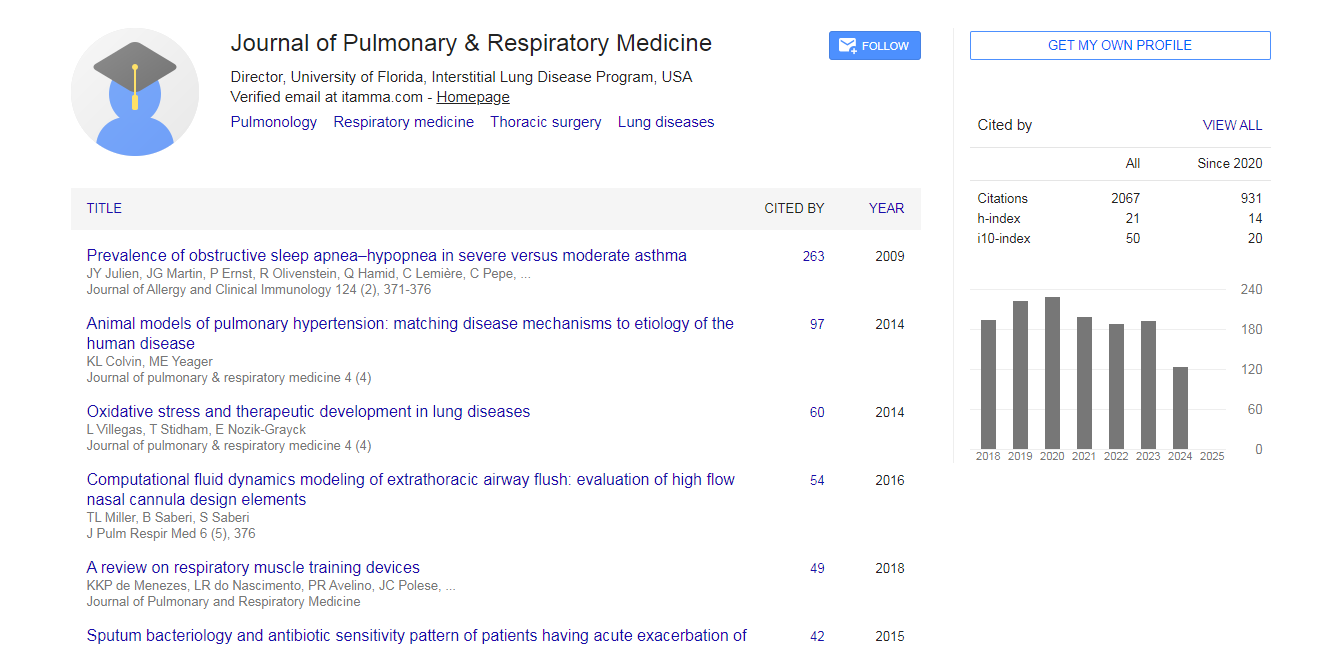
Pulmonary & Respiratory Medicine received 1690 citations as per Google Scholar report