Commentary - (2025) Volume 11, Issue 4
Received: 02-Nov-2025, Manuscript No. jotr-25-175617;
Editor assigned: 04-Nov-2025, Pre QC No. P-175617;
Reviewed: 18-Nov-2025, QC No. Q-175617;
Revised: 24-Nov-2025, Manuscript No. R-175617;
Published:
29-Nov-2025
, DOI: 10.37421/2476-2261. 2025.11.328
Citation: Al-Farouqi, Mohamed Saeed. ”Advancing Non-Invasive Early Cancer Detection.” J Oncol Transl Res 11 (2025):328.
Copyright: © 2025 Al-Farouqi S. Mohamed This is an open-access article distributed under the terms of the Creative Commons Attribution License, which permits unrestricted use, distribution and reproduction in any medium, provided the original author and source are credited.
Advances in oncology are rapidly transforming early cancer detection and personalized treatment. The diverse research in this field covers innovative blood tests, artificial intelligence applications, and specialized biomarker analysis. This study evaluates the performance of a multi-cancer early detection blood test in individuals at average risk, showcasing its potential to detect various cancers before symptoms appear. The findings suggest a promising avenue for population-level screening, emphasizing the importance of non-invasive methods for improving cancer outcomes. [1].
This review explores the rapidly evolving role of Artificial Intelligence (AI) in cancer diagnosis and personalized treatment strategies. It highlights how AI can enhance the accuracy and speed of early detection, address current limitations, and shape future directions in oncology, paving the way for more tailored patient care. [2].
The article discusses the significant progress in utilizing circulating tumor Deoxyribonucleic Acid (ctDNA) for the early detection of hepatocellular carcinoma (HCC). It outlines how ctDNA analysis can serve as a sensitive and specific biomarker, improving diagnostic accuracy and facilitating timely interventions for this challenging cancer. [3].
This review summarizes the latest breakthroughs in non-invasive techniques for the early detection of gastric cancer. It covers various biomarkers and diagnostic methods, highlighting their potential to improve screening rates and reduce mortality through earlier intervention, offering a less burdensome alternative to traditional invasive procedures. [4].
This research investigates the utility of multi-omic blood biomarkers in identifying pancreatic cancer at its early, more treatable stages. The study demonstrates how combining various molecular data can significantly improve diagnostic sensitivity and specificity, offering a crucial step forward in tackling one of the most aggressive cancers. [5].
This comprehensive review examines the innovations in early detection of colorectal cancer, spanning from new molecular biomarkers to the integration of Artificial Intelligence. It highlights how these advancements are transforming screening strategies, aiming to improve early diagnosis and ultimately, patient survival rates. [6].
The article provides an in-depth review of precision cancer prevention, exploring how personalized approaches based on individual risk factors and biomarkers can significantly enhance early detection efforts. It discusses cutting-edge strategies and future directions for tailoring preventive measures to optimize outcomes. [7].
This article discusses emerging novel biomarkers for the early detection of lung cancer, outlining their potential to improve diagnostic accuracy and facilitate earlier intervention. It also addresses the significant challenges in translating these discoveries into clinical practice, providing a balanced view of current progress and future directions. [8].
The article explores the burgeoning field of extracellular vesicles (EVs) as diagnostic tools for early cancer detection. It summarizes the current progress in utilizing EVs as biomarkers, alongside the technical and practical challenges that need to be overcome for their widespread clinical application, offering a comprehensive overview. [9].
This review delves into the potential of whole-genome sequencing (WGS) for revolutionizing early cancer detection. It outlines the significant promises of WGS in identifying genetic predispositions and early-stage cancerous changes, while also addressing the considerable challenges related to data interpretation, cost, and ethical implications. [10].
These efforts collectively aim to improve diagnostic accuracy, facilitate timely interventions, and ultimately enhance patient survival rates. Continued research addresses the inherent challenges in translating these breakthroughs into widespread clinical utility.
The landscape of cancer diagnosis and treatment is undergoing significant transformation, with a strong emphasis on early detection. Developing non-invasive methods for identifying various cancers before symptoms appear holds substantial promise for improving patient outcomes and facilitating population-level screening [1]. These advancements often leverage cutting-edge technologies to enhance the accuracy and speed of diagnosis, paving the way for more personalized and effective patient care [2]. The ongoing research addresses not only the promise but also the inherent challenges in translating scientific discoveries into widespread clinical practice [8, 9, 10].
Blood-based tests are emerging as a powerful tool for early cancer detection. For instance, multi-cancer early detection blood tests are being evaluated for their performance in average-risk populations, showing potential for broad screening applications [1]. Artificial Intelligence (AI) is rapidly evolving to support cancer diagnosis and precision oncology, enhancing detection accuracy and speed, while addressing current limitations and shaping future strategies [2]. Circulating tumor Deoxyribonucleic Acid (ctDNA) analysis has made significant progress, serving as a sensitive and specific biomarker for the early detection of challenging cancers like hepatocellular carcinoma (HCC), thereby improving diagnostic accuracy and intervention timing [3]. Other non-invasive techniques are also being explored, such as those for gastric cancer, aiming to improve screening rates and reduce mortality [4].
Beyond traditional approaches, multi-omic blood biomarkers are under investigation for their utility in identifying aggressive cancers such as pancreatic cancer at early, more treatable stages. Combining diverse molecular data significantly improves diagnostic sensitivity and specificity for this condition [5]. Similarly, new molecular biomarkers, sometimes integrated with Artificial Intelligence, are transforming screening for colorectal cancer, aiming for earlier diagnosis and improved survival rates [6]. Emerging novel biomarkers are also being explored for the early detection of lung cancer, though their translation into clinical practice faces considerable hurdles [8]. A burgeoning area of research involves extracellular vesicles (EVs) as diagnostic tools. Significant progress has been made in utilizing EVs as biomarkers, yet technical and practical challenges remain for their widespread clinical application [9].
The concept of precision cancer prevention is gaining traction, focusing on personalized approaches based on individual risk factors and biomarkers. This strategy aims to enhance early detection efforts and optimize outcomes through tailored preventive measures [7]. Whole-genome sequencing (WGS) holds immense potential to revolutionize early cancer detection by identifying genetic predispositions and early-stage cancerous changes. However, this technology comes with considerable challenges, including data interpretation complexities, high costs, and ethical implications that require careful consideration [10]. Collectively, these diverse research avenues underscore a concerted global effort to push the boundaries of early cancer detection, making significant strides toward better patient prognosis and survivorship.
Research in early cancer detection is rapidly advancing, focusing on non-invasive methods and innovative biomarkers. One promising development involves multi-cancer early detection blood tests, which show potential for population-level screening by identifying various cancers before symptoms emerge, improving outcomes through non-invasive means. Artificial Intelligence (AI) also plays a crucial role in enhancing diagnosis and personalized treatment, boosting accuracy and speed in detection while addressing current limitations. Specific cancers are seeing breakthroughs too; circulating tumor Deoxyribonucleic Acid (ctDNA) analysis is proving to be a sensitive biomarker for hepatocellular carcinoma (HCC), and multi-omic blood biomarkers are improving diagnostic sensitivity for pancreatic cancer. For gastric and colorectal cancers, new non-invasive techniques and molecular biomarkers, often integrated with AI, are transforming screening strategies to reduce mortality. Emerging novel biomarkers are also being explored for lung cancer, though their translation into clinical practice presents challenges. Additionally, extracellular vesicles (EVs) are gaining traction as diagnostic tools, presenting both significant progress and practical hurdles for widespread use. The broader goal is to improve early diagnosis and patient survival rates across various cancer types by leveraging these diverse technologies.
None
None
Christine DF, Michael JH, Charles S. "Accuracy of a Blood-Based Multi-Cancer Detection Test in an Average-Risk Population".JNCI Cancer Spectr 7 (2023):pkad077.
Indexed at, Google Scholar, Crossref
Afsah A, Zaher A, Maham B. "Artificial intelligence for cancer diagnosis and precision oncology: advancements, challenges, and perspectives".Cancer Cell Int 23 (2023):297.
Indexed at, Google Scholar, Crossref
Hanbo C, Zhiyuan F, Chang L. "Advances in Circulating Tumor DNA for Early Detection of Hepatocellular Carcinoma".Theranostics 12 (2022):5971-5989.
Indexed at, Google Scholar, Crossref
Guang F, Guiling L, Qi Z. "Recent advances in non-invasive early diagnosis of gastric cancer".Exp Biol Med (Maywood) 247 (2022):2337-2347.
Indexed at, Google Scholar, Crossref
Xuan H, Chen Y, Shanshan L. "Multi-omic blood biomarkers for early detection of pancreatic cancer".Int J Biol Sci 19 (2023):2888-2900.
Indexed at, Google Scholar, Crossref
Tianyu C, Siyuan S, Xiaomin Z. "Advances and perspectives in early detection of colorectal cancer: from molecular biomarkers to artificial intelligence".Transl Oncol 38 (2023):101784.
Indexed at, Google Scholar, Crossref
Shaoxian L, Xuelan C, Hongwei L. "Precision cancer prevention: A review of the state-of-the-art and future perspectives".Front Oncol 13 (2023):1195679.
Indexed at, Google Scholar, Crossref
Xinyue L, Yiran Z, Yuchun W. "Novel biomarkers for early detection of lung cancer: Prospects and challenges".Front Oncol 13 (2023):1205164.
Indexed at, Google Scholar, Crossref
Cong L, Fei C, Chunlan W. "Extracellular Vesicles in Early Cancer Diagnosis: Progress and Challenges".J Clin Med 12 (2023):4744.
Indexed at, Google Scholar, Crossref
Pan H, Yanhua L, Bin S. "Whole-genome sequencing for early cancer detection: Promises and challenges".Front Genet 13 (2022):980184.
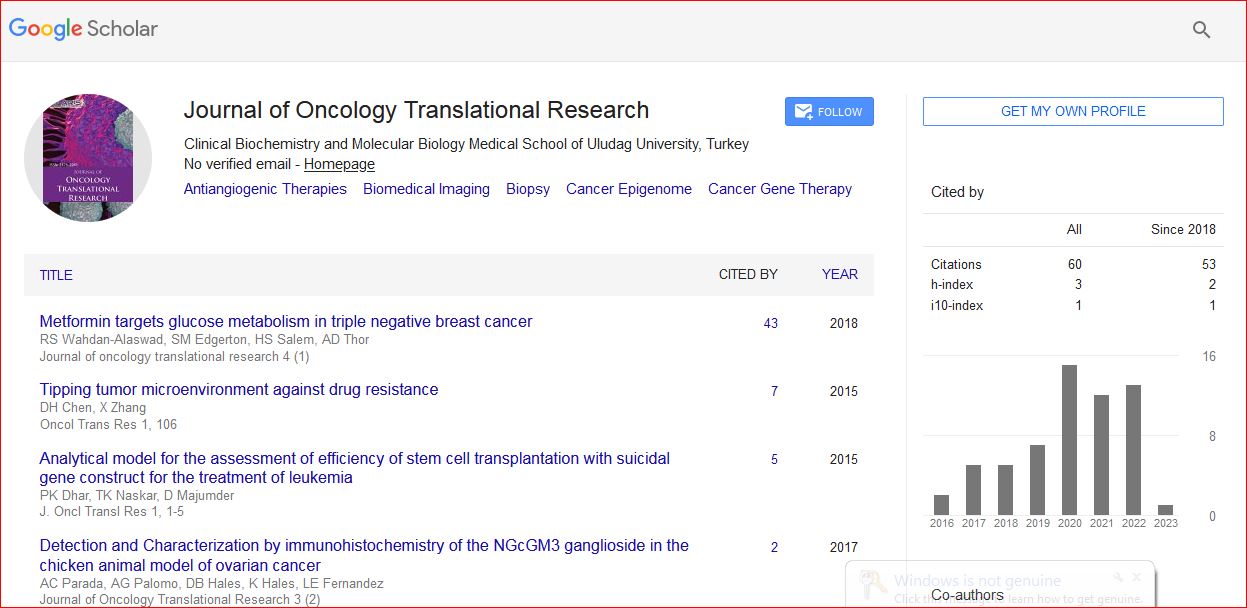
Journal of Oncology Translational Research received 93 citations as per Google Scholar report