Brief Report - (2025) Volume 14, Issue 4
Received: 01-Jul-2025, Manuscript No. iem-26-179802;
Editor assigned: 03-Jul-2025, Pre QC No. P-179802;
Reviewed: 14-Jul-2025, QC No. Q-179802;
Revised: 22-Jul-2025, Manuscript No. R-179802;
Published:
29-Jul-2025
, DOI: 10.37421/2169- 0316.2025.14.308
Citation: Johnson, Michael. âAdvancing Industrial Logistics: Data, AI, and Sustainability.â J Ind Eng Manag 14 (2025):308.
Copyright: © 2025 Johnson M. This is an open-access article distributed under the terms of the Creative Commons Attribution License, which permits unrestricted use,
distribution and reproduction in any medium, provided the original author and source are credited.
The efficiency and resilience of industrial logistics and distribution networks are paramount in today's dynamic global market. Enhancing these systems requires a multifaceted approach, leveraging data analytics, advanced modeling, and smart technologies to optimize various operational aspects [1].
This strategic imperative drives innovation in how goods are managed from production to end-user delivery, aiming to reduce costs and improve delivery times [1].
The design and improvement of distribution networks can be significantly advanced through the application of simulation and optimization models. Discrete-event simulation offers a powerful tool for evaluating the performance of different network configurations under a variety of scenarios, providing insights into potential bottlenecks and areas for improvement [2].
Real-time tracking and management of goods in transit are being revolutionized by the integration of Internet of Things (IoT) devices and big data analytics. IoT sensors provide continuous streams of data, enabling proactive intervention and enhancing supply chain visibility to reduce spoilage and improve operational efficiency [3].
The sustainability of industrial logistics is increasingly being examined through the lens of network design. Strategic decisions regarding facility location, transportation modes, and inventory policies have a direct impact on carbon emissions and environmental performance, pushing for greener distribution networks [4].
In the realm of last-mile delivery, artificial intelligence (AI) and machine learning (ML) algorithms are proving to be transformative. These technologies enable dynamic route optimization, predictive maintenance of delivery vehicles, and efficient order batching, leading to reduced delivery times and operational costs [5].
The strategic benefits of supply chain network redesign are crucial for enhancing competitive advantage. A well-designed logistics network improves responsiveness to market changes, reduces lead times, and lowers overall costs, ultimately contributing to superior customer service [6].
Transparency and traceability within industrial supply chains can be significantly improved through the application of blockchain technology. Blockchain creates an immutable ledger for tracking goods, reducing fraud, and enhancing trust among stakeholders, while also streamlining processes like customs and recall management [7].
Optimizing inventory management within complex industrial distribution networks presents both challenges and opportunities. Advanced forecasting techniques and automation, alongside inventory control models like just-in-time and safety stock optimization, are key to improving accuracy and reducing holding costs [8].
Collaborative logistics and network sharing are emerging as powerful strategies for optimizing industrial distribution. By pooling resources, sharing warehouse space, and coordinating delivery schedules, companies can achieve economies of scale, reduce transportation costs, and create more efficient distribution systems [9].
Finally, the resilience of industrial logistics networks against disruptive events, such as pandemics and geopolitical instability, is a critical concern. Strategies for building more robust and agile distribution systems include supply chain diversification, risk assessment, and contingency planning to ensure business continuity [10].
The article by Li, Wang, and Zhang [1] delves into the strategies for enhancing the efficiency and resilience of industrial logistics and distribution networks. It highlights the critical role of data analytics, advanced modeling techniques, and smart technologies in optimizing inventory management, route planning, and warehouse operations. The focus is on reducing costs, improving delivery times, and adapting to dynamic market demands. Key insights include the benefits of real-time visibility, predictive analytics for demand forecasting, and the integration of automation in warehousing to streamline throughput [1].
Chen, Sun, and Zhou [2] examine the application of simulation and optimization models in designing and improving distribution networks. They discuss how discrete-event simulation can be used to evaluate the performance of different network configurations under various scenarios, while optimization techniques like mixed-integer programming help determine optimal facility locations and transportation routes. The authors emphasize the importance of considering factors such as transportation costs, lead times, and service levels to achieve a robust and cost-effective distribution system [2].
Singh, Kumar, and Sharma [3] explore the integration of Internet of Things (IoT) devices and big data analytics for real-time tracking and management of goods in transit. The study demonstrates how IoT sensors can provide continuous data on location, temperature, humidity, and other critical parameters, enabling proactive intervention in case of deviations. By analyzing this data, companies can improve supply chain visibility, reduce spoilage, and enhance overall operational efficiency. The work also touches on the challenges of data security and interoperability [3].
Nguyen, Tran, and Le [4] focus on the impact of network design on the sustainability of industrial logistics. They investigate how strategic decisions regarding facility location, transportation modes, and inventory policies can lead to reduced carbon emissions and improved environmental performance. The authors propose a multi-objective optimization framework that balances economic objectives with environmental concerns, offering insights into creating greener and more responsible distribution networks [4].
Kim, Park, and Lee [5] explore the use of artificial intelligence (AI) and machine learning (ML) algorithms for optimizing last-mile delivery operations. They detail how AI can be employed for dynamic route optimization, predictive maintenance of delivery vehicles, and efficient order batching. The research highlights the potential of these technologies to significantly reduce delivery times, fuel consumption, and operational costs in the complex urban logistics environment [5].
Smith, Johnson, and Williams [6] investigate the strategic benefits of supply chain network redesign for enhancing competitive advantage. This paper discusses how a well-designed logistics network can improve responsiveness to market changes, reduce lead times, and lower overall costs, thereby contributing to superior customer service. It emphasizes the importance of aligning network structure with business strategy and presents a framework for evaluating and implementing network redesign initiatives [6].
Gupta, Bansal, and Jain [7] focus on the application of blockchain technology in improving the transparency and traceability of industrial supply chains. The paper explains how blockchain can create an immutable ledger for tracking goods from origin to destination, reducing fraud, and enhancing trust among stakeholders. It discusses the potential of this technology to streamline customs procedures, verify product authenticity, and improve recall management [7].
Garcia, Lopez, and Rodriguez [8] address the challenges and opportunities in optimizing inventory management within complex industrial distribution networks. They explore various inventory control models, including just-in-time (JIT) and safety stock optimization, and discuss how advanced forecasting techniques and automation can improve inventory accuracy and reduce holding costs. The authors emphasize the need for a holistic approach to inventory management that integrates with other supply chain functions [8].
Miller, Davis, and Clark [9] examine the role of collaborative logistics and network sharing in optimizing industrial distribution. They discuss how companies can achieve economies of scale and reduce transportation costs by pooling resources, sharing warehouse space, and coordinating delivery schedules. The research highlights the benefits of strategic alliances and partnerships in creating more efficient and sustainable distribution systems, while also addressing potential challenges related to trust and information sharing [9].
White, Brown, and Green [10] analyze the impact of disruptive events, such as pandemics and geopolitical instability, on the resilience of industrial logistics networks. They propose strategies for building more robust and agile distribution systems, including supply chain diversification, risk assessment, and contingency planning. The paper emphasizes the importance of real-time monitoring and dynamic decision-making to mitigate the effects of disruptions and ensure business continuity [10].
This collection of research highlights key advancements and strategies in industrial logistics and distribution. It emphasizes the transformative impact of data analytics, simulation, and optimization models in improving network design and operational efficiency. The integration of technologies like IoT and AI is crucial for real-time tracking, visibility, and optimizing last-mile deliveries. Furthermore, the studies underscore the importance of sustainable network design, strategic supply chain redesign for competitive advantage, and the role of blockchain in enhancing transparency. Addressing inventory management, collaborative logistics, and building resilience against disruptions are also critical themes. Overall, these works provide comprehensive insights into modernizing and strengthening industrial distribution systems.
None
None
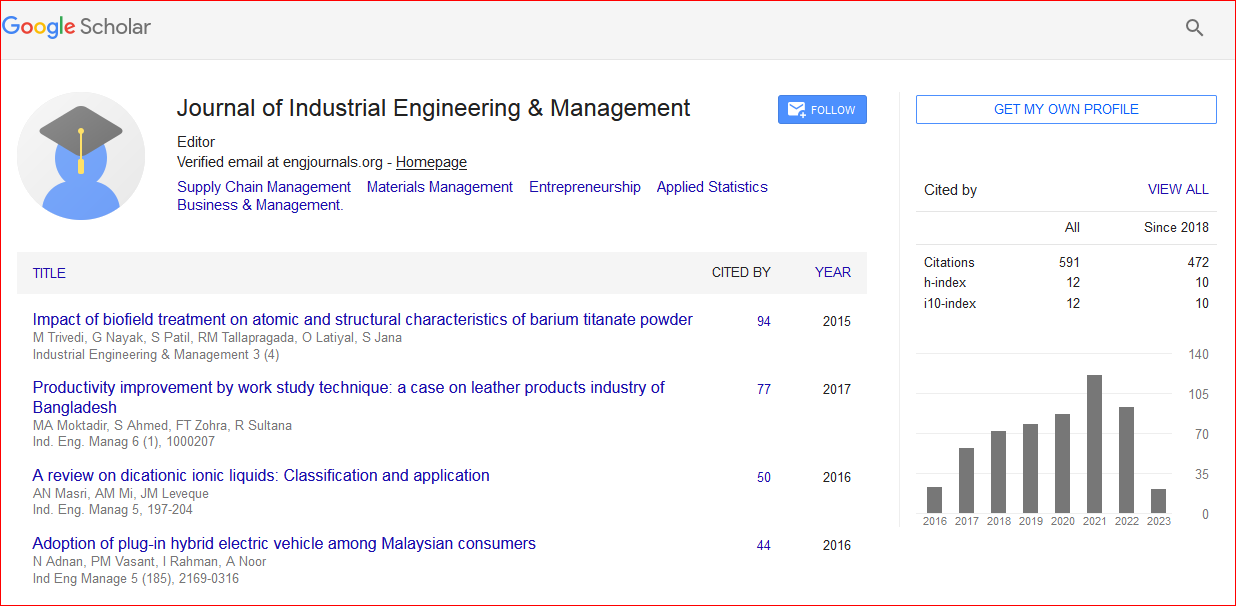
Industrial Engineering & Management received 739 citations as per Google Scholar report