Opinion - (2025) Volume 13, Issue 2
Received: 01-Apr-2025, Manuscript No. jcdd-25-175430;
Editor assigned: 03-Apr-2025, Pre QC No. P-175430;
Reviewed: 17-Apr-2025, QC No. Q-175430;
Revised: 22-Apr-2025, Manuscript No. R-175430;
Published:
29-Apr-2025
, DOI: 10.37421/2329-9517.2025.13.658
Citation: James Walker. ”Advancing Heart Failure: Personalized,
Digital, Comprehensive.” J Cardiovasc Dis Diagn 13 (2025):658.
Copyright: © 2025 W. James This is an open-access article distributed under the terms of the Creative Commons Attribution License, which permits unrestricted use,
distribution and reproduction in any medium, provided the original author and source are credited.
Recent advances are transforming the management of heart failure (HF), moving towards more personalized and evidence-based approaches. A pivotal development is the 2022 AHA/ACC/HFSA guidelines, which offer comprehensive updates emphasizing patient-centered care and the critical role of disease-modifying therapies. These guidelines advocate for the early initiation of quadruple therapyâ??Angiotensin Receptor Neprilysin Inhibitors (ARNI), Angiotensin-Converting Enzyme Inhibitors (ACEi) or Angiotensin Receptor Blockers (ARB), beta-blockers, Mineralocorticoid Receptor Antagonists (MRA), and Sodium-Glucose Cotransporter-2 (SGLT2) inhibitorsâ??for Heart Failure with Reduced Ejection Fraction (HFrEF) [1].
Moreover, the guidelines expand treatment options significantly for Heart Failure with Preserved Ejection Fraction (HFpEF) and Heart Failure with Mildly Reduced Ejection Fraction (HFmrEF), with SGLT2 inhibitors emerging as a key therapy across these phenotypes. This push for multidisciplinary care and shared decision-making underscores a holistic approach to patient management. A notable trial supporting these recommendations is DELIVER, which vividly demonstrated that dapagliflozin, an SGLT2 inhibitor, profoundly reduced the risk of cardiovascular death or worsening heart failure in patients with HFmrEF or HFpEF [2].
This trial established SGLT2 inhibitors as a foundational treatment for the entire spectrum of heart failure ejection fractions, filling a substantial gap in evidence-based pharmacological interventions for HFpEF and HFmrEF, conditions long associated with limited treatment options. Another significant investigation, the PARAGON-HF trial, explored sacubitril/valsartan in HFpEF. While it didn't meet its primary endpoint for overall cardiovascular events, it showed a promising trend towards reducing heart failure hospitalizations and cardiovascular death [3].
Subgroup analyses from PARAGON-HF suggested particular benefits for women and individuals with lower ejection fractions within the HFpEF range, sparking important discussions about patient selection and individualized therapeutic strategies for this complex patient population. Beyond pharmacological interventions, technological advancements are reshaping how heart failure is managed. Remote monitoring, encompassing telemonitoring of physiological parameters and consistent patient communication, has been confirmed through systematic reviews and meta-analyses to improve patient outcomes. This includes a reduction in heart failure-related hospitalizations and overall mortality, highlighting its potential as an effective tool for timely intervention and disease management, especially in long-term care settings [4].
Further emphasizing technology's role, telehealth interventions, combining remote monitoring and virtual consultations, have also proven effective in improving outcomes for heart failure patients. A recent systematic review and meta-analysis specifically demonstrated that telehealth lowers heart failure-related hospital readmissions and mortality while simultaneously enhancing patient self-care and quality of life. These findings strongly advocate for integrating telehealth into routine heart failure management, offering flexible and accessible care pathways, particularly relevant in the digital health era [10].
In understanding the heterogeneity of HFpEF, machine learning techniques are now being employed to identify distinct patient phenotypes. This research indicates that various patient clusters, characterized by unique clinical attributes and comorbidities, exhibit differing prognoses and therapeutic responses. Pinpointing these phenotypes paves the way for more precise, individualized treatment approaches, moving away from a uniform strategy for HFpEF [5].
Addressing specific comorbidities, the AFFIRM-AHF trial showcased that intravenous ferric carboxymaltose improved outcomes for patients hospitalized with acute heart failure and concurrent iron deficiency. This trial underlines the importance of routine screening and treatment for iron deficiency in heart failure patients, as it can significantly decrease hospital readmissions and enhance quality of life, acting as a vital adjunctive therapy [6].
Acute Heart Failure (AHF) management itself continues to evolve, with recent strategies focusing on early risk stratification, individualized treatment, and a seamless transition to guideline-directed medical therapy post-discharge. Emerging approaches aim to optimize diuresis, alleviate congestion, and identify candidates for advanced therapies, all with the goal of reducing morbidity and mortality in this high-risk group [7].
A pervasive and intricate complication in heart failure patients is cardiorenal syndrome, the complex interplay between the heart and kidneys. Contemporary research is elucidating its underlying mechanisms and pointing to novel therapeutic avenues. SGLT2 inhibitors and mineralocorticoid receptor antagonists, for instance, show promise in disrupting the detrimental cycle of cardiorenal deterioration, offering dual cardiac and renal benefits that are transforming management strategies [8].
Finally, biomarkers are becoming increasingly indispensable in the diagnosis, prognosis, and management of AHF. Beyond established natriuretic peptides, new markers are surfacing that provide deeper insights into myocardial injury, inflammation, and fibrosis. Integrating these novel biomarkers into clinical practice allows for refined risk stratification, more informed treatment decisions, and precise monitoring of therapeutic responses, ultimately leading to more personalized and effective care for AHF patients [9].
Modern heart failure management is undergoing a significant transformation, guided by the 2022 AHA/ACC/HFSA guidelines. These comprehensive updates emphasize patient-centered care and the crucial role of disease-modifying therapies. For Heart Failure with Reduced Ejection Fraction (HFrEF), early initiation of quadruple therapyâ??Angiotensin Receptor Neprilysin Inhibitors (ARNI)/Angiotensin-Converting Enzyme Inhibitors (ACEi)/Angiotensin Receptor Blockers (ARB), beta-blockers, Mineralocorticoid Receptor Antagonists (MRA), and Sodium-Glucose Cotransporter-2 (SGLT2) inhibitorsâ??is recommended. Importantly, the guidelines also expand treatment options for Heart Failure with Preserved Ejection Fraction (HFpEF) and Heart Failure with Mildly Reduced Ejection Fraction (HFmrEF), with SGLT2 inhibitors playing a pivotal role across these phenotypes. Multidisciplinary care and shared decision-making are highlighted as essential components [1].
Key clinical trials have profoundly impacted the treatment of HFpEF and HFmrEF. The DELIVER trial, for instance, demonstrated that dapagliflozin significantly reduced cardiovascular death or worsening heart failure in patients with HFmrEF or HFpEF. This crucial finding established SGLT2 inhibitors as a foundational therapy across the full spectrum of heart failure ejection fractions, providing a much-needed treatment option where evidence-based interventions were previously limited [2]. Additionally, the PARAGON-HF trial investigated sacubitril/valsartan in HFpEF, showing a trend towards reduced heart failure hospitalizations and cardiovascular death, despite not meeting its primary endpoint. Subgroup analyses from PARAGON-HF suggested potential benefits, particularly in women and those with lower ejection fractions within the HFpEF spectrum, contributing to ongoing discussions about individualized therapy [3].
Technology is increasingly integral to optimizing heart failure care. Remote monitoring, encompassing telemonitoring of physiological parameters and regular patient communication, has been shown through systematic reviews and meta-analyses to improve patient outcomes. This technology-driven approach effectively reduces heart failure-related hospitalizations and overall mortality, underscoring its potential for timely intervention and disease management in chronic settings [4]. Similarly, telehealth interventions, combining remote monitoring with virtual consultations, have proven effective. A systematic review and meta-analysis demonstrated that telehealth reduces heart failure-related hospital readmissions and mortality while enhancing patient self-care and quality of life. These findings support integrating telehealth into routine heart failure management, offering flexible and accessible care pathways in the digital health era [10].
Towards precision medicine, machine learning techniques are identifying distinct phenotypes within the heterogeneous syndrome of HFpEF. This research reveals that different patient clusters, defined by clinical characteristics and comorbidities, exhibit varying prognoses and therapeutic responses. Understanding these phenotypes can lead to more precise, individualized treatment strategies, moving beyond a â??one-size-fits-allâ? approach for HFpEF [5]. In acute heart failure (AHF), biomarkers are crucial for diagnosis, prognosis, and management. Beyond traditional natriuretic peptides, emerging biomarkers offer insights into myocardial injury, inflammation, and fibrosis. Integrating these novel markers into clinical practice refines risk stratification, guides treatment decisions, and monitors therapeutic responses, leading to more personalized and effective AHF care [9].
Comorbidities significantly impact heart failure outcomes. The cardiorenal syndrome, a complex interplay between the heart and kidneys, is a common complication. Recent research clarifies its mechanisms and identifies novel therapies, like SGLT2 inhibitors and mineralocorticoid receptor antagonists, that offer dual cardiac and renal benefits, transforming management strategies [8]. For acute heart failure (AHF) management, strategies emphasize early risk stratification, individualized therapy, and seamless transition to guideline-directed medical therapy post-discharge. Novel approaches focus on optimizing diuresis, mitigating congestion, and identifying patients for advanced therapies, aiming to reduce morbidity and mortality [7]. Additionally, the AFFIRM-AHF trial highlighted the benefit of intravenous ferric carboxymaltose for hospitalized AHF patients with iron deficiency, demonstrating its role in reducing hospital readmissions and improving quality of life as a crucial adjunctive therapy [6].
Recent advancements in heart failure management emphasize comprehensive, patient-centered care. The 2022 guidelines underscore early initiation of quadruple therapy for HFrEF and expand options for HFpEF and HFmrEF, with SGLT2 inhibitors playing a critical role across all phenotypes. Trials like DELIVER established SGLT2 inhibitors as foundational, while PARAGON-HF showed sacubitril/valsartan benefits, particularly in subgroups of HFpEF. Technological integration is transforming care. Remote monitoring and telehealth interventions consistently reduce hospitalizations and mortality, enhancing patient self-care and quality of life. These digital solutions offer flexible and accessible approaches, supporting timely interventions and chronic disease management. Furthermore, personalized medicine is progressing through machine learning, which identifies distinct HFpEF phenotypes with varying prognoses and treatment responses. This allows for more precise, individualized strategies. Biomarkers are also crucial for acute heart failure, refining risk stratification and guiding therapy. Addressing comorbidities is vital. The complex cardiorenal syndrome is being managed with novel therapies like SGLT2 inhibitors, which offer dual cardiac and renal benefits. Iron deficiency treatment with ferric carboxymaltose improves outcomes in acute heart failure. Overall, these advancements, coupled with evolving acute heart failure management strategies, signify a move towards highly effective, tailored interventions that significantly improve patient outcomes and quality of life across the full spectrum of heart failure.
Indexed at, Google Scholar, Crossref
Indexed at, Google Scholar, Crossref
Indexed at, Google Scholar, Crossref
Indexed at, Google Scholar, Crossref
Indexed at, Google Scholar, Crossref
Indexed at, Google Scholar, Crossref
Indexed at, Google Scholar, Crossref
Indexed at, Google Scholar, Crossref
Indexed at, Google Scholar, Crossref
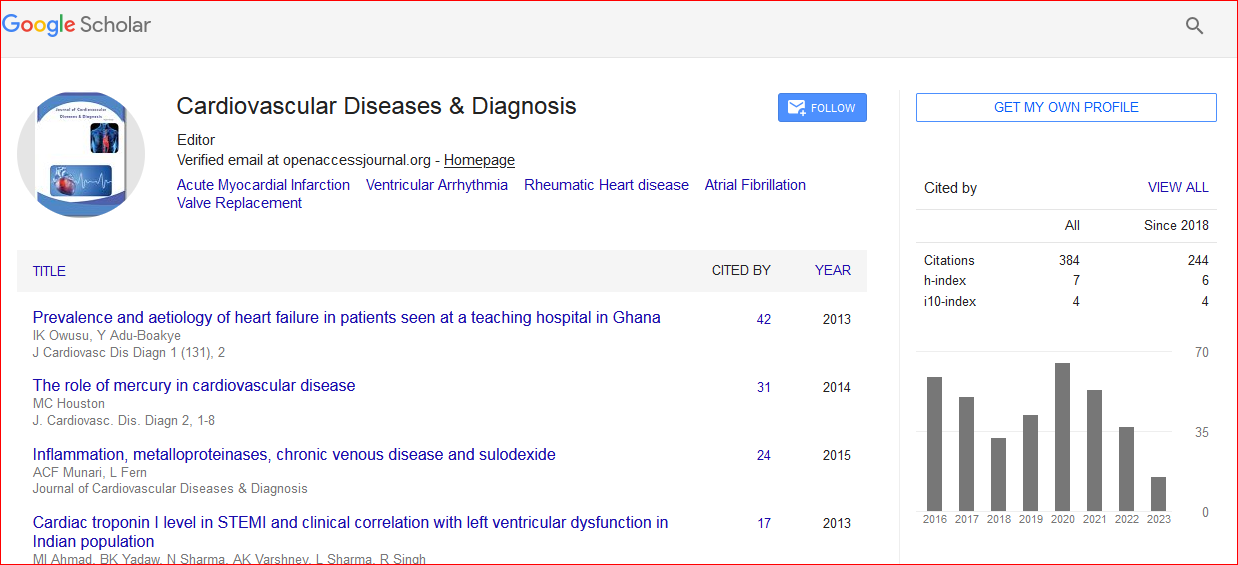
Cardiovascular Diseases & Diagnosis received 427 citations as per Google Scholar report