Brief Report - (2025) Volume 13, Issue 5
Received: 01-Oct-2025, Manuscript No. jcdd-25-177659;
Editor assigned: 03-Oct-2025, Pre QC No. P-177659;
Reviewed: 17-Oct-2025, QC No. Q-177659;
Revised: 22-Oct-2025, Manuscript No. R-177659;
Published:
29-Oct-2025
, DOI: 10.37421/2329-9517.2025.13.690
Citation: Lewis, Samantha. "Advancing Diabetes Care: Research,
Technology, Therapies." J Cardiovasc Dis Diagn 13 (2025):690.
Copyright: © 2025 Lewis S. This is an open-access article distributed under the terms of the Creative Commons Attribution License, which permits unrestricted use, distribution
and reproduction in any medium, provided the original author and source are credited.
Recent advancements in the pharmacological management of type 2 diabetes have significantly broadened therapeutic horizons. These developments include the introduction of new drug classes and innovative combination therapies, which are thoroughly reviewed for their efficacy, safety profiles, and their positive impact on cardiovascular and renal outcomes. A key focus remains on developing personalized treatment approaches to cater to the diverse needs of patients [1].
Parallel to this, remarkable progress has been made in the management of type 1 diabetes, largely driven by technological innovations. Continuous Glucose Monitoring (CGM) systems and Automated Insulin Delivery (AID) systems represent major strides, fundamentally transforming how patients manage their condition. These advancements, coupled with novel therapeutic strategies, are demonstrably improving glycemic control and enhancing the overall quality of life for individuals with type 1 diabetes [2].
Understanding and addressing the myriad complications of diabetes is another critical area of research. This includes a deep dive into both microvascular and macrovascular complications, scrutinizing their underlying pathological mechanisms. Current diagnostic approaches and therapeutic strategies are also evaluated, with an eye towards identifying persistent challenges and charting future research directions that could lead to better patient outcomes [3].
Gestational Diabetes Mellitus (GDM) receives considerable attention, with comprehensive articles outlining its current diagnostic criteria and effective screening methods. The management strategies for GDM are diverse, encompassing crucial lifestyle interventions alongside appropriate pharmacological treatments. Furthermore, the long-term implications of GDM for both the mother and the child are carefully considered, highlighting the importance of early detection and intervention [4].
Preventive strategies for type 2 diabetes are paramount, with a strong emphasis on lifestyle modifications. Reviews synthesize compelling evidence on the crucial roles of dietary changes and regular exercise in averting the onset of the disease. Beyond lifestyle, the potential benefits and limitations of various pharmacological interventions for individuals at high risk of developing type 2 diabetes are also critically discussed [5].
A fundamental understanding of type 2 diabetes requires an exploration of its complex pathophysiology. Detailed analyses focus on key mechanisms such as insulin resistance, the critical role of pancreatic beta-cell dysfunction, the often-impaired incretin effect, and the pervasive inflammatory pathways. Such insights provide a comprehensive understanding of the disease's intricate progression, guiding therapeutic development [6].
The intricate relationship between type 2 diabetes and cardiovascular disease (CVD) is a major public health concern, warranting state-of-the-art reviews. These discussions delve into shared risk factors and underlying pathological mechanisms that link these two conditions. Critically, the efficacy of modern glucose-lowering therapies in actively mitigating cardiovascular events in diabetic patients is thoroughly examined, showing how diabetes management can improve cardiovascular health [7].
The rapid evolution of diabetes technology continues to revolutionize patient care. This area encompasses significant advancements, including highly innovative Continuous Glucose Monitoring systems, sophisticated advanced insulin pumps, and fully integrated closed-loop systems. These technologies are pivotal in not only improving glycemic control but also in simplifying the daily burden of disease management for patients, thereby enhancing their autonomy and well-being [8].
Emerging research underscores the significant role of the gut microbiome in the pathogenesis and progression of diabetes mellitus. Updates in this field explore how dysbiosis, an imbalance in gut microbiota, directly influences key metabolic processes like insulin resistance and glucose metabolism, and contributes to systemic inflammation. This area suggests promising avenues for therapeutic interventions targeting the microbiome [9].
Looking beyond conventional treatments, novel pharmacological targets for type 2 diabetes are actively being explored. This involves delving into emerging biochemical pathways, identifying new molecules, and developing therapeutic agents that demonstrate considerable promise. The aim is to improve glycemic control, preserve vital beta-cell function, and effectively mitigate the various diabetes-related complications, pushing the boundaries of current treatment paradigms [10].
The contemporary understanding of diabetes encompasses a broad spectrum of research, from advanced pharmacological interventions to the intricate biological mechanisms driving disease progression. For type 2 diabetes (T2D), significant advancements in pharmacological treatments are continuously being made, introducing new drug classes and refining combination therapies. These developments are rigorously evaluated for their efficacy, safety, and particularly their impact on critical cardiovascular and renal outcomes, with a growing emphasis on personalized treatment approaches for individual patients [1]. Beyond established therapies, the field actively explores novel pharmacological targets for T2D, delving into emerging pathways, molecules, and therapeutic agents. The promise of these new interventions lies in their potential to further improve glycemic control, preserve beta-cell function, and effectively mitigate a wider range of diabetes-related complications [10].
Understanding the foundational causes and progression of T2D remains a central theme in research. Detailed investigations illuminate its complex pathophysiology, focusing on key mechanisms like insulin resistance, the crucial role of pancreatic beta-cell dysfunction, the often-impaired incretin effect, and the systemic inflammatory pathways that contribute to the diseaseâ??s progression [6]. Complementing treatment efforts, robust strategies for preventing T2D are a high priority. These strategies extensively highlight the vital importance of lifestyle modifications, such as balanced diet and regular exercise, which are foundational. Additionally, the potential benefits and limitations of various pharmacological interventions are explored for individuals identified as high-risk, aiming to avert disease onset [5].
Meanwhile, type 1 diabetes management has seen transformative progress, largely propelled by rapid technological innovations. Breakthroughs include advanced Continuous Glucose Monitoring (CGM) systems and sophisticated Automated Insulin Delivery (AID) systems. These technologies, alongside novel therapeutic strategies, are instrumental in markedly improving glycemic control and significantly enhancing the quality of life for patients living with type 1 diabetes [2]. This technological revolution extends across diabetes care, as emerging technologies continue to simplify disease management through innovative CGM systems, advanced insulin pumps, and integrated closed-loop systems, collectively making daily routines less burdensome for patients [8].
Diabetes, in its various forms, is unfortunately associated with a range of severe complications. Research meticulously explores both microvascular and macrovascular complications, dissecting their underlying pathological mechanisms. Current diagnostic approaches and therapeutic strategies are continuously refined, while identifying key challenges and future research directions is crucial for improving patient outcomes and preventing long-term damage [3]. Another distinct form, Gestational Diabetes Mellitus (GDM), is also a focus of comprehensive review, covering its contemporary diagnostic criteria, effective screening methods, and a full spectrum of management strategies. These include critical lifestyle interventions and appropriate pharmacological treatments, with careful consideration given to the long-term implications for both the mother and the child [4].
Finally, the intricate interplay between diabetes and other physiological systems is gaining deeper appreciation. A state-of-the-art review explores the profound relationship between type 2 diabetes and cardiovascular disease, discussing shared risk factors and underlying mechanisms. It also evaluates the efficacy of modern glucose-lowering therapies in actively mitigating cardiovascular events in diabetic patients, underscoring the systemic impact of diabetes [7]. Furthermore, an evolving understanding of the gut microbiome's critical role in the pathogenesis and progression of diabetes mellitus is emerging. Research in this area investigates how dysbiosis in the gut influences key processes such as insulin resistance, glucose metabolism, and systemic inflammation, suggesting promising new therapeutic targets for intervention within the gut-body axis [9].
Recent research highlights significant advancements across the spectrum of diabetes management and understanding. Pharmacological treatments for type 2 diabetes are evolving with new drug classes and combination therapies, focusing on efficacy, safety, and impacts on cardiovascular and renal health, emphasizing personalized approaches. Similarly, type 1 diabetes management has seen progress through technological innovations like Continuous Glucose Monitoring (CGM) and Automated Insulin Delivery (AID) systems, alongside new therapeutic strategies that enhance glycemic control and patient quality of life. Understanding the underlying mechanisms of diabetes is crucial. Studies detail the complex pathophysiology of type 2 diabetes, including insulin resistance, beta-cell dysfunction, impaired incretin effect, and inflammatory pathways. Research also explores the intricate relationship between type 2 diabetes and cardiovascular disease, examining shared risk factors and how glucose-lowering therapies can mitigate cardiovascular events. Efforts to prevent type 2 diabetes emphasize lifestyle modifications such as diet and exercise, complemented by pharmacological interventions for high-risk individuals. The field also addresses the various microvascular and macrovascular complications of diabetes, outlining their pathological mechanisms, diagnostic methods, and therapeutic strategies, while identifying future research directions. Gestational Diabetes Mellitus (GDM) is comprehensively reviewed, covering diagnosis, screening, and management, including both lifestyle and pharmacological treatments, along with long-term implications for mother and child. Furthermore, the role of the gut microbiome in diabetes pathogenesis, progression, and potential therapeutic targets is being updated, alongside explorations of novel pharmacological targets for type 2 diabetes treatment that aim to improve glycemic control and preserve beta-cell function. Diabetes technology continues to advance, simplifying disease management through innovative CGM systems and integrated closed-loop systems.
Indexed at, Google Scholar, Crossref
Indexed at, Google Scholar, Crossref
Indexed at, Google Scholar, Crossref
Indexed at, Google Scholar, Crossref
Indexed at, Google Scholar, Crossref
Indexed at, Google Scholar, Crossref
Indexed at, Google Scholar, Crossref
Indexed at, Google Scholar, Crossref
Indexed at, Google Scholar, Crossref
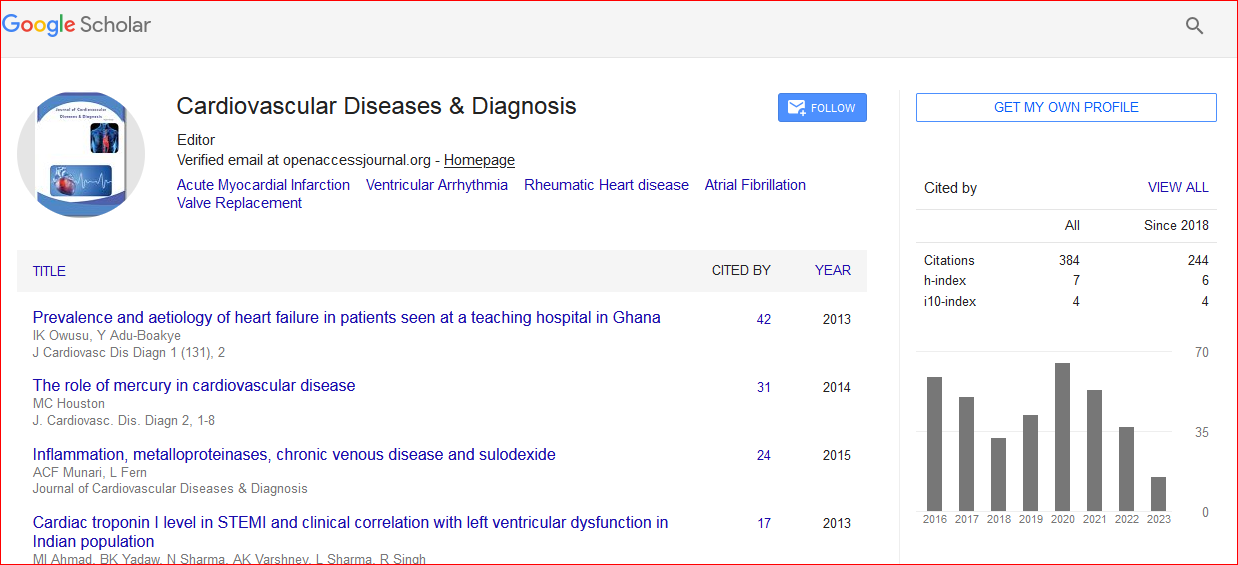
Cardiovascular Diseases & Diagnosis received 427 citations as per Google Scholar report