Short Communication - (2025) Volume 10, Issue 2
Received: 01-Apr-2025, Manuscript No. jcct-26-183209;
Editor assigned: 03-Apr-2025, Pre QC No. P-183209;
Reviewed: 17-Apr-2025, QC No. Q-183209;
Revised: 22-Apr-2025, Manuscript No. R-183209;
Published:
29-Apr-2025
, DOI: 10.37421/2577-0535.2025.9.307
Citation: Collins, Hannah J.. ”Advancing Cancer Therapies: Early Trials, Biomarkers, and Innovation.” J Cancer Clin Trials 10 (2025):307.
Copyright: © 2025 Collins J. Hannah This is an open-access article distributed under the terms of the Creative Commons Attribution License, which permits unrestricted use, distribution and reproduction in any medium, provided the original author and source are credited.
Early-phase clinical trials are foundational in the rigorous evaluation of novel targeted cancer therapies, serving as the critical first step in assessing their safety and efficacy in human subjects. These initial investigations are meticulously designed to pinpoint the optimal dose, the most effective administration schedule, and the specific patient subgroups most likely to benefit from these groundbreaking agents [1].
A key strategy in modern early-phase trial design involves biomarker-driven approaches, which enable the precise selection of patients who possess biological characteristics predictive of a positive response to the therapy. This targeted enrollment strategy significantly enhances the scientific validity and efficiency of these studies [2].
The landscape of early-phase trial design is continuously evolving, driven by a pressing need to accelerate the drug development pipeline and, more importantly, to improve the clinical outcomes for cancer patients. Innovations in trial methodology are central to this advancement [1].
Biomarker-guided patient selection has emerged as a powerful tool, substantially increasing the probability of success in early-phase targeted therapy trials. By identifying specific genetic mutations or protein expression profiles, investigators can enroll patients with a demonstrably higher likelihood of experiencing a therapeutic benefit [2].
Adaptive trial designs represent another significant advancement, offering inherent flexibility that allows for modifications to the study protocol as accumulating data become available. These adaptations can include adjusting sample sizes, discontinuing non-performing treatment arms, or optimizing dose escalation strategies, all contributing to a more efficient and dynamic research process [3].
Evaluating combination therapies in the early phases of clinical development introduces a unique set of challenges, yet it holds immense promise for overcoming treatment resistance and improving response rates. These trials are designed to identify synergistic drug combinations through complex dose-finding strategies [4].
Pharmacokinetic (PK) and pharmacodynamic (PD) studies are indispensable components of early-phase investigations. They provide essential insights into how a drug is absorbed, distributed, metabolized, and excreted by the body, as well as its biological effects on target pathways, thereby informing dose optimization [5].
The ethical dimensions of early-phase cancer clinical trials are of paramount importance. Adherence to core principles such as ensuring comprehensive informed consent, safeguarding patient safety throughout the trial, and promoting equitable access to investigational treatments are non-negotiable ethical imperatives that guide all aspects of these studies [6].
Investigator-initiated trials (IITs) are instrumental in exploring innovative targeted therapies, offering researchers greater scientific autonomy to investigate hypotheses that may not align with the priorities of pharmaceutical sponsors. These trials contribute valuable and often unique data to the broader understanding of cancer therapeutics [7].
Emerging trends in early-phase trial design include the integration of real-world data (RWD) and real-world evidence (RWE). RWD can inform the selection of appropriate patient populations and provide crucial context for interpreting trial findings, potentially streamlining the overall drug development process [8].
Early-phase clinical trials are indispensable for the initial assessment of safety and efficacy of new targeted cancer therapies, focusing on determining optimal doses, schedules, and patient populations, often utilizing biomarker strategies to identify likely responders. The design of these trials is actively being refined to expedite drug development and enhance patient outcomes [1].
Biomarker-guided patient selection plays a pivotal role in increasing the success rates of targeted therapy trials. By identifying specific genetic alterations or protein expressions, researchers can enroll patients who are more likely to benefit from the treatment, leading to more informative early-phase studies and a better understanding of drug activity [2].
Adaptive trial designs offer critical flexibility in early-phase oncology studies, allowing for real-time modifications based on emerging data. This adaptability can involve adjusting sample sizes, eliminating ineffective treatment arms, or more efficiently escalating doses, all contributing to faster identification of promising therapeutic agents [3].
The evaluation of combination therapies within early-phase trials presents distinct challenges but is crucial for identifying synergistic drug regimens that can overcome resistance mechanisms and improve patient response rates. These trials often necessitate sophisticated dose-finding methodologies [4].
Pharmacokinetic and pharmacodynamic assessments are integral to early-phase trials, providing vital information on drug absorption, distribution, metabolism, excretion, and biological target engagement. This data is fundamental for optimizing drug dosages and treatment regimens [5].
Ethical considerations are of utmost importance in early-phase cancer clinical trials. Key principles include obtaining robust informed consent, ensuring the safety and well-being of all participants, and maintaining fairness in access to experimental treatments [6].
Investigator-initiated trials (IITs) are significant in exploring novel targeted therapies, providing investigators with the autonomy to pursue unique scientific hypotheses and generate valuable data that may not be covered by industry-sponsored research [7].
The incorporation of real-world data (RWD) and real-world evidence (RWE) into early-phase trial design is a growing trend. RWD can assist in defining patient populations and contextualizing clinical trial results, potentially accelerating the drug development pathway [8].
Advancements in drug delivery systems are profoundly influencing early-phase trials for targeted therapies. Novel technologies designed to enhance drug targeting and minimize off-target toxicities hold the potential for developing more effective and better-tolerated treatments [9].
Increasing patient engagement in the design and conduct of early-phase cancer clinical trials is becoming increasingly recognized as vital. Incorporating patient perspectives can enhance recruitment, improve retention rates, and ensure that research efforts are aligned with patient needs and priorities [10].
Early-phase clinical trials are essential for assessing the safety and efficacy of new cancer therapies, employing biomarker-driven strategies and adaptive designs to accelerate development. Key components include PK/PD studies, ethical considerations, and the growing integration of real-world data. Combination therapies and novel drug delivery systems are also areas of focus, alongside the increasing importance of patient engagement. Investigator-initiated trials contribute unique insights, and these evolving methodologies aim to improve patient outcomes in oncology.
None
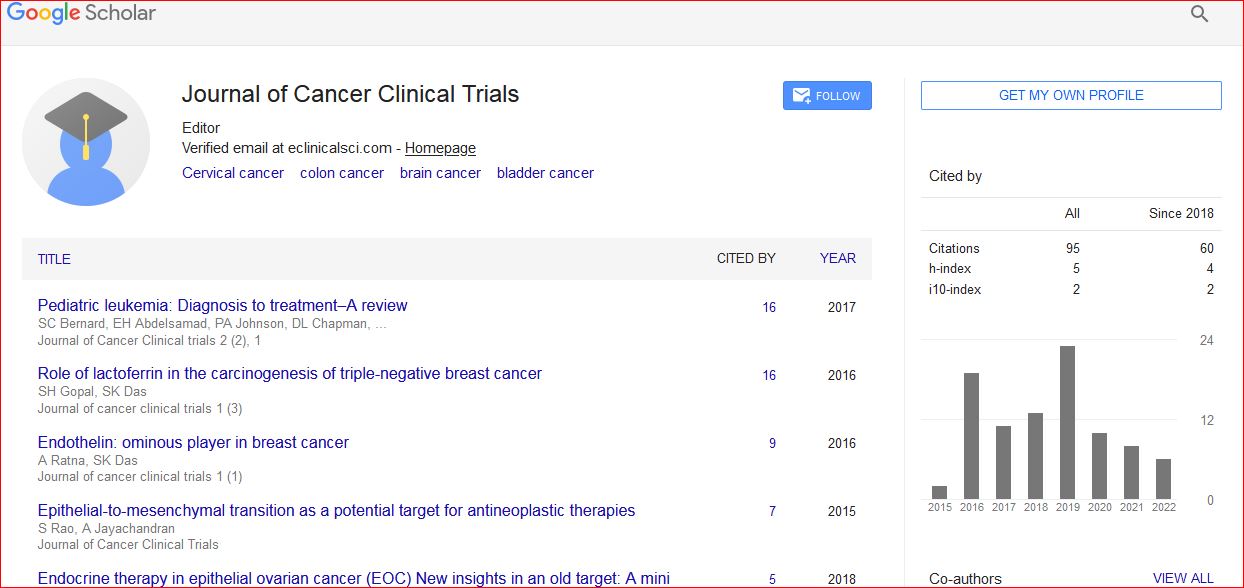
Journal of Cancer Clinical Trials received 95 citations as per Google Scholar report