Opinion - (2025) Volume 9, Issue 2
Received: 01-Apr-2025, Manuscript No. ahbs-26-182406;
Editor assigned: 03-Apr-2025, Pre QC No. P-182406;
Reviewed: 17-Apr-2025, QC No. Q-182406;
Revised: 22-Apr-2025, Manuscript No. R-182406;
Published:
29-Apr-2025
, DOI: 10.37421/2952-8097.2025.9.309
Citation: O Neill, Sarah K.. "Advancing Animal Welfare Assessment:
Tools and Technologies." J Anim Health Behav Sci 09 (2025):309.
Copyright: © 2025 O Neill K. Sarah This is an open-access article distributed under the terms of the Creative Commons Attribution License, which permits unrestricted use,
distribution and reproduction in any medium, provided the original author and source are credited.
The scientific and ethical imperative to understand and enhance animal welfare has driven significant advancements in assessment methodologies. Early efforts often relied on general observations, but the growing body of research has led to the development of sophisticated tools designed to objectively quantify an animal's subjective experiences. This has been crucial in identifying distress and improving living conditions across a wide range of species, from domesticated farm animals to those in captive environments [1].
Ethological principles, the study of animal behavior in natural settings, have been fundamental in guiding the design of these assessment tools. By understanding species-specific behaviors and their motivations, researchers can develop more accurate indicators of welfare. This approach ensures that observed behaviors are interpreted within the context of the animal's natural repertoire, leading to more reliable welfare evaluations in both research and practical settings, such as zoos and farms [1].
A significant technological leap in animal welfare assessment has been the integration of automated systems and machine learning. These advancements allow for continuous, large-scale monitoring of animal behavior, overcoming the limitations of manual observation. Such technologies are particularly valuable for detecting subtle changes that might indicate pain or stress, enabling early intervention and proactive welfare management in livestock and companion animals alike [2].
The development of wearable sensors represents another frontier in non-invasive welfare monitoring. Devices like accelerometers can capture real-time data on an animal's movement, posture, and potentially physiological parameters. This continuous stream of information offers a powerful means to assess activity patterns and detect deviations from normal states, though challenges in data interpretation and validation remain [3].
Assessing pain in farm animals, a critical aspect of welfare, requires robust and validated methods. Researchers are actively developing specific behavioral indicators, often advocating for a multi-modal approach that combines direct observations of behaviors such as lameness or vocalization with physiological measures. The goal is to ensure indicators are sensitive, specific, and reliable in distinguishing pain from other conditions [4].
Beyond immediate physical indicators, the emotional state of animals is increasingly recognized as a vital component of welfare. Cognitive bias tests have emerged as a promising tool in this area, operating on the principle that animals experiencing negative affective states tend to interpret ambiguous stimuli more pessimistically. This approach offers a more nuanced understanding of animal sentience and their subjective experiences [5].
Structured frameworks for welfare assessment are essential for comprehensive evaluation. The 'Five Domains' model provides such a framework, categorizing welfare into key areas like nutrition, environment, health, behavior, and mental state. By systematically analyzing behavioral observations within this model, a more complete picture of both positive and negative welfare experiences can be obtained [6].
While the tools for welfare assessment are becoming more sophisticated, ethical considerations and practical challenges remain paramount. The application of these tools across diverse animal populations, including wild, captive, and domestic animals, requires careful attention to species-specific ethograms and the potential for observer bias. Rigorous training and standardization of assessors are crucial for ensuring the validity and reliability of collected data [7].
In laboratory settings, where precise welfare monitoring is critical for research integrity and animal well-being, comprehensive assessment protocols are vital. These protocols often integrate a range of behavioral endpoints, such as grooming and social interaction, alongside physiological and physical indicators. Such integrated approaches enhance the sensitivity and reliability of welfare and stress response measures in experimental contexts [8].
Finally, remote sensing technologies are opening new avenues for non-contact welfare assessment. Tools like thermal imaging and acoustic monitoring can provide valuable insights into an animal's physiological state and behavior without causing disturbance. These methods hold significant potential for large-scale and continuous monitoring, particularly in livestock and wildlife management [9].
The development and application of behavioral assessment tools have revolutionized the monitoring of animal welfare, enabling the objective identification of distress and the enhancement of living conditions across diverse species. These tools are grounded in ethological principles, ensuring that behavioral observations are interpreted within the species-specific context. Their utility spans both research and practical settings, including zoos and farms, underscoring their broad applicability [1].
Technological advancements, particularly in automated video analysis and machine learning, have significantly improved the objectivity and scalability of animal behavior measurement relevant to welfare. These techniques overcome the inherent limitations of manual observation, facilitating continuous and large-scale monitoring. Their application in livestock and companion animals demonstrates the potential for detecting subtle indicators of pain or stress, thereby enabling early intervention and more effective welfare management [2].
Wearable sensors, such as accelerometers, offer a non-invasive method for continuously monitoring animal activity patterns and physiological states. By providing real-time data on movement and posture, these devices facilitate the detection of subtle changes that may indicate welfare concerns. However, the interpretation of this data and its validation against established indicators remain key areas of focus [3].
For farm animals, the development and validation of reliable behavioral indicators of pain are crucial. A multi-modal approach, integrating direct behavioral observations with physiological measures, is advocated to ensure that the chosen indicators are sensitive and specific. This rigorous scientific approach is essential for accurately distinguishing pain from other physiological states and ensuring that welfare interventions are appropriately targeted [4].
The assessment of an animal's emotional state, a critical aspect of welfare, is being advanced through cognitive bias tests. These tests are based on the premise that animals experiencing negative affective states will interpret ambiguous stimuli more pessimistically. The implementation of these tests across various species, including rodents and birds, offers a more nuanced understanding of animal sentience and their subjective welfare experiences [5].
Structured frameworks, such as the 'Five Domains' model, provide a comprehensive approach to animal welfare assessment, with a strong emphasis on behavioral indicators. This model categorizes welfare into domains of nutrition, environment, health, behavior, and mental state, allowing for the evaluation of both positive experiences and the avoidance of negative ones through systematic behavioral observation [6].
Ethical considerations and practical challenges are inherent in the application of behavioral assessment tools across different animal populations. These include the need for species-specific ethograms, the mitigation of observer bias, and the importance of rigorous training and standardization among assessors. Addressing these factors is vital for ensuring the validity and reliability of behavioral data used for welfare monitoring [7].
In laboratory animal science, comprehensive welfare assessment protocols are essential for maintaining research integrity and animal well-being. These protocols integrate various behavioral endpoints, such as grooming and social interaction, with physiological and physical indicators. Such integrated approaches yield more sensitive and reliable measures of well-being and stress responses in experimental settings [8].
Remote sensing technologies, including thermal imaging and acoustic monitoring, provide non-contact methods for assessing animal welfare. These techniques offer valuable insights into physiological states and behavioral patterns without causing disturbance, making them suitable for large-scale and continuous monitoring in contexts such as livestock farming and wildlife research [9].
The relationship between housing conditions and animal behavior is central to welfare. Environmental enrichment strategies aim to prevent abnormal behaviors and promote well-being in captive animals by providing stimulating environments. Behavioral assessment tools are critical for evaluating the effectiveness of these enrichment strategies and their impact on species-specific behaviors [10].
This compilation of research explores the multifaceted field of animal welfare assessment, highlighting the evolution from traditional observation methods to technologically advanced techniques. Key areas of focus include the development and application of behavioral assessment tools grounded in ethological principles, the integration of automated video analysis and machine learning for objective monitoring, and the use of wearable sensors for continuous data collection. The research also delves into specific methodologies such as cognitive bias tests for evaluating emotional states, the 'Five Domains' model for structured assessment, and the validation of behavioral indicators for pain in livestock. Ethical considerations, practical challenges in diverse animal populations, and the role of environmental enrichment are also discussed. Furthermore, advancements in remote sensing technologies offer non-contact monitoring capabilities, complementing the comprehensive protocols developed for various settings, from laboratories to farms.
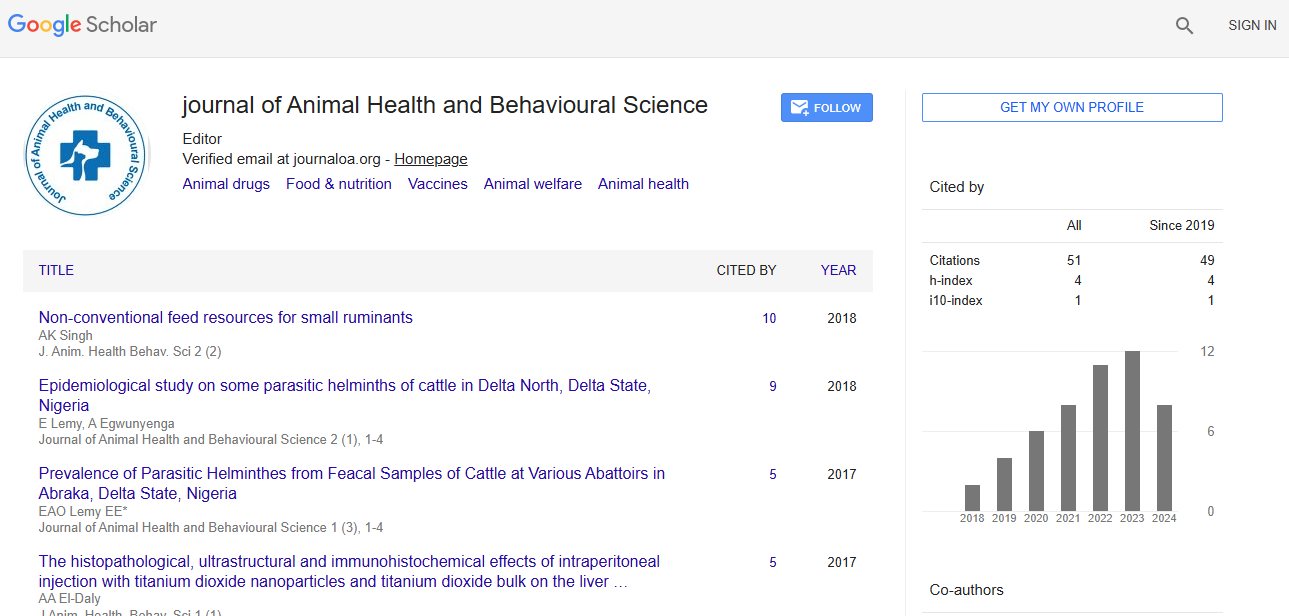
Journal of Animal Health and Behavioural Science received 38 citations as per Google Scholar report