Commentary - (2025) Volume 14, Issue 2
Received: 01-Apr-2025, Manuscript No. idse-26-182767;
Editor assigned: 03-Apr-2025, Pre QC No. P-182767;
Reviewed: 17-Apr-2025, QC No. Q-182767;
Revised: 22-Apr-2025, Manuscript No. R-182767;
Published:
29-Apr-2025
, DOI: 10.37421/2168-9768.2025.14.480
Citation: Romano, Giuseppe. ”Advancing Agricultural Water
Management: Irrigation and Drainage.” Irrigat Drainage Sys Eng 14 (2025):480.
Copyright: © 2025 Romano G. This is an open-access article distributed under the terms of the Creative Commons Attribution License, which permits unrestricted use,
distribution and reproduction in any medium, provided the original author and source are credited.
Agricultural water management is a critical field, encompassing the efficient use of water resources for crop production and the mitigation of water-related challenges. Recent advancements in irrigation system design have focused on enhancing water use efficiency and agricultural productivity through novel approaches to water distribution and real-time monitoring using sensor integration. The application of advanced modeling techniques is also proving vital for optimizing irrigation scheduling, leading to significant water savings and improved crop yields through precision irrigation strategies [1].
Concurrently, the design and analysis of subsurface drainage systems are crucial for addressing waterlogging and improving soil aeration in agricultural lands. Investigations into different drainage configurations reveal their impact on soil moisture regimes and crop performance, underscoring the importance of proper hydrological analysis and modeling for effective drainage system design, which can reduce salinity and enhance crop resilience [2].
The development and evaluation of smart irrigation controllers represent another significant stride in precision agriculture. These systems utilize weather data and soil moisture sensors for automated irrigation scheduling, demonstrating marked improvements in water application uniformity and reductions in water consumption compared to conventional methods. The economic and environmental implications of adopting these technologies are also noteworthy [3].
Understanding the hydraulic performance of agricultural drainage pipes is fundamental to designing efficient systems. Studies analyzing flow rates, pressure drops, and clogging potential of various pipe types under different soil conditions offer practical guidelines for material selection and parameter optimization, ensuring long-term system efficiency [4].
A comparative analysis of different irrigation systems, such as surface and drip irrigation, highlights their respective efficiencies in water use, energy consumption, and crop yield. Drip irrigation, in particular, shows superior performance in water-scarce regions by delivering water directly to the root zone, with considerable economic feasibility and environmental benefits [5].
The integration of remote sensing and GIS technologies is revolutionizing the design and management of irrigation networks. Satellite imagery and spatial analysis aid in identifying water-stressed areas, delineating command areas, and optimizing water allocation, thereby improving the planning and operation of large-scale irrigation systems [6].
Furthermore, the anticipated impact of climate change on agricultural drainage requirements necessitates adaptive system designs. Climate projection models assist in predicting changes in precipitation and evapotranspiration, informing the development of more resilient drainage systems capable of responding to future climatic conditions [7].
The application of artificial intelligence and machine learning algorithms is emerging as a powerful tool for optimizing irrigation scheduling and drainage management. Predictive models forecast crop water needs and soil moisture levels, enabling precise and adaptive water management, which significantly enhances the efficiency and sustainability of agricultural water systems [8].
Addressing the challenges of designing efficient drainage systems for saline-affected lands is also a key research area. Investigations into various drainage techniques aim to reduce soil salinity and improve groundwater quality, facilitating the reclamation of salt-affected soils for sustainable agriculture [9].
Finally, a comprehensive evaluation of the economic and environmental impacts of different irrigation system designs is essential. Analyzing the cost-benefit ratios of advanced technologies and their contribution to reducing agriculture's ecological footprint provides crucial guidance for selecting cost-effective and environmentally sound irrigation solutions [10].
b
The advancements in irrigation system design are profoundly impacting agricultural practices, with a strong emphasis on improving water use efficiency and boosting crop productivity. Novel water distribution methods, coupled with sensor integration for real-time monitoring, are central to these developments. The sophisticated application of advanced modeling techniques further refines irrigation scheduling, ultimately leading to substantial water conservation and enhanced crop yields through the adoption of precision irrigation strategies [1].
In parallel, the critical role of subsurface drainage systems in managing waterlogged agricultural lands and enhancing soil aeration is widely recognized. Research exploring various drainage configurations demonstrates their influence on soil moisture dynamics and crop performance. The findings consistently highlight the necessity of robust hydrological analysis and modeling for the effective design of drainage systems, which contribute to mitigating salinity issues and increasing crop resilience [2].
The emergence of smart irrigation controllers represents a significant leap in the automation of agricultural water management. These controllers leverage weather data and soil moisture sensor readings to automate irrigation scheduling, resulting in notable improvements in water application uniformity and a considerable reduction in overall water consumption when compared to traditional irrigation methods. The associated economic advantages and positive environmental implications of employing these smart technologies are also significant [3].
Detailed studies on the hydraulic performance of diverse agricultural drainage pipe materials are indispensable for optimizing system design. Such research provides a thorough analysis of flow characteristics, pressure dynamics, and the propensity for clogging under varied soil conditions. The practical guidance offered by these studies is invaluable for selecting appropriate drainage materials and design parameters to ensure the long-term operational efficiency of drainage networks [4].
A comparative assessment of different irrigation system types, specifically contrasting surface irrigation with drip irrigation, reveals distinct advantages in terms of water efficiency, energy consumption, and crop output. Drip irrigation, in particular, demonstrates superior performance, especially in regions facing water scarcity, by facilitating direct water delivery to the crop's root zone. The economic viability and environmental benefits associated with transitioning to drip irrigation are also key considerations [5].
The implementation of remote sensing and Geographic Information System (GIS) technologies is transforming the planning and management of irrigation networks. These advanced tools utilize satellite imagery and spatial analysis to accurately identify areas experiencing water stress, precisely delineate irrigation command areas, and enable optimized water distribution. This technological integration significantly enhances the effectiveness of planning and operational management for large-scale irrigation projects [6].
The influence of climate change on agricultural drainage requirements and the subsequent design of drainage systems is a growing concern. By employing climate projection models, researchers can anticipate shifts in precipitation patterns and evapotranspiration rates, thereby assessing their impact on the demand for subsurface drainage. This foresight is crucial for developing adaptive drainage system designs that are resilient to future climatic variability [7].
The integration of artificial intelligence (AI) and machine learning (ML) algorithms is proving to be a transformative approach for optimizing both irrigation scheduling and drainage management. AI-driven predictive models are capable of accurately forecasting crop water requirements and soil moisture levels, facilitating more precise and responsive water management practices. The potential for AI to substantially improve the efficiency and sustainability of agricultural water systems is immense [8].
Addressing the complexities of designing effective drainage systems for agricultural lands affected by salinity presents unique challenges. Research in this domain investigates the efficacy of various drainage techniques in reducing soil salt content and enhancing the quality of groundwater. The insights gained are critical for designing systems that not only manage excess water but also actively contribute to the reclamation of salt-affected soils, thereby promoting sustainable agricultural practices [9].
An in-depth evaluation of the economic and environmental consequences associated with different irrigation system designs is vital for informed decision-making. This analysis typically involves assessing the cost-benefit ratios of adopting modern irrigation technologies and quantifying their contribution to reducing agriculture's overall ecological footprint. The results offer essential guidance for policymakers and agricultural practitioners in selecting irrigation solutions that are both economically sound and environmentally responsible [10].
This compilation of research addresses critical aspects of agricultural water management, focusing on irrigation and drainage systems. Advancements in irrigation technology, including precision strategies, smart controllers, and drip systems, aim to enhance water use efficiency and crop yields. The research also covers subsurface drainage system design for waterlogged and saline lands, material selection for drainage pipes, and the integration of remote sensing, GIS, and AI for optimizing water management. Furthermore, the impact of climate change on drainage requirements and the economic and environmental implications of different irrigation designs are explored, providing a comprehensive overview of modern approaches to sustainable agricultural water use.
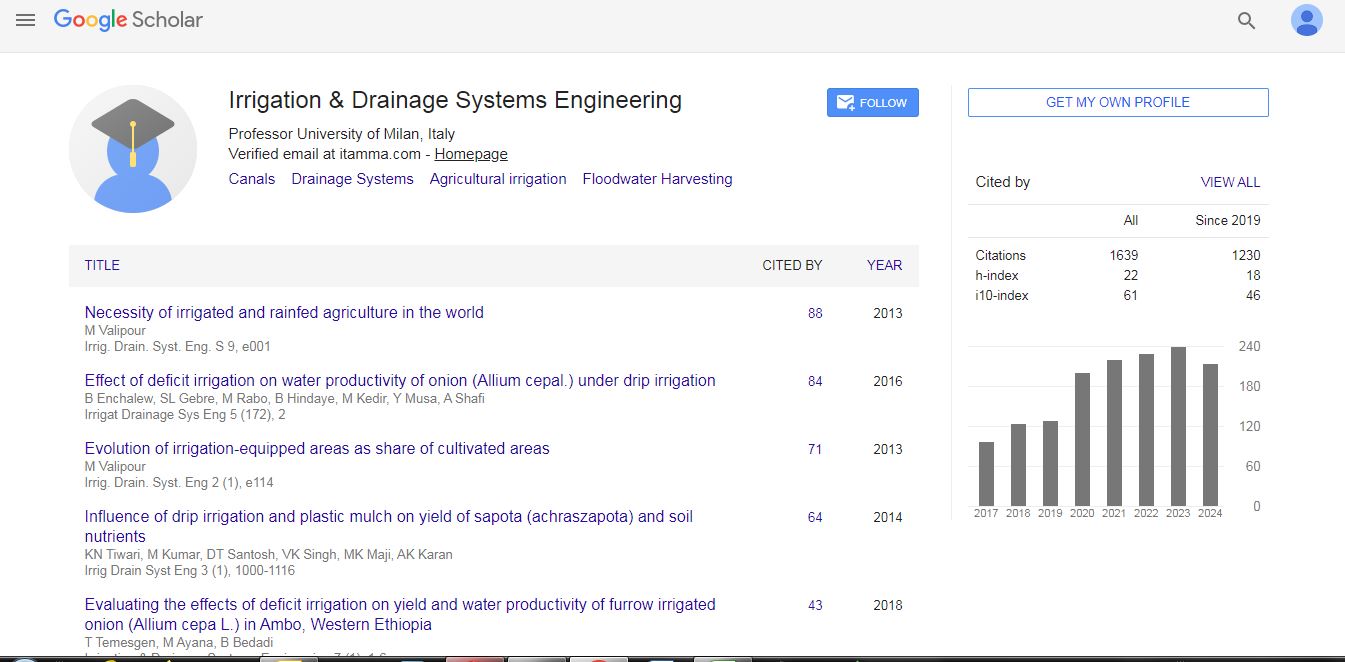
Irrigation & Drainage Systems Engineering received 835 citations as per Google Scholar report