Brief Report - (2025) Volume 15, Issue 6
Received: 03-Nov-2025, Manuscript No. jcde-25-177521;
Editor assigned: 05-Nov-2025, Pre QC No. P-177521;
Reviewed: 19-Nov-2025, QC No. Q-177521;
Revised: 24-Nov-2025, Manuscript No. R-177521;
Published:
01-Dec-2025
, DOI: 10.37421/2165-784X.2025.15.631
Citation: Ford, Chadwick. ”Advancing 3D Printing: Materials,
Fields, and Impact.” J Civil Environ Eng 15 (2025):631.
Copyright: © 2025 Ford C. This is an open-access article distributed under the terms of the Creative Commons Attribution License, which permits unrestricted use, distribution
and reproduction in any medium, provided the original author and source are credited.
Three-dimensional (3D) printing technologies have profoundly transformed the manufacturing and design landscape. This revolutionary approach, often termed additive manufacturing, enables creating complex geometries and functional parts directly from digital designs, layer by layer. Its widespread adoption stems from customization, rapid prototyping, and use with diverse materials. Recent research highlights multifaceted advancements and applications shaping 3D printings future. A significant innovation area lies within the biomedical sector, where 3D bioprinting makes strides toward regenerative medicine and tissue engineering. Researchers explore novel materials and techniques to fabricate intricate biological structures, aiming to overcome hurdles like high resolution and cellular viability. Future prospects include complex tissues and organs, alongside in-situ bioprinting and organ-on-a-chip models [1].
Building on this, 3D printing for medical implants represents another critical frontier. This technology facilitates patient-specific devices, boasting complex geometries, optimized mechanical properties, and enhanced biocompatibility. Ongoing research expands clinical applications, addressing challenges and defining future directions [5].
Parallel to these biological developments, additive manufacturing of metals experiences rapid advancements. These include various processes like powder bed fusion and directed energy deposition, alongside new metallic materials. Innovations in process control improve part quality, leading to diverse applications across aerospace, biomedical, and automotive industries [2].
The pharmaceutical industry leverages 3D printing to revolutionize drug delivery systems. Reviews detail technologies and materials enabling personalized medicine, including customized dosage forms with complex geometries and controlled release, offering significant advantages over traditional manufacturing [3].
Polymeric materials remain a cornerstone of 3D printing, with continuous advancements refining techniques and introducing new formulations. Research focuses on how polymer characteristics influence printability and final mechanical performance, covering methods from Fused Deposition Modeling (FDM) to Stereolithography (SLA). These innovations unlock emerging applications [4].
Further extending polymer utility, 3D printing of continuous fiber-reinforced polymer composites is an area of intense research. This field examines fabrication methods, material selection, and resulting mechanical properties. Addressing challenges in optimal fiber alignment and matrix impregnation is key to improving structural integrity for lightweight, high-strength applications [7].
Pushing scale boundaries, micro-3D printing technologies enable fabrication of structures with intricate details at the microscale. Various techniques and materials are explored for diverse applications in microfluidics, biomedical devices, and optical components. The emphasis is on unparalleled precision and versatility, with research aiming for finer resolutions [8].
The dental field has also seen a transformative impact from 3D printing. A wide array of applications, including dental models, surgical guides, prostheses, and aligners, are now commonplace. Benefits include enhanced precision, customization, and efficiency, though challenges related to material biocompatibility and regulatory standards continue to be addressed [9].
Beyond fabrication, an important environmental consideration is the recycling of waste plastics for 3D printing. This area explores methods for processing plastic waste into printable filaments, evaluating their properties. The focus is on environmental benefits and economic potential, addressing challenges like material degradation to promote circularity in manufacturing [10].
Even the culinary world utilizes 3D printing, with significant progress in 3D food printing. This dynamic field involves edible materials and innovative techniques to create customized food products. Applications span enhancing aesthetics and nutritional value to providing personalized nutrition, with an eye toward future industrial production [6].
Collectively, these advancements illustrate 3D printings dynamic influence across scientific and industrial landscapes. Continuous development in materials, techniques, and applications signifies a future where customized, high-performance, and sustainable solutions become increasingly accessible and integral to modern life.
The evolution of 3D printing, also known as additive manufacturing, has ushered in a new era of possibilities across a vast spectrum of industries. This technology empowers designers and engineers to transform digital models into physical objects, layer by precise layer, allowing for unprecedented complexity and customization. From the micro-scale fabrication of intricate components to the large-scale production of functional parts, 3D printing continues to push boundaries, challenging traditional manufacturing paradigms. Its inherent flexibility in material usage, coupled with its ability to produce highly specific geometries, positions it as a cornerstone for future innovation.
In the realm of medicine, 3D printing offers transformative solutions. 3D bioprinting, for instance, focuses on creating living tissues and organs for regenerative medicine. This involves carefully selecting materials and techniques to ensure cellular viability and high resolution, addressing the complex demands of biological structures. Future research aims to facilitate the in-situ bioprinting of organs and the development of sophisticated organ-on-a-chip models [1]. Concurrently, the fabrication of medical implants has been revolutionized, enabling the production of patient-specific devices. These implants feature complex designs, optimized mechanical properties, and enhanced biocompatibility, marking a significant leap forward in personalized healthcare. Researchers continue to explore new biomaterials and advanced printing technologies to expand clinical applications and overcome existing challenges [5].
Beyond biological tissues, the application of 3D printing extends robustly into material science. Additive manufacturing of metals is seeing significant trends, with processes like powder bed fusion and directed energy deposition becoming more refined. The continuous development of new metallic materials, coupled with innovations in process control, ensures improved part quality and performance for critical applications in aerospace, biomedical, and automotive sectors [2]. Similarly, the advancements in 3D printing of polymeric materials are noteworthy. This includes refining techniques such as Fused Deposition Modeling (FDM) and Stereolithography (SLA), and developing new material formulations. Understanding how polymer characteristics influence printability and the final mechanical performance is crucial for unlocking diverse applications [4]. Furthermore, the complexity increases with continuous fiber-reinforced polymer composites, where achieving optimal fiber alignment and matrix impregnation presents challenges, yet promises lightweight, high-strength structures for demanding applications [7].
The pharmaceutical industry is harnessing 3D printing to advance personalized medicine. This involves utilizing various printing technologies and materials to create customized dosage forms with complex geometries and controlled release profiles. Such capabilities offer distinct advantages over traditional manufacturing, allowing for tailored drug delivery systems that can significantly improve patient outcomes [3]. Another fascinating application lies in 3D food printing, which employs edible materials and innovative techniques to craft customized food products. This technology can enhance food aesthetics, nutritional value, and texture, addressing needs from personalized nutrition to specialized dietary requirements, with considerable potential for industrial production [6].
Precision engineering at the smallest scales also benefits immensely from 3D printing. Micro-3D printing technologies enable the fabrication of structures with intricate details at the microscale, opening doors for applications in microfluidics, biomedical devices, and optical components. The quest for even finer resolutions continues, emphasizing the precision and versatility these methods offer [8]. In dentistry, 3D printing has become indispensable for fabricating dental models, surgical guides, prostheses, and aligners. Its benefits include enhanced precision, customization, and efficiency, though ongoing efforts address material biocompatibility and regulatory standards [9].
Moreover, the environmental sustainability aspect of 3D printing is increasingly important. The recycling of waste plastics for use in 3D printing explores various methods for processing plastic waste into printable filaments. This approach evaluates the mechanical and thermal properties of recycled materials, highlighting environmental benefits and economic potential. Addressing challenges like material degradation and consistency is key to enhancing circularity in additive manufacturing and promoting a more sustainable future [10]. These diverse applications underscore 3D printing's vast and expanding influence, making it a pivotal technology across numerous sectors.
Recent progress in 3D printing technologies is revolutionizing numerous fields, offering unparalleled precision and customization. In the biomedical sector, 3D bioprinting is advancing rapidly, utilizing innovative materials and techniques to create complex tissues and organs, addressing challenges like resolution and cellular viability, and exploring in-situ bioprinting and organ-on-a-chip models. Similarly, the fabrication of medical implants has seen significant breakthroughs, enabling patient-specific designs with optimized properties and enhanced biocompatibility. The pharmaceutical industry is embracing 3D printing for personalized medicine, developing customized dosage forms with controlled release profiles that offer substantial advantages over traditional manufacturing methods. Beyond biological applications, additive manufacturing of metals is trending, with new materials and process controls improving part quality for aerospace, biomedical, and automotive applications. Polymeric materials are also undergoing significant development, with advancements in printing techniques like Fused Deposition Modeling (FDM) and Stereolithography (SLA), focusing on how polymer characteristics influence printability and final mechanical performance. This extends to continuous fiber-reinforced polymer composites, where challenges in fiber alignment and matrix impregnation are being tackled to produce lightweight, high-strength structures. Moreover, the versatility of 3D printing is evident in specialized areas like 3D food printing, which uses edible materials to enhance aesthetics, nutrition, and texture, addressing personalized dietary needs. Micro-3D printing pushes the boundaries further, fabricating intricate structures at the microscale for microfluidics, biomedical devices, and optical components, emphasizing precision and versatility. Environmentally, the recycling of waste plastics for 3D printing filaments presents a sustainable approach, evaluating material properties and addressing degradation to promote circularity in manufacturing. Finally, 3D printings impact on dentistry is substantial, improving the precision and efficiency of dental models, surgical guides, and prostheses.
1. Yuqian W, Shishen G, Ruiyun D. "Advances in 3D bioprinting toward tissue engineering and regenerative medicine".J Nanobiotechnol 21 (2023):295.
Indexed at, Google Scholar, Crossref
2. Mohammad F, Mohammad RS, Mahmoud Y. "Trends in Additive Manufacturing of Metals: From Materials to Process Control and Applications".Metals 13 (2023):1673.
Indexed at, Google Scholar, Crossref
3. Xueliang S, Siyu L, Bing H. "3D Printing of Pharmaceuticals: Technologies, Materials, and Applications in Drug Delivery".J Pharm Sci 112 (2023):70-87.
Indexed at, Google Scholar, Crossref
4. Junwei G, Weiwei S, Guanglei W. "Advanced 3D printing of polymers: A review".Polymer Test 126 (2023):108115.
Indexed at, Google Scholar, Crossref
5. Yuze L, Tianyi Z, Jingnan L. "3D Printing of Implants: Recent Advances and Future Perspectives".ACS Biomater Sci Eng 9 (2023):1478-1498.
Indexed at, Google Scholar, Crossref
6. Yu D, Yuxiang Z, Yiheng S. "Recent advances in 3D printing of food: From materials to applications".Food Hydrocoll 145 (2023):109043.
Indexed at, Google Scholar, Crossref
7. Haibo L, Mengting L, Yuan S. "3D printing of continuous fiber-reinforced polymer composites: Recent progress and challenges".Composites Part B Eng 268 (2023):111059.
Indexed at, Google Scholar, Crossref
8. Rui C, Li-Ming L, Jing-Jing Z. "Advances in micro-3D printing technologies and applications".J Nanobiotechnol 21 (2023):432.
Indexed at, Google Scholar, Crossref
9. Junhao S, Tianyi Z, Xiaowei Z. "3D printing in dentistry: A review of current applications and future perspectives".J Oral Sci 65 (2023):260-270.
Indexed at, Google Scholar, Crossref
10. Yuqian L, Huayang Z, Zhizhong S. "Recycling of waste plastics for 3D printing: A comprehensive review".J Clean Prod 422 (2023):138657.
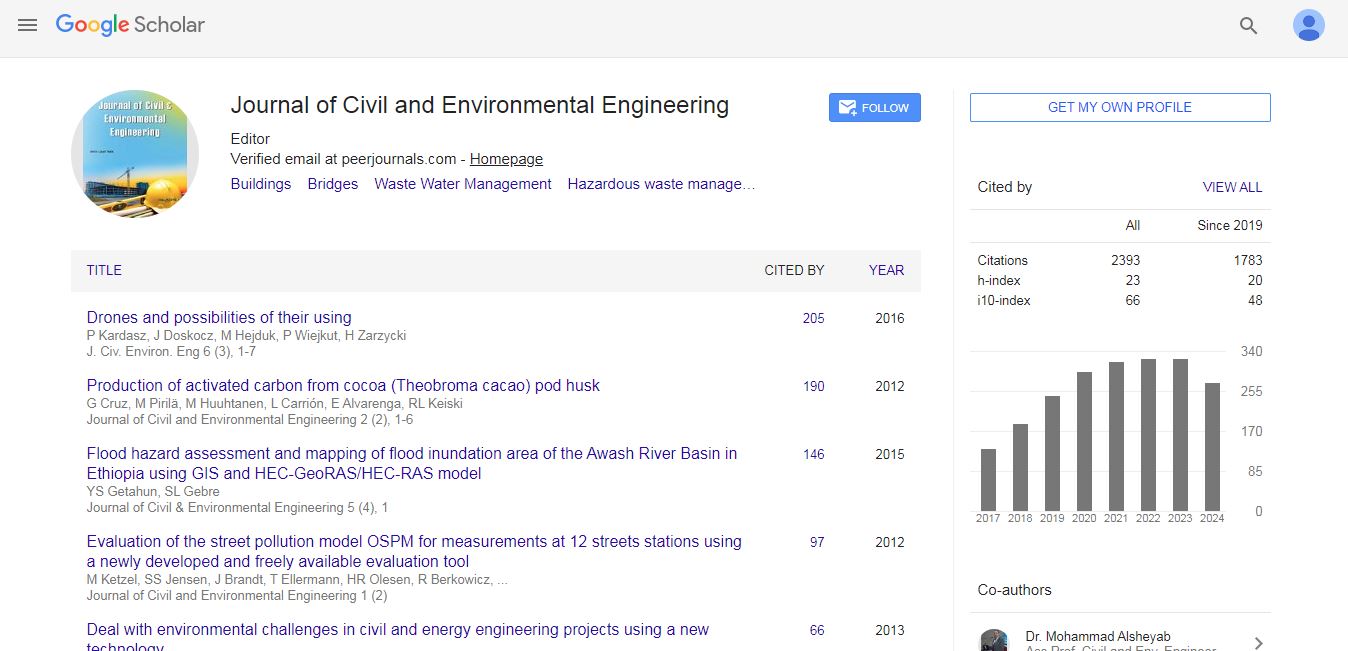
Journal of Civil and Environmental Engineering received 1798 citations as per Google Scholar report